


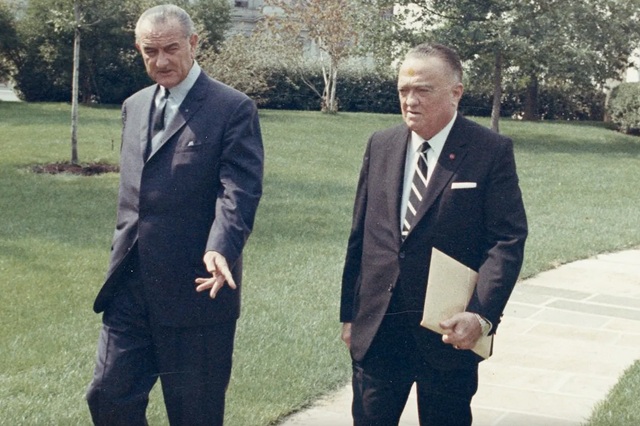
Recently declassified MI5 files have unveiled how British officials worked to maintain the UK-US “special relationship” during the Cold War by appeasing J. Edgar Hoover, the FBI’s long-serving director. As reported by Financial Times, the documents, now available at the National Archives in Kew, include a fascinating episode from 1951 in which Hoover sought recognition of his honorary knighthood in the prestigious British almanac, Debrett’s.
Hoover received the honorary title the previous year as a diplomatic gesture following the Klaus Fuchs spy scandal, in which a UK citizen leaked nuclear secrets from the Manhattan Project to the Soviet Union. Although Hoover initially expressed gratitude, tensions arose when he discovered his title was absent from Debrett’s. Geoffrey Patterson, MI5’s Washington liaison, reported Hoover’s disappointment in a cable to London, noting that he had checked the embassy’s copy of Debrett’s for his listing.
The Cold War was a period marked by intrigue, distrust, and high-stakes diplomacy. The revelations unearthed in recently declassified MI5 files shed new light on the lengths British officials went to secure strategic alliances during this turbulent time, even as they wrestled with internal betrayals. One of the most surprising episodes involved efforts to appease J. Edgar Hoover, the longtime director of the FBI, whose influence spanned over five decades and whose relationship with Britain became a key element in the so-called “special relationship” between the UK and the US.
In 1951, MI5 worked behind the scenes to address Hoover’s dissatisfaction with not being included in Debrett’s, a prestigious British almanac that listed honorary knights. Despite receiving the honorary title the year before as a diplomatic gesture following the Klaus Fuchs spy scandal, Hoover’s name had been mysteriously omitted from the 1951 edition of the almanac. MI5’s quick response to this diplomatic oversight highlighted the delicate balance British officials had to maintain to keep Hoover—one of the most powerful figures in American intelligence—on their side during a time of Cold War espionage.
This episode is a reflection of broader efforts by MI5 and the British government to secure US cooperation during a period of mounting intelligence threats. While British agencies grappled with the internal scandals of the Cambridge Five—espionage ring members who had infiltrated the UK’s intelligence services on behalf of the Soviet Union—the UK was keen to maintain its vital alliance with Washington. Hoover, despite his own controversial career, was seen as essential to securing this alliance. His relationship with British officials was complex, though, as MI5 worked tirelessly to manage his expectations while navigating its own domestic intelligence challenges.
The MI5 files also reveal the darker side of Cold War espionage. In particular, the files expose how British intelligence was grappling with the fallout of the Cambridge Five and its own institutional betrayals. The papers reveal the extent to which the British intelligence community was undermined by Soviet spies, some of whom, like Anthony Blunt, had direct access to the royal family. Blunt’s 1964 confession, along with the revelations of Kim Philby’s betrayal, show the extent of the espionage that had infiltrated the British establishment and the anxiety it caused at the highest levels of government.
These revelations offer a window into the duality of Cold War diplomacy: While Britain worked diligently to appease Hoover and the United States, it was also forced to contend with a series of internal crises that threatened its own intelligence integrity. The efforts to placate Hoover and protect the US-UK alliance serve as a reminder of the compromises made during this era, where espionage, betrayal, and diplomacy were inextricably linked.
The legacy of J. Edgar Hoover, whose tenure at the FBI spanned over fifty years, is similarly marked by contradictions. As the architect of many of the FBI’s most controversial initiatives, Hoover wielded vast power and amassed influence that made him one of the most consequential figures in American public life. However, his legacy is one that is often defined by his rigid, reactionary politics and his penchant for undermining civil liberties in the name of national security. Yet, as historian Beverly Gage points out in her Pulitzer Prize-winning biography G-Man, Hoover also established an FBI that was professional, non-partisan, and resolutely committed to the scientific principles of law enforcement.
For all of Hoover’s misdeeds, he was also responsible for transforming the FBI into a modern, professional law enforcement agency. His drive to modernize the Bureau, introduce scientific methods to criminal investigation, and eliminate corruption within local police forces contributed significantly to the agency’s credibility and effectiveness. But, as Gage’s biography shows, Hoover’s drive for control and his personal beliefs about threats—particularly from communism—led to policies that were often excessive and unconstitutional.
This complex legacy is reflected in the way British officials handled their relationship with Hoover. While MI5 worked to placate him, they were also navigating the fraught terrain of espionage within their own ranks. The tension between cooperating with Hoover while managing their own intelligence failures is emblematic of the broader challenges faced by intelligence agencies on both sides of the Atlantic during the Cold War.
As we reflect on this history, it becomes clear that the Cold War was not just a battle between ideologies but also a struggle over trust, loyalty, and the role of intelligence agencies in shaping the future. The relationship between MI5, the FBI, and their respective governments underscores the importance of strategic alliances, even when internal conflicts and betrayals threaten to unravel them. The story of J. Edgar Hoover, as well as the MI5 files, serves as a reminder of the lengths to which intelligence officials went to maintain power, even as they were forced to confront their own moral and ethical dilemmas. In the end, the Cold War was as much about managing the tension between loyalty and betrayal as it was about defeating external enemies.












Talk about bad news for British Intelligence what with Philby, Blunt and the Queen but it’s hardly surprising given that even Ian Fleming didn’t know what a secret agent really was! Ian Fleming dubbed James Bond a “secret” agent yet simultaneously depicted 007 as an employee on MI6’s payroll. Given Ian Fleming’s background in British naval intelligence in World War 2, that contradictory classification of 007 was about as absurd as calling a Navy Seal a Coastguard as noted in this news article – https://theburlingtonfiles.org/news_2024.09.13.php. If only the Cambridge Five had been able to read Bill Fairclough’s fact based spy thriller, Beyond Enkription in TheBurlingtonFiles series, they may not have been caught!