by Our Diplomatic Affairs Editor
When Donald Trump used his inauguration speech to assert that the United States should “take back” the Panama Canal, his words echoed across the globe, drawing renewed attention to one of the most significant maritime passages in history. But why does the newly elected president seem so fixated on this 51-mile stretch of waterway connecting the Atlantic and Pacific Oceans? A closer look reveals both historical significance and strategic importance, as well as the human cost behind its construction.
The Panama Canal, a marvel of engineering, was constructed to shorten the journey for commercial vessels travelling between the east and west coasts of the Americas, bypassing the perilous southern route around the tip of South America. Before its completion, ships were forced to take an extended, dangerous route via Cape Horn, costing valuable time and increasing the risks involved. It connects the city of Colón on the Atlantic side, via Gatún Lake, to the Bay of Panama on the Pacific side.
The idea for such a canal dates back to the early 16th century, but it wasn’t until the French attempted to build it in 1889 that efforts began in earnest. The French project, led by Ferdinand de Lesseps, the engineer behind the Suez Canal, ended in failure due to poor planning, disease, and financial difficulties. Afterward, the United States took over the project in 1904, and under the leadership of President Theodore Roosevelt, construction resumed with a renewed focus.
The canal was finally completed in 1913, after nearly a decade of labourious work, and opened to traffic on 15th August 1914. The first ship to pass through was the American cargo and passenger ship SS Ancon. However, the human cost of this great engineering achievement was staggering. According to The Times, UK, while Trump claimed that 38,000 Americans died during the canal’s construction, historical records indicate that around 25,000 people perished, most of them during the failed French construction attempt, with many dying from diseases like yellow fever and malaria. When the U.S. took over, an additional 5,609 lives were lost. Of these, the vast majority were Black workers, many of them from Jamaica and Barbados. The death rate among workers was extraordinarily high, at 408 per 1,000, making it one of the deadliest construction projects in modern history.
Trump’s remarks also referred to the canal as a “foolish gift” to Panama, echoing sentiments about the 1999 treaty that transferred control from the U.S. to Panama. Signed by President Jimmy Carter in 1977, the deal was controversial at the time but viewed as a step toward fostering better relations with Latin America. Trump, however, has suggested that this agreement was violated and has hinted that the U.S. may seek to regain control, even through military means. His rhetoric includes claims that China is “operating” the canal, despite the fact that the waterway itself is managed by a Panamanian authority. While a Hong Kong company owns ports at each end of the canal, it has no authority over the canal’s operations or traffic.
The canal today remains a vital global artery, moving roughly $270 billion worth of cargo annually. While the U.S. is the largest user, accounting for 70% of the traffic, China, Japan, and South Korea are also major contributors. In 2023, the U.S. transported 208.8 million tons of cargo through the canal, followed by China (64.36 million), Japan (41.26 million), and South Korea (27.88 million). Other significant users include Chile, Mexico, and Peru, all relying on the canal for trade.
Despite a decline in the number of transits last year due to drought conditions that lowered water levels and made it more difficult for large vessels to pass, the Panama Canal continues to generate enormous revenue. Tolls on passing ships have increased steadily over the years, with revenues rising from $1.91 billion in 2014 to nearly $3.4 billion in 2024. This has been crucial for Panama’s economy, which heavily depends on the waterway. Yet, the reduced number of transits in 2024 marked the lowest level in the last decade, largely due to the effects of climate change and prolonged drought, which threaten the canal’s ability to maintain its efficiency.
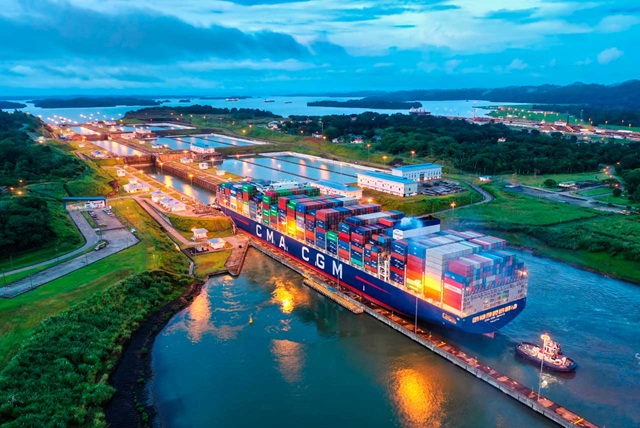
The canal uses a system of locks to lift ships 85 feet above sea level to the level of Gatún Lake, before lowering them again at the other end. The average transit time through the canal is between eight and ten hours, a relatively short period compared to the months-long journey around Cape Horn. If the canal were closed or ceased to function, it would force ships to take a longer and much more dangerous route, severely impacting global trade.
While Trump’s controversial statements about the canal’s ownership and control have generated much debate, Panama’s current president Laurentino Cortizo has firmly rejected any U.S. interference. In a statement to The Times, UK, Cortizo emphasised Panama’s sovereignty over the canal, calling the suggestion of military action “unacceptable.” For now, the canal remains firmly under Panamanian control, with the U.S. continuing to rely on it as a key component of its trade and naval strategy.
In the broader context, the Panama Canal is not just a relic of the past but a living, breathing force in global commerce. With shipping companies increasingly relying on it for the efficient transport of goods across the globe, its continued operation—and any attempts to challenge its control—will have far-reaching implications for international relations, trade, and geopolitics.
As the world watches, Trump’s rhetoric about reclaiming the canal may be more about political posturing than any realistic effort to reverse the decision made decades ago. But with climate change and shifting global trade patterns affecting the canal’s operations, the future of this waterway could still hold surprises for all involved.