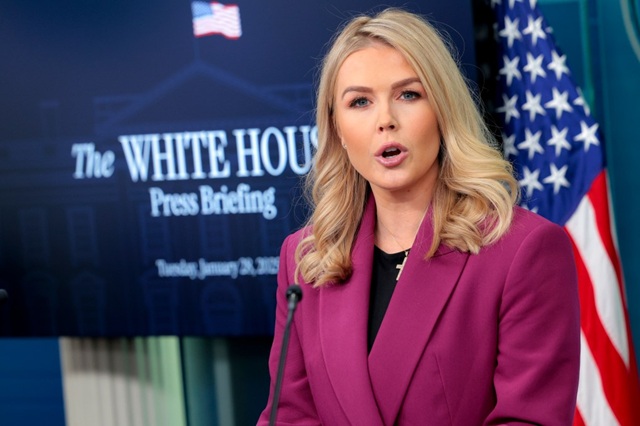
In a statement that quickly went viral, White House Press Secretary Karoline Leavitt claimed that Elon Musk’s “cost-cutting department” had discovered that the US was spending $50 million annually on condoms for Gaza. The assertion was made during Leavitt’s inaugural briefing to the media, where she defended the Trump administration’s decision to freeze foreign aid. She criticized the allocation of taxpayer money, calling it a “preposterous waste.” The statement ignited immediate backlash, with many questioning the figure and its validity.
Leavitt did not provide any supporting evidence for her claim, and reporters in the room did not press for further details. The story rapidly spread, with conservative figures like Robby Starbuck and Fox News host Jesse Watters amplifying the claim. Musk, who leads the Department for Government Efficiency (Doge) and also owns the social media platform X, posted that this was “the tip of the iceberg” and speculated without evidence that much of the money had ended up in the hands of Hamas.
However, experts and analysts were quick to dismiss the claim. Andrew Miller, former deputy assistant secretary for Israeli-Palestinian affairs under the Biden administration, called the $50 million figure “outlandish.” He suggested that while some funds might be allocated for sexual health services, they would not be solely for condoms. A comprehensive report by the US Agency for International Development (USAID) reviewed by The Times found that while $60.8 million in funding for condoms and contraceptives was allocated globally in 2023, none of it was sent to Gaza.
The report showed that USAID’s funds were directed primarily toward contraceptive implants ($23 million) and injectables ($17 million), with only about $7 million going toward male condoms. Furthermore, the only shipment of contraceptives to the Middle East was a small delivery of $45,680 worth of oral and injectable contraceptives to Jordan, not Gaza.
Dan Evon, from the News Literacy Project, pointed out that contraceptive funding was not a new initiative exclusive to the Biden administration, noting that the Trump administration also allocated substantial amounts—about $40 million—in 2019 for similar programs around the world.