


Continued U.S. control of the Panama Canal “looks like pure colonialism,” Henry Kissinger advised President Gerald Ford during a National Security Council meeting in May 1975, 50 years ago. “Internationally, failure to conclude a treaty is going to get us into a cause celebre, with harassment, demonstrations, bombing of embassies,” Kissinger warned, according to a declassified memorandum of conversation issued recently by the National Security Archive. The lead negotiator for a new Canal Zone treaty, Ambassador Ellsworth Bunker, reinforced that point: “I have no doubt that failure in these negotiations would entail unacceptable risks,” Bunker told the president, “including negative effects beyond Panama which would disrupt our relations with Latin America, lead to world condemnation, and hamper the operation of the waterway.”
According to Kissinger, “This is no issue to face the world on.”
The NSC ”memcon” is featured in a new Electronic Briefing Book published today by the National Security Archive as confrontation over the Panama Canal escalates into a central U.S. foreign policy and international issue. On February 2, Secretary of State Marco Rubio held meetings in Panama to press the Trump administration’s claims that the presence of a Chinese company in the Canal Zone violates the neutrality clause of the 1977 Treaty. “Secretary Rubio made clear that this status quo is unacceptable and that absent immediate changes, it would require the United States to take measures necessary to protect its rights under the treaty,” the State Department said in a threatening summary of the meeting. During his inaugural address, President Trump said, “We didn’t give it to China. We gave it to Panama, and we’re taking it back”—an ominous statement that prompted Panama to file a complaint to the United Nations that the U.S. is in violation of the UN Charter prohibiting “the threat or use of force” against the territorial integrity of member nations. But during Secretary Rubio’s visit to Panama, Trump reiterated that threat: “We’re going to take it back, or something very powerful is going to happen.”
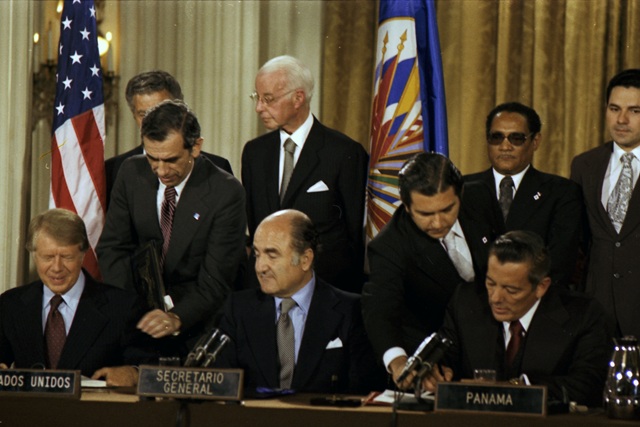
The documents posted today include CIA reports, NSC briefing papers, White House meeting minutes, telephone transcripts and audio tapes dating back to the Kennedy era. Although the current Canal accords were signed by President Jimmy Carter and Panamanian leader General Omar Torrijos in September 1977, negotiations for a new treaty ceding sovereignty of the Canal Zone back to Panama spanned a period of 13 years—from 1964 to 1977—during the Johnson, Nixon, Ford and Carter administrations. Almost a half century after complex and protracted bilateral diplomatic efforts finally removed the Canal Zone as a contentious and internationally repudiated symbol of U.S. hegemony in the Latin America region, these fascinating archival records provide a contextual, factual overview to understand and appreciate the historical foundations of the foreign policy crisis that is escalating today over Panama.
Historical Takeaways
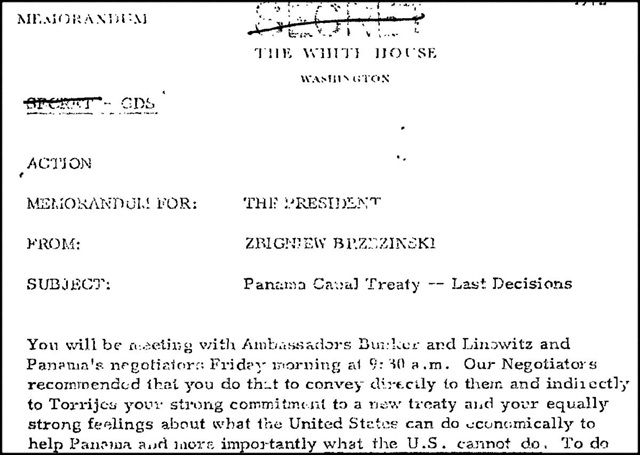
The various phases of bilateral talks evolved during different eras and with a variety of approaches on both the U.S. and Panamanian sides. But as a collection, the documents provide several key takeaways that can inform the increasingly misleading and aggressive political discourse over Panama. Among them:
**The Canal Treaty negotiations were bipartisan: Diplomatic negotiations to withdraw U.S. control of the Canal Zone and recognize Panama’s sovereignty over the waterway were conducted under two Democratic administrations—Johnson and Carter—and two Republican administrations—Nixon and Ford. Although the Carter administration receives due historical credit in the media for negotiating and signing the current Panama Canal accords, that historic agreement evolved from talks initiated under the Johnson Administration in early 1964, after anti-American protests in the Zone and the U.S. response cost the lives of 22 Panamanian students and four U.S. soldiers and left hundreds injured. In April 1964, Johnson appointed the first “special ambassador,” Robert M. Anderson, to negotiate a new treaty to replace the imperial 1903 agreement giving the U.S. carte blanche political, military, economic and administrative control over the Canal territories. Over the course of three years, Anderson negotiated a package of three treaties governing the administration and defense of the Canal Zone; for political reasons, the accords were never signed or ratified in either Washington or Panama. But Anderson continued as chief negotiator during the Nixon administration until June 1973.
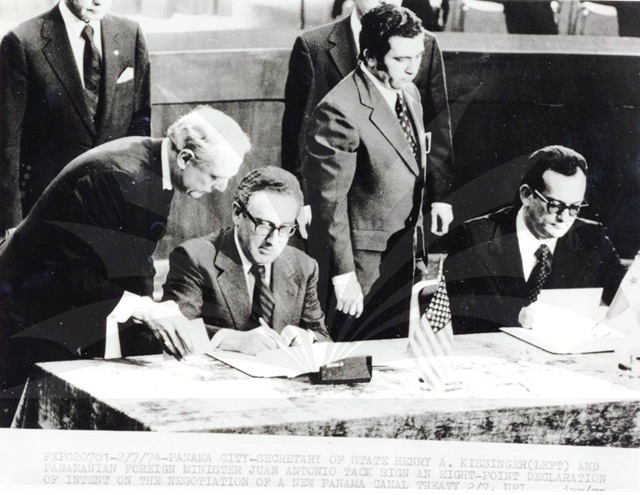
During Henry Kissinger’s tenure as Secretary of State, negotiations between the U.S. and Panama gained significant momentum. In February 1974, Kissinger traveled to Panama for a signing ceremony of a “Declaration of Principles” that established an eight-point framework for negotiations to cede control of the Zone to Panama. Given the contentious domestic politics surrounding U.S. control of the Zone, the Ford administration planned to finalize and sign an accord after the November 1976 presidential election on the assumption that Ford would win. Instead, the new Carter administration quickly affirmed that it would finalize negotiations to replace the 1903 treaty with a two-treaty package—one on administrative control and one on the future defense of the canal. President Carter also committed himself to a major public relations campaign to educate U.S. public opinion on how the new treaties would advance U.S. interests and lobby swing senators from both parties to vote to ratify the two-treaty agreement.
U.S. policy motivations were to secure sustainable, peaceful access to, and defense of, the waterway: After President Carter died at age 100, President Trump accused him of “giving [the Canal] away.” But the documents show that Carter, like his three predecessors, sought to advance U.S. strategic and economic interests in redefining an enduring and unstable symbol of an imperious U.S. presence in Central America into a zone of mutual and harmonious collaboration. As early as 1962, as a declassified memorandum of conversation between President Kennedy and Panama’s President Roberto Chiari reveals, Panamanian officials warned the U.S. of “the intensity of the feeling of the present Panamanian generation with regard to the 1903 treaty” and demanded new accords that respected Panama’s sovereignty over the Canal Zone. Those warnings became reality when violent, deadly riots broke out in early 1964, convincing President Johnson that a new treaty was needed to stabilize the geostrategic and economically imperative waterway. In three different national security directives, President Nixon instructed his negotiators to continue treaty negotiations, at one point calling for a new draft treaty by the end of 1971. When President Ford faced hostile domestic opposition to a treaty and division among his own national security team, top aides led by Henry Kissinger advised him on the regional and international repercussions of terminating the Canal Zone negotiations: “There will be an uproar in Panama, with riots and harassment. It will become an armed camp and will spread rapidly to the Western Hemisphere. It will become an OAS issue around which they will all unite. Then it will spread into the international organizations,” Kissinger told him. Ford was convinced. “It is my feeling that yes, we want a treaty,” Ford told his advisors during a July 1975 NSC meeting. “We don’t want a blow-up here in the United States or down there either. We want the situation under control here and certainly not a renewal of the fighting from 1964 there where people were killed and we had a hell of a mess.”
Domestic politics were a critical consideration and obstacle: Changing public opinion about the Canal and securing a two thirds vote in the Senate to ratify a new treaty with Panama were ever-present considerations for U.S. presidents. President Kennedy flat-out rejected the entreaties of Panama’s president, Roberto Chiari, to negotiate a new treaty on political grounds because, according to the summary of their conversation, “he could not see the end of the road in sitting down to rewrite the treaty nor how he could demonstrate to two-thirds of the Senate that such a course had advanced the United States interest.” President Ford was advised that “a new treaty could constitute a striking foreign-policy achievement for the Administration. It will not be easy to move a treaty through the Senate. But the real problem derives more from ignorance than antipathy.” With Ronald Reagan challenging Ford in the 1976 primaries with the mantra “When it comes to the Panama Canal, we built it; we paid for it; and…we are going to keep it,” discussions on treaty negotiations during the Ford administration repeatedly addressed how to sustain the pretense of talks while not actually finalizing an agreement until after the November 1976 election. The very first policy review meeting on Panama during the Carter administration determined that the President should start the campaign to inform public opinion by including Panama in his fireside chats, and that he should authorize “a National Citizens Committee on the Panama Canal…to stimulate a national educational campaign.” The Carter administration did mount a major and ultimately successful public relations effort to win hearts and minds (and votes) that included recruiting Hollywood star John Wayne to specifically rebut Ronald Reagan for spreading falsehoods and “misinforming people” about the treaty proposals.
Diplomacy Produces Positive Results: In his first conversation with the President of Panama after the January 9, 1964, riots in the Canal Zone, during which U.S. security personnel shot and killed some 20 Panamanians, President Johnson portrayed himself as “cold and hard and tough as hell.” But by April, when he appointed a special ambassador to engage in treaty negotiations, Johnson had adopted a proactive diplomatic attitude which helped contain the dangerous and explosive threat of unrest targeting the Canal Zone for the duration of his presidency. Mitigating unrest through the promise of diplomatic negotiations for a new treaty was also a strategy of the Nixon/Ford administrations. Carter had far more empathy for Panama’s historical grievances than his predecessors—“It is obvious we cheated the Panamanians out of their canal,” he wrote in his diary—but according to Kai Bird’s biography, The Outlier, Carter was influenced by intelligence briefings of how vulnerable the Zone was to political unrest and that 100,000 U.S. troops would be needed to defend it. Diplomacy was far more promising than the use of force. Carter’s special ambassadors, Sol Linowitz and Ellsworth Bunker, quickly negotiated a two-treaty solution—one on jurisdiction and administration and the other securing the U.S. rights to defend the Canal against threats to its neutrality. At a White House meeting with General Torrijos one day before the September 7, 1977, signing ceremony, according to the summary posted today, Carter told him that “the treaty opened the way to a new era of mutual respect, equality and friendship between our peoples.”
For almost half a century since the signing of those historic accords, that “new era” has more or less endured; notwithstanding the U.S. invasion of Panama in 1989 to seize General Manuel Noriega, the Canal Zone has functioned to the advantage of the U.S., Panama and the international community—until now. “As the U.S. threatens a return to an era of gunboat diplomacy in Panama,” notes Archive analyst Peter Kornbluh, “the historical record of the Canal Zone negotiations reflects the pragmatic promise of actual diplomacy to advance U.S. interests.”













Where’s the document. The National Security Archives link to the document is down. Actually, the whole site is.