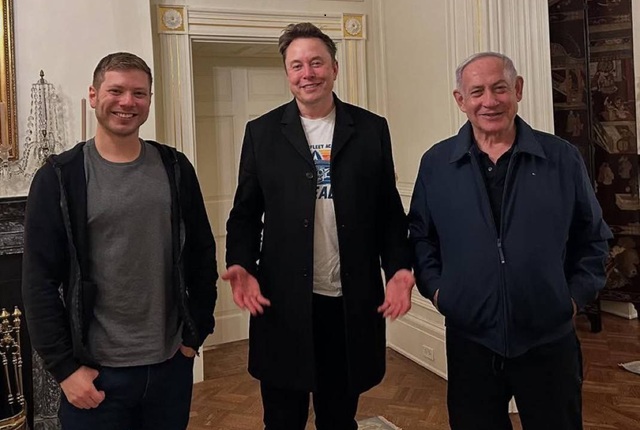
Before his pivotal meeting with U.S. President Donald Trump, Israeli Prime Minister Benjamin Netanyahu and his son Yair Netanyahu met with billionaire entrepreneur Elon Musk. The meeting, which Yair Netanyahu shared on social media, has sparked speculation about the topics discussed, particularly in light of growing geopolitical tensions surrounding Israel and the U.S. administration’s controversial new policy on Gaza.
Yair Netanyahu, who has been residing in Florida since 2023, has drawn criticism for remaining abroad while eligible for military service. Reports indicate that the Israeli government is using taxpayer funds to provide him with security during his stay in Miami Beach. His continued absence from Israel, especially as the nation navigates heightened security challenges, has fueled public debate.
The Musk meeting took place just before Netanyahu traveled to Washington, D.C., for high-stakes discussions with President Trump, during which the U.S. leader announced an unprecedented plan for the United States to assume control over the Gaza Strip and permanently relocate its Palestinian residents. Speaking at a joint press conference at the White House, Trump outlined his vision for Gaza’s future under American stewardship, promising to clear unexploded ordnance, demolish existing structures, and transform the area into a thriving economic zone.
“We’ll own it and be responsible for dismantling all the dangerous unexploded bombs and other weapons, level the site, and create economic development that will supply unlimited numbers of jobs and housing for the people of the area,” Trump declared.
Arguing that Gaza had been “a symbol of death and destruction for decades,” Trump asserted that allowing the current population to remain and rebuild would be counterproductive. Instead, he proposed the relocation of all 1.8 million residents to various unspecified locations across the globe, suggesting that “many countries with humanitarian hearts” would accept them.
“It could be one, two, three, or maybe even twelve different sites,” Trump added. “But the people will be able to live in comfort and peace. They’re going to have peace, not be shot at, killed, and destroyed like this civilization of wonderful people has had to endure.”
When pressed on whether this would require deploying U.S. troops to Gaza, Trump did not rule it out. “If it’s necessary, we’ll do that. We’re gonna take over that piece and develop it, create thousands and thousands of jobs. It will be something the entire Middle East can be very proud of,” he stated. He described Gaza as “a hellhole—before the bombing started, frankly” but envisioned it as a potential “Riviera of the Middle East” under U.S. administration.
Netanyahu, standing alongside Trump, fully endorsed the plan, calling it a “higher-level approach” to resolving the conflict. “President Trump is taking it to a much higher level. He sees a different future for that piece of land that has been the focus of so much terrorism and attacks against us, so many trials and tribulations. He has a different idea, and it’s worth paying attention to this,” Netanyahu said.
While Trump’s proposal has drawn widespread controversy, National Unity leader Benny Gantz appeared to support aspects of it, particularly the idea of voluntary resettlement for Gazans. Following a faction meeting, Gantz praised Trump’s commitment to Israel’s security and suggested that shifting responsibility for Gaza’s population from Hamas to the international community could be beneficial for Israel.
“The idea of building safe and prosperous areas for the residents of Gaza outside the Strip and allowing those who wish to relocate is admirable and will stand the test of reality,” Gantz said. “Whether it succeeds fully or partially, Israel has nothing to lose—only something to gain.”
Gantz also stressed the importance of preventing future reconstruction funds from being misused by Hamas. “We need to ensure that reconstruction funds do not once again become funds for recruiting [terror] operatives, manufacturing weapons, and building tunnels, but are intended for the residents of Gaza, for the civilian reconstruction of a Gaza Strip demilitarized from military threats,” he stated.
Beyond Gaza, Gantz reaffirmed his stance on Iran, aligning with Trump’s position against Tehran’s nuclear ambitions. “We have a window of opportunity to remove the Iranian nuclear threat. We must not miss it. We must work hand in hand with the American administration and together create a better and more stable reality for Israel, the countries of the region, and the entire world,” he said.
Trump’s announcement has sent shockwaves through the region and beyond, raising urgent questions about the feasibility, legality, and humanitarian implications of U.S. control over Gaza and the mass displacement of its population. While Netanyahu and Gantz have expressed varying degrees of support for the proposal, reactions from the international community remain uncertain.