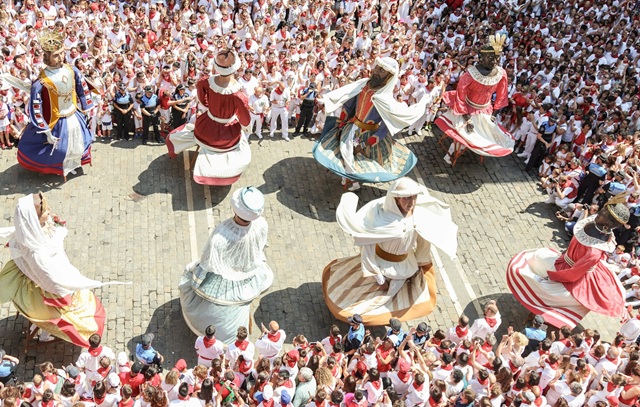
A groundbreaking study published in Nature on February 5 has uncovered surprising patterns in the behavior of large crowds. Researchers studying the movement of crowds at Spain’s traditional Feast of San Fermín in Pamplona have discovered that densely packed people in public spaces form swirling “vortex” patterns that had never before been documented in human gatherings. This revelation contrasts with prior studies, which have typically observed more chaotic crowd movements.
The study, co-authored by physicist François Gu from the École Normale Supérieure in Lyon, France, involved an in-depth computer analysis of video footage from the festival. Gu was initially baffled by the discovery, particularly the timing of the vortex’s cyclical motion. “I was like, what is this? Why 18 seconds?” Gu said, reflecting on how frequently the swirling pattern repeated itself. After meticulously checking the methods, Gu realized that the movement was clearly visible once the footage was sped up.
Gu and his team focused on the opening of the San Fermín festival, where thousands of people gather in the Plaza Consistorial. While the famous “running of the bulls” is a key event in the festival, the researchers focused on the crowd dynamics during the opening ceremony. Cameras set up on balconies overlooking the plaza captured the crowd’s movement, and sophisticated computer models were used to analyze the footage.
The study modeled the crowd as a dense continuum, similar to a fluid made up of particles, rather than the discrete individuals often used in crowd dynamics research. They found that once the crowd density reached around four people per square meter, it started to form slowly rotating vortices. As the plaza became more crowded, the motion intensified, with vortex formations occurring at a periodicity of 18 seconds as the crowd density reached its maximum — about nine people per square meter.
While the discovery was unexpected, it has crucial implications for crowd safety. Understanding the dynamics of how people move in dense gatherings could inform strategies to prevent dangerous situations. Dirk Helbing, a computational social scientist at the Swiss Federal Institute of Technology, highlighted the significance of this discovery, particularly in the context of crowd safety during mass events. “This research is highly relevant for creating livable cities and for crowd safety, particularly during mass events,” he said. Helbing pointed out that these vortex patterns could offer valuable insights into preventing crowd crushes, such as the 2010 Love Parade disaster in Germany, which resulted in the tragic deaths of 21 people.
By studying crowd behavior through a new lens, researchers hope to better understand how large gatherings can be managed to avoid the risks of stampedes and other crowd-related tragedies. The discovery of vortex-like motions in crowds not only expands the knowledge of human behavior but also has the potential to save lives at crowded events worldwide.