The harrowing ordeal of Azerbaijan Airlines flight 8243 on Christmas morning unfolded against a backdrop of high tension and unimaginable stress. Captain Igor Kshnyakin, an experienced veteran of Soviet-era aviation, faced an unprecedented crisis when, after aborting a second attempt to land at Grozny in southern Russia, his flight was hit by two Russian anti-air missiles, causing catastrophic damage. As The Times UK reported, despite the jet being critically disabled, Kshnyakin’s skill and composure ultimately saved the lives of 27 passengers and two crew members, though tragically, he and his first officer did not survive the crash landing.
The flight, which had 62 passengers and five crew members aboard, was en route from Baku to Grozny when Russian air defense systems—intended to protect against Ukrainian drone strikes—jammed the satellite signals essential for the aircraft’s approach. The flight crew, unaware of the impending danger, struggled to land in low visibility and were ultimately forced to turn back towards Baku. It was then that disaster struck. At 9:13 a.m. local time, a deafening “sonic boom” rocked the plane, followed by a second, equally violent explosion. The plane had been struck by metal shrapnel from the nearby missiles, tearing apart essential flight control systems, including the elevators, rudder, and ailerons.
In the chaos that followed, Kshnyakin and his first officer, Aleksandr Kalyaninov, fought to keep control of the jet. With the autopilot disabled and no working flight controls, the pilots relied on their training and ingenuity, adjusting the engine thrust to keep the aircraft aloft. As described in The Times UK, the crew, faced with a crippled aircraft, continued to navigate the Embraer 190 across the Caspian Sea, trying to reach a safe destination. The pilots initially considered nearby airports in Russia, but after assessing the conditions, they decided to head for Aktau, Kazakhstan, over 240 miles away, in a desperate bid for a safe landing.
While Kshnyakin and Kalyaninov were focused on controlling the plane, the situation on board grew more dire. Passengers and crew, including the chief flight attendant, Zulfugar Asadov, were struck by the brutal force of the explosions. Asadov was wounded by shrapnel, and panic spread throughout the cabin as the reality of the disaster set in. “We tried to calm them down,” Asadov recalled, speaking to The Times UK from his hospital bed. “When I tried to move forward, I was hit on the arm as a result of the impact from outside the plane. It felt as if someone had struck it with an axe.” Despite the injuries and chaos, Asadov continued to assist the passengers as best he could.
The pilots’ struggle to control the plane was nothing short of heroic. With the aircraft’s control surfaces rendered useless, Kshnyakin and Kalyaninov used the engine thrust to steer the plane. This extraordinary feat allowed them to keep the plane airborne for over an hour, navigating across the Caspian Sea, despite a significant loss of pressurization in the cabin and several unconscious passengers. The decision to head towards Aktau was a difficult one, but it ultimately proved to be the crew’s best option, as the weather conditions at other airports were not suitable for landing.
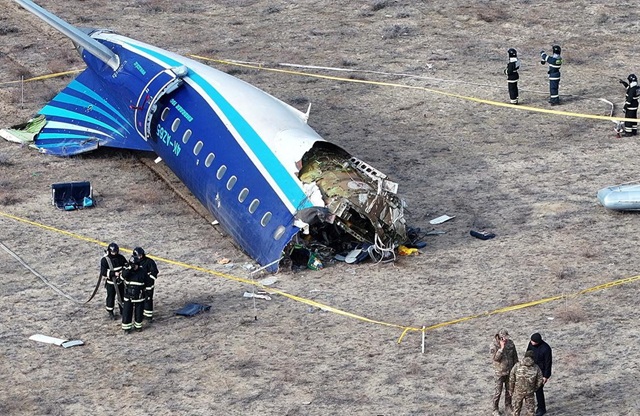
As the plane approached Aktau, the crew prepared for the crash landing. Despite their best efforts, the plane was torn apart upon impact, landing three miles short of the runway. The right wing hit the ground first, and the aircraft cartwheeled in a fireball. However, thanks to the placement of most of the surviving passengers in the rear section of the plane, many escaped the disaster. As Asadov and his colleagues helped passengers out of the wreckage, he called for assistance from the rescue teams waiting nearby.
The aftermath of the crash has been documented in a preliminary report, which was shared with The Times UK. The report, compiled by experts from Kazakhstan, Azerbaijan, and Brazil, confirmed that the explosion of two anti-air missiles was responsible for the damage to the aircraft. Although Kazakhstan’s official report avoided directly naming the missiles, citing “objects from outside” as the cause, there was ample evidence—shrapnel lodged in the plane and puncture holes in the fuselage—that pointed to a missile strike. The evidence has prompted accusations from Azerbaijan’s President Ilham Aliyev, who declared that the aircraft had been shot down by Russian forces.
The crash of flight 8243 has drawn comparisons to the 1989 United Airlines Flight 232 crash in Iowa, where the flight crew similarly used engine thrust to control a disabled plane. Despite the tragic loss of both pilots, Kshnyakin’s actions have been hailed as heroic. In a statement following the crash, Aliyev honored Kshnyakin with the highest national distinction for his bravery. The Times UK noted how Kshnyakin’s actions under extreme pressure not only saved lives but demonstrated the depth of skill and experience required to navigate such a catastrophic event.
As the investigation into the incident continues, the families of the victims and survivors are left grappling with the loss. For the passengers and crew who survived, the heroism of the flight crew will never be forgotten. In a final tribute to their bravery, Azerbaijan Airlines is likely to name the pilots of flight 8243 among the country’s national heroes for their extraordinary efforts under unimaginable circumstances.