
by Durga
Evy Poumpouras’s Becoming Bulletproof is not merely a self-help book but an existential roadmap for psychological resilience, strategic deception detection, and the cultivation of a mind impervious to manipulation. Poumpouras, a former U.S. Secret Service agent, distills her battlefield experiences into a manifesto of modern-day fortitude, weaving together memoir, psychology, and hard-nosed pragmatism.
Her opening gambit is devastatingly effective: “Nothing is, everything is becoming” (p.1)—a Heraclitean war cry against complacency. The author does not peddle empty affirmations; instead, she insists that resilience must be rigorously built, layer upon layer, like the Kevlar vests she once donned. “Wearing it gave me confidence, but it also reminded me that I was not completely safe” (p.18). The stark paradox of protection: it makes you aware of your vulnerabilities.
Poumpouras’s exploration of fear is surgical. “The will to survive is fundamental to us all. But in a life-or-death situation, most of us will lose our shit” (p.15). This is not the usual milquetoast coaching rhetoric. The author illustrates how fear can be harnessed rather than suppressed, citing Epictetus: “Difficulties are things that show a person what they are” (p.19). She advocates a calculated embrace of fear rather than its dismissal, pushing the reader to transform terror into tactical acumen. She further argues that “Fear is not your enemy; complacency is” (p.37), a statement that echoes throughout the book as she details how one can train themselves to become mentally and emotionally bulletproof.
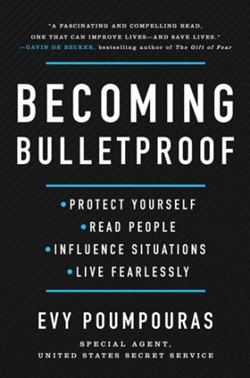
Her chapter on reading people is a clinic in behavioral forensics. “Everybody lies” (p.143), she declares, channeling a hybrid of House M.D. and Sun Tzu. Poumpouras trains the reader in decoding deception, identifying verbal ‘bleeding’ and ‘clusters of behavior’ that reveal cognitive dissonance. “It’s not just what people say, but what they fail to say that matters” (p.148). Her interrogation anecdotes are riveting, and her reverence for silence as a tool of influence is revelatory: “People hate silence. Use it. They will fill it with their insecurities” (p.152). She dissects the psychology of manipulation, teaching how to recognize when someone is attempting to control the conversation through passive aggression, guilt-tripping, or subtle linguistic shifts.
This book does not pamper the reader; it indoctrinates them. From analyzing body language to commanding respect in hostile situations, Becoming Bulletproof is a psychological boot camp that leaves no room for weakness. “You are either your own shield, or you are someone’s target” (p.273). In today’s hyper-political, hyper-manipulative world, this book is an armory for the mind.
Poumpouras shares gripping accounts of her time in the Secret Service, including the nerve-shattering moments of her 9/11 experience: “The roar was deafening. The ground shook. This was not a drill” (p.47). These firsthand experiences lend credence to her teachings, making it impossible to dismiss them as theoretical exercises. The book moves beyond fear and deception; it explores human nature, our fundamental desire for control, and how that desire can be weaponized or harnessed. “Power is an illusion, but control is a skill” (p.322). This understanding is crucial in an era of psychological warfare, misinformation, and digital manipulation.
Poumpouras’s insights into resilience extend to everyday encounters. “Your body language is your first shield; your words are your second” (p.198). She illustrates how people unknowingly project vulnerability, providing attackers—whether physical or psychological—with an opening. “A downward gaze signals submission. A hesitant step invites confrontation” (p.205). By dissecting even the smallest behaviors, she builds a powerful thesis: survival is often a matter of presence, confidence, and an unyielding refusal to show weakness.
Her anecdotes on personal security are harrowing yet enlightening. She details how quick decision-making in high-pressure situations can mean the difference between life and death: “You have mere seconds to react before danger materializes fully” (p.315). This book is as much about strategic thinking as it is about survival. She repeatedly emphasizes the idea that mental and emotional resilience must be trained and cultivated: “You don’t wake up fearless. You become fearless through exposure to adversity” (p.360).
Through over 300 pages of psychological strategies, real-world applications, and unrelenting emphasis on the necessity of control, Poumpouras transforms the reader’s perspective on strength. Becoming Bulletproof is more than a book—it is a battle-tested framework for navigating life’s most brutal realities.