



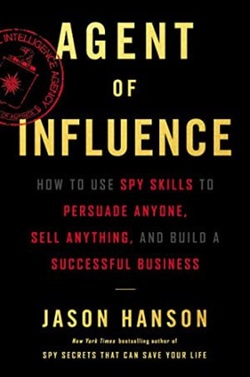
Jason Hanson’s Agent of Influence is an audacious blend of espionage tactics and business acumen, promising readers a shortcut to success by employing the psychological strategies used by CIA operatives. It is a book that teeters between ingenuity and outright manipulation, offering insights that could either empower or unsettle its audience. Hanson, a former CIA officer, boldly claims that “spy skills are great business skills” (p. 3) and sets out to prove that intelligence-gathering techniques can be seamlessly transferred to the world of sales, leadership, and entrepreneurship. He insists that confidence, adaptability, and the ability to influence others are the hallmarks of both spies and successful businesspeople. However, beneath this slick narrative lies an undercurrent of ethical ambiguity that forces the reader to question whether the end truly justifies the means.
The book opens with a provocative assertion: “Spies aren’t selling an ordinary product… the product they’re selling is treason” (p. 12). The starkness of this claim sets the tone for the rest of the work, in which Hanson repeatedly draws parallels between espionage and business. The SADR cycle (Spotting, Assessing, Developing, Recruiting) is presented as a universal formula for persuasion, whether in intelligence operations or corporate negotiations. “If an intelligence officer doesn’t close a deal, he might end up getting killed or spending the rest of his life inside a foreign prison” (p. 27), he writes, implying that the stakes of business, while not life-threatening, are no less dependent on one’s ability to persuade, deceive, and control a narrative. The extent to which such tactics should be employed in a professional setting is left unanswered, leaving the reader to grapple with the fine line between persuasion and manipulation.
Hanson’s anecdotes are undeniably gripping, particularly his personal experiences from CIA training. He recounts, “I was in a deep sleep when I was woken up by a loud, forceful knock at the door… I had to find someone willing to drive a strange man, alone, to Bethesda in the middle of the night” (p. 45). This initiation into intelligence work is framed as an exercise in adaptability, persuasion, and quick thinking—traits that he argues are just as crucial in closing a business deal. However, the comparison raises unsettling implications. Should entrepreneurs and executives truly view their interactions through the same lens as covert operatives persuading foreign assets to betray their nations? Hanson appears to dismiss such ethical considerations, focusing instead on the effectiveness of the methods themselves.
The book’s most controversial aspect is its underlying endorsement of deception as a legitimate business tool. Hanson asserts, “Spies stay well informed so they can more easily develop rapport with a target” (p. 68), and encourages readers to apply the same principles to networking and sales. He advocates for mirroring behaviour, subtly aligning oneself with another person’s interests and beliefs to gain their trust. While these techniques may indeed foster rapport, they also raise ethical concerns. Is authenticity sacrificed in the pursuit of influence? At what point does strategic relationship-building become manipulation? Hanson does not offer clear answers, leaving the reader to navigate these murky waters alone.
There is also an undeniable streak of American exceptionalism that runs through the book, one that some readers may find grating. The dedication itself sets the tone: “To all entrepreneurs and salesmen. The unsung heroes who help make America the greatest country on earth” (p. 5). While patriotism is expected in a book written by a former CIA officer, the relentless emphasis on American supremacy and capitalist success may alienate international readers. Moreover, the comparison of entrepreneurs to intelligence operatives seems hyperbolic at best and deeply problematic at worst. In Hanson’s world, success is not simply about skill or hard work; it is about outwitting, outmanoeuvring, and, when necessary, deceiving one’s opponents.
Hanson’s discussion of emotional intelligence and empathy, however, adds a layer of complexity to his argument. “An intelligence officer’s job is to complete the requirement they’re given, and that will often involve gathering intelligence from a source. You simply can’t pull information from a source if they don’t trust you, don’t like you, and don’t want to be around you” (p. 89). This insight, applied to the business world, suggests that genuine connection and emotional awareness are key components of success. But again, the question arises: is this genuine empathy, or merely another tool for manipulation? Hanson seems to suggest that the distinction is irrelevant so long as the objective is achieved.
One cannot ignore the capitalist undercurrent that runs throughout Agent of Influence. Hanson’s own business success is framed as a direct result of his CIA training, reinforcing the idea that his methods are foolproof. He recounts, “Fast-forward just nine years later, and I’m proud to say I’m the owner of a very successful, multimillion-dollar business” (p. 102). This personal testimony serves as both inspiration and sales pitch, subtly implying that those who fail to adopt the operative mind-set are simply not playing the game well enough. The book, in essence, becomes less about sharing knowledge and more about selling a philosophy—one that is as ruthless as it is effective.
Despite its controversial nature, Agent of Influence is undeniably compelling. Hanson’s writing is engaging, his anecdotes thrilling, and his advice undeniably practical. However, the ethical quandaries embedded within his framework make it a book that should be approached with caution. While it provides valuable insights into confidence, persuasion, and adaptability, it also challenges the reader to consider the moral implications of these skills. Should business truly be treated as a battleground, where deception is just another tool in the arsenal? Or does success, when built on manipulation, come at too great a cost?
Hanson does not provide a definitive answer, leaving it to the reader to decide whether they will embrace or reject the operative mind-set. For some, this book will serve as a powerful blueprint for professional success. For others, it will be a cautionary tale about the dangers of prioritising influence over integrity. Either way, Agent of Influence forces its audience to confront uncomfortable truths about the nature of power, persuasion, and the lengths to which people will go to succeed. In doing so, it ensures that the reader, much like a well-trained spy, remains ever watchful, ever questioning, and, perhaps, ever suspicious.












In business, your word is a contract, trust is of uttermost importance. If one advocates to use deception as business tool, then this book is THE Handbook MEANT FOR the Sakvithi Ranasinghes!!!