by Our Correspondent in Colombo
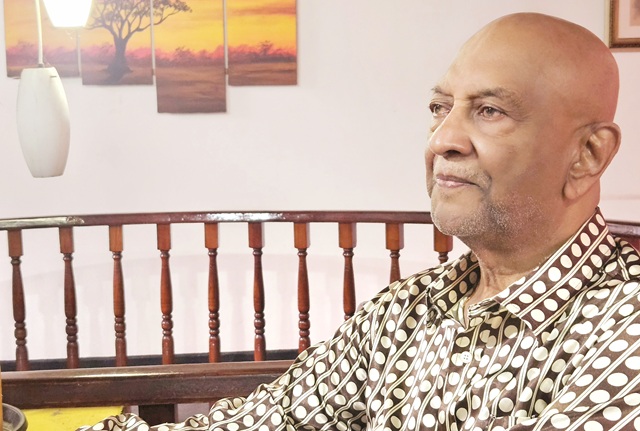
We sat down with Jayantha Gnanakone, whose story is a poignant testament to the devastation endured by Tamils over the years. Beginning in 1958, his family’s businesses were looted and set ablaze three times by Sinhalese mobs, with the police and firefighters standing idly by, seemingly indifferent to the destruction. The personal toll was immeasurable—Jayantha’s best friend was burned alive in one of these violent episodes, a memory that continues to haunt him. As the violence escalated, Jayantha had no choice but to flee to the United States for safety, leaving behind a land gripped by chaos. Despite the enormity of the suffering his family endured, there were no prosecutions, no justice, and no compensation, even for the land, buildings, machinery by the UDA, and for 42 years the land remain untouched, unoccupied by the UDA and Sugathadasa Stadium except some corrupt deals. I unequivocaly blame PM/President Ranil for most of the delays. He deliberately delayed everything and mislead me.
Today, 17 February, as Jayantha celebrates his birthday in Colombo, he remains focused on the ongoing struggle for accountability and justice for the innocent Tamil civilians, continuing his search for answers and an equitable resolution to the trauma that has defined so much of his life. The mother of his children is a Singhalese from Colpetty.
At the outset, he recalls his early life with vivid clarity, painting a picture of a childhood deeply intertwined with his father’s entrepreneurial spirit in Colombo. “We had a very interesting and itriguing life,” he reflects. His father, V.P. Gnanakone, started with a shop in Wellawatta, located opposite Vihara Lane which was a den of vice, mainly dealing with Kassipu, and other unsavory activities. It was near the police station, one of only two grocery stores in the area at the time, 67 years ago. However, life in Sri Lanka was not without its challenges. “ On May 27th, 1958. This was the first race riot in post-independence Sri Lanka. And they allowed the riots to go on for two days, deliberately.” Unlike the events of July 1983, which he describes as “premeditated, preplanned, and pre-warned,” the riots of 1958 were not state-sponsored.
By 1964, his father transitioned into the shipping industry, a move that set the course for the family’s future. “My older brother, Charles, was already an officer, in the merchant navy” he explains. Jayantha himself was one of four siblings, with two brothers who became master mariners and a sister who was the only one to attend university. “She never worked in her life,” he adds. His involvement in the family business began early. “I was actively hands-on in shipping activities, prior to becoming a British qualified Commercial Pilot graduating from the prestigous flying academy, The Oxford Air Training College, where British Airways, Swiss Air sent their selected trainees to complete their CPL/IR training.
Shipping activities in the family owned business, Gnanakone and sons, had an early start, because I was the only one at home doing the driving and telex typing,” he recalls, explaining how his father neither typed nor drove. “Especially on weekends and nights, when the driver was unavailable, I was in action following up.”
His journey took him to the United Kingdom in 1968, via India, Egypt, Beirut, Greece, Switzerland, Germany, Monaco and France, visiting shipping associates and ship owners at a young age establishing a long term friendship. In London he pursued ship brokering at the Baltic Exchange, prior to joining the Commercial Flying School at Oxford. Upon returning, he joined Air Ceylon as a first officer, flying DC-3s.
“These are the same routes I’m trying to get the government of Sri Lanka to participate today—to promote domestic aviation and Tourism. Ratmalana to Jaffna, Jaffna to Trichy, Jaffna to Chennai. Sixty years later, we have nothing.” Rajapakses appointed an Air Ceylon Steward of 2 year experience to handle a highly technical and professional position as Director of Civil Aviation, as he was Gotabaya Rajapakse’s friend and travel agent in Los Angeles, USA.
Gnanakone’s early career saw him selected for advanced training in Paris France, with UTA French Airlines, due to his British flying licence and European experience. “I was one of the youngest pilots in the world flying DC-8s, a 260-seater aircraft,” he notes. His colleagues at training included senior pilots from British Airways, Swiss Air, and Air France. “Two of our Air Ceylon candidates failed and were sent back. Out of the six, only four carried on.”
Despite his promising aviation career, shipping business constraints led to an early retirement in 1975. “When I retired, my salary was only 1,500 rupees, because I didn’t have much seniority and other reasons. it was an hostile environment for me” By that time, his family shipping business was growing rapidly in Singapore and Sri Lanka. “We had already established an office in Singapore, on 1 Shenton Way but most of our businesses were out of Colombo and India. We opened offices in Chennai, and Cairo Egypt to handle the Middle East business which was booming after the 1973 Yom Kippur War. We were brokering, tendering for the food department, the rice, wheat flour, fertiliser, cement, and petroleum corporation.” By the mid seventies, they had expanded into ship ownership. “We were ship owners based in Singapore.” The scale of their operations was significant. “Fifteen ships owned and managed,” he clarifies. “Neptune Orient Lines, the Singapore government ownedshipping company, provided us two ships to crew – using Sri Lankan crew. We also crewed Greek tankers.” Their connections extended to Hellenic Lines, a major Greek shipping company. “The son of the owner, Gregory Callimanopolis, was in the tanker business, and Hellenic Lines had owned 80 ships, which was Greece’s National Carrier. We were handling about 60% of the entire crewing of Sri Lankan origin.” Most of the crew selected because of their Seamanship, loyalty to the company, and “Seawater running in their veins”.
Success, however, brought envy, jealousy leading to scrutiny. “I had an interesting clash with Lalith Athulathmudali, the Minister of Shipping. He accused me, in public, of recruiting terrorists!!” Gnanakone’s response was defiant. “I said, you are the Minister of Internal Security. provide me a list of the terrorists. I won’t touch them. That ended the conversation.” Despite the minister’s antagonism, the Sri Lanka Port Authority’s containerisation in 1979 positively impact their business, especially on transshipment as lobbied and predicted by the Gnanakone brothers. “It was a great decision although a few years late due to politics and ignorance. One of my friends, DPR Rajapaksa, became chairman in 1977, and Chinnakone, who was known to us as a junior SLPA official, and from Church, became Chief Operations Manager.”
Jayantha played a role in modernising Sri Lanka’s port operations. “We were working with the Ministry of Shipping to containerize and modernise the port from our Singapore operational experience.”
It took 3 years, from 1978 to 1981, to establish the first container crane in South Asia and Sri Lanka.” However, the process faced bureaucratic and political resistance. “The first time there was a cabinet meeting presented by the President, proposing the establishment of a container crane, the Minister of Shipping, Wimala Kannangara, objected saying, “No sir, we have plenty of cranes. We don’t need a container crane.’” Her ignorance was striking. “What she thought was that the old shore cranes were good enough to discharge the containers from big container ships. Shipping Minister immediately replaced by the President – he appointed Athulathmudali, who was well educated but corrupt!!”
The instability in Sri Lanka soon reached a boiling point. “The 1983 race riots came,” he states grimly. “UDA under Premadasa Sr. acquired my container freight station, Marine Engineering workshop, Civil Construction and Accounting dept. offices, and clearing, forwarding, and Road transport offices right next to Sugathadasa Stadium, without any any rime or reason. I had 250 employees at that time. They did that. I had 25 lorries. They burnt every single lorry in different locations.” He questions the randomness of these attacks. “How would a gang of thugs in some junction in Wattala or somewhere in Ratmalana or Kalutara know that this is a Tamil-owned lorry? The name of my company was Majulah Agencies. How can they stop a vehicle and burn it?” His conclusion is unequivocal. “This is why we always said it was premeditated and preplanned”
Warnings came from unexpected places. “A minister told me, ‘Next time you fellows kill a policeman, Colombo will be burning.” This prompted him to buy a ticket to the United States as a precaution. Even within the government, people were warning him not to hang around.
His departure was swift. The destruction of his business was absolute. He left Sri Lanka on July 25th 1983, leaving his younger brother in charge for a very brief period. Soon afterwards, his younger brother was also forced to leave. A friend at the US Embassy arranged a five-year multiple-entry visa for him as well, so he could leave.
Thereafter, the police, CID, TID, everybody gave his employees a hard time. The employees took advantage of the situation. They vandalised everything. “I had three chartered accountants. They helped themselves. And most of them strangely died suddenly with strange diseases. That’s what I call the curse of Majula.” His exile lasted 19 years. “I only returned when Ranil Wickremesinghe became Prime Minister in 2001.”
His involvement in the peace process was immediate. “We were able to sign the ceasefire agreement on the 22nd of February, 2002, within 45 days of Ranil becoming Prime Minister.” The agreement, he asserts, did not materialise overnight. “Ranil came to see me in Los Angeles in 2001 and asked for my advice and help in negotiating with the LTTE.” His long-standing links with the LTTE made him a valuable intermediary. “I called them, and they said yes, but they did not trust anybody.” He saw an opportunity. “I said, it’s time for us to end the war, at least start this thing.”
Despite his role in negotiations, accusations persisted. “Athulathmudali came to the United States in 1984 and said I was funding and supporting the LTTE.” This led to his first interviews with the FBI. “The FBI called me two or three days later. They said, ‘We have researched you.’ ” His response was blunt. “I said, yes, I was expecting your call. I know what the Minister told the Secret Service.”
Rebuilding his life in the United States, he ventured into the travel industry. “I bought an existing travel agency in Manhattan Beach, together with a Sinhalese friend of mine.” The partnership was built on mutual trust. “He had travel business experience in London and Los Angeles.” His personal life also took a turn. “I finally got married to a Sinhalese woman,” he remarks, before adding, “I love to forget it. Because I’m divorced for 25 years. But had full custody of the children with child support, that was only partially honored.” She went up to the Appeals court and Supreme Court appearing Pro Per as I did not want to waste my money on lawyers. SC denied most of her appeal.