Editorial
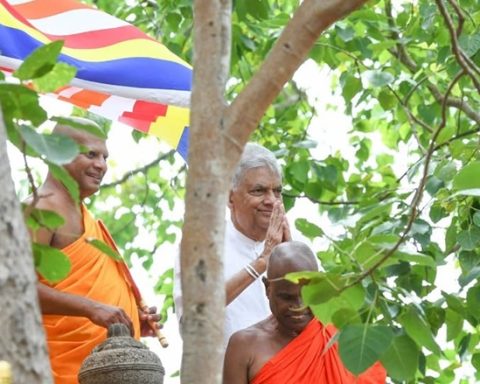
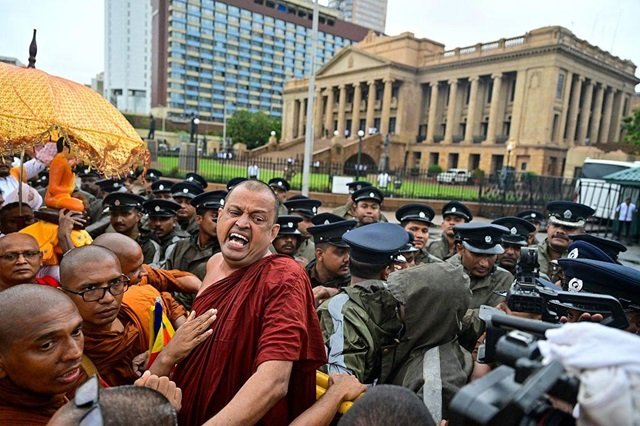
When a society can no longer distinguish political dissent from supernatural intimidation, the problem extends far beyond religion. It signals a crisis of reason, historical consciousness and public responsibility. The recent use of was kavi by Sri Lankan Buddhist monks protesting against the government exposes an uncomfortable contradiction. A tradition that emerged within a culture shaped profoundly by Buddhism is being mobilised through a ritual language that invokes supernatural punishment against political opponents. The verses may express genuine anger, institutional distrust and frustration with the failures of political authority. Yet their significance lies less in whether anyone believes a curse will work than in what their public performance reveals about the intellectual condition of the society in which they circulate. When political grievances are expressed through the threat of occult retaliation, the language of accountability risks surrendering to the logic of superstition.
Friedrich Nietzsche declared that God was dead, not as a triumphant announcement that religious belief had disappeared, but as a diagnosis of the collapse of Christianity’s authority over European moral and intellectual life. The consequences, he warned, were profound. A society can abandon the authority of traditional religion without developing the intellectual independence necessary to live beyond it. The result is not necessarily enlightenment. It may be a vacuum filled by new dogmas, inherited prejudices and comforting illusions. Sri Lanka presents a revealing variation of this predicament. Buddhism remains institutionally powerful, politically influential and culturally indispensable, yet rational inquiry is frequently subordinated to ritual authority and inherited supernatural assumptions. The gods may have lost their unquestioned authority in some areas of public life, but the appetite for supernatural intervention has hardly disappeared. In this god-dead society, nonsense has not replaced religion. It has occupied the space where critical thought should have been.
The historical irony is particularly sharp because the Buddha’s teaching offers substantial resources for challenging such dependence. Early Buddhist texts repeatedly question speculative metaphysics, reject the proposition that ritual purification alone can eliminate suffering, and direct attention towards ethical conduct, disciplined inquiry and the causes of human experience. In the Kālāma Sutta, the Buddha cautions against accepting claims merely because they derive from tradition, scripture, popular opinion or the authority of a teacher. The passage is not a modern declaration of scientific atheism, and the Buddha did not reject every supernatural belief found in the religious culture of his time. Nevertheless, its insistence that claims must be examined rather than accepted blindly stands in direct tension with any practice that demands unquestioning faith in the power of ritual words. A tradition that celebrates the Buddha while neglecting this intellectual discipline preserves the symbols of Buddhism at the expense of its critical force.
The corruption of this inheritance cannot, however, be explained simply by blaming Hinduism. Buddhism and Hindu traditions developed through centuries of interaction across South Asia, exchanging philosophical concepts, ritual forms, devotional practices and cosmological ideas. Buddhist communities themselves transformed over time, developing diverse traditions that cannot be reduced to a single rationalist ideal. To describe every later ritual as a foreign Hindu intrusion would be historically careless. Yet the broader question remains legitimate. Did the absorption of increasingly elaborate ritual practices, protective rites, astrological prescriptions and supernatural promises sometimes marginalise the analytical and ethical dimensions of Buddhist thought? In particular contexts, the answer warrants serious investigation. Sri Lanka’s intellectual history should not be protected from such questions by appeals to religious sentiment. Nor should cultural exchange be confused with intellectual progress. Traditions must be judged by what they encourage people to think, question and understand, not merely by their antiquity or popularity.
The was kavi controversy brings this problem into the present. There is no credible scientific evidence that a metrical curse can inflict supernatural punishment on a political opponent. That does not make the episode socially insignificant. A ritual can generate fear, mobilise collective anger, stigmatise an adversary and attract enormous attention without possessing the supernatural efficacy attributed to it. Its consequences arise through human behaviour, not demonstrable occult forces. The more important question, therefore, is why political protest should require the language of supernatural retribution at all. If a government has acted unjustly, the response should involve evidence, public scrutiny, legal accountability and organised dissent. A curse may communicate desperation, but it cannot substitute for an argument. Nor does the religious status of those performing it place their claims beyond critical examination.
Sri Lanka does not need to choose between religious identity and intellectual independence. It needs the courage to distinguish them. The Buddha’s legacy cannot be defended merely by venerating his image, reciting his words or attaching Buddhist authority to political causes. It must be defended through the willingness to question inherited beliefs, investigate claims and confront the social consequences of irrationality. Nietzsche’s warning remains relevant because the disappearance of unquestioned authority does not automatically produce freedom. Without critical thought, old certainties return in new disguises. The tragedy is not that monks have entered politics, nor that citizens use traditional forms to express dissent. It is that a society possessing a profound philosophical inheritance can still mistake ritual intimidation for political argument. When nonsense occupies the place of reason, the first casualty is not religion. It is the public’s capacity to think for itself.