by Our Special Correspondent in Jaffna
An interim archaeological investigation at Chemmani in Sri Lanka’s northern Jaffna district has recovered 574 minimum-number-of-individuals human skeletons, documented 51 accumulations of disarticulated bones and registered 170 artefact entries, but has not established when the individuals died, how they were buried or whether their deaths were connected to any specific historical event. The findings, detailed in a report dated 10 October 2026, provide substantial new evidence about the site while leaving the central historical questions unresolved.
The report, prepared by archaeologist Raj Somadeva, PhD, and Anusha Wanninayake, MSc, examines the remains recovered from the Sittupatti Cemetery during an investigation conducted over approximately 80 days. The work followed the accidental exposure of human remains during construction-related digging and proceeded under an order issued by the Magistrate’s Court in Jaffna, with the Magistrate and the Chief Judiciary Medical Officer of Jaffna Hospital observing the excavation.
The findings are particularly important because Chemmani has been associated locally with allegations of serious past abuses and suspected human rights violations. Yet the report does not establish those allegations through archaeological evidence, nor does it identify the individuals responsible for the deaths or burials. Its authors state explicitly: “The assemblage of material evidence documented in this report is insufficient, in isolation, to support a definitive conclusion regarding the nature and character of the burials investigated.”
That qualification is central to interpreting the discovery. The recovery of hundreds of skeletons establishes the scale of the human remains found at the site. It does not, by itself, establish a massacre, the identity of those responsible, a particular cause of death or an attempt by any party to conceal evidence. Equally, the report does not disprove allegations about historical abuses. Those questions require corroborating evidence beyond the archaeological findings presented in this interim assessment.
The principal excavation, designated Trench 1, covered 513 square metres, measuring 28.5 metres by 18 metres. The recorded depth of excavation reached 1.60 metres below the highest point of the surrounding ground. Skeletons were found at varying depths, from approximately 24 centimetres to 1.52 metres below the present surface. A second potential burial area, Trench 2, was investigated through three interconnected trial trenches, but the report does not provide a comparable total of human remains recovered there. The 574 individuals therefore represent the report’s principal recorded assemblage, not an established count of all remains that may exist across the wider area.
The researchers identified the potential excavation areas after examining satellite imagery showing rectangular patches of soil discolouration. They subsequently used ground-penetrating radar, which revealed “numerous subsurface anomalies”, some potentially consistent with additional burials. The results suggest that the area containing archaeological features may extend beyond the excavated trench, but the anomalies have not all been confirmed as graves. Further ground investigation would be necessary to establish their nature and extent.
One of the report’s most consequential findings concerns the estimated ages of the deceased. Its preliminary assessment classifies 41 per cent as children, 22 per cent as infants, 30 per cent as adults and 5 per cent as sub-adults. Children and infants together account for 63 per cent of the reported distribution. This is a significant demographic observation, but the report does not establish the cause of death for these individuals or explain why they were buried at the site.
There is also a statistical discrepancy: the four age percentages total 98 per cent rather than 100 per cent. The report does not explain the missing two percentage points. Until the underlying records and classifications are reconciled, the figures should be treated as preliminary estimates rather than a complete demographic breakdown. The proportion of children and infants warrants careful forensic examination, but it cannot independently establish the circumstances in which they died.
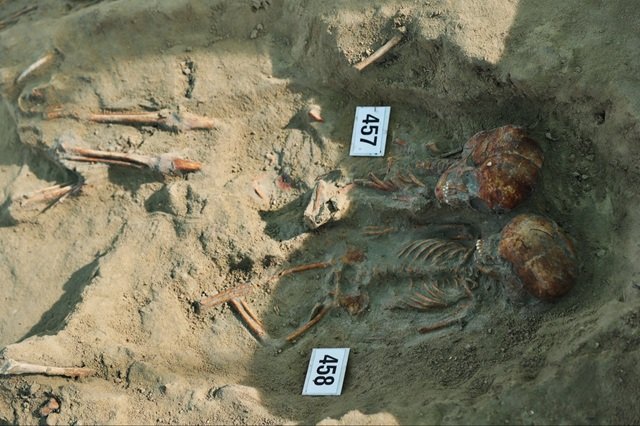
The physical arrangement of the skeletons presents another layer of complexity. The researchers recorded 51 accumulations of disarticulated human bones, separate from the 574 individuals. These groupings include complete and fragmented skeletal elements found together in discrete areas. The authors suggest that some may have resulted from later digging that disturbed earlier burials, displacing bones and creating secondary concentrations. The number of accumulations does not establish the number of separate graves, burial episodes or incidents of deliberate disturbance.
The site has also experienced substantial modern interference. The report documents pits, waste disposal and buried animal carcasses, including a dead cow, as well as hospital waste distributed across the surface. Fragmented human and animal bones, including cattle and goat remains, were found in disturbed soil deposits. Such activity complicates the reconstruction of original burial positions and means that the location of a bone when excavated cannot automatically be treated as its original position at interment.
The distribution of the skeletons is irregular, with some remains overlapping. The researchers consider successive episodes of burial a possible explanation, but they do not establish when those episodes occurred or whether the entire assemblage belongs to the same period. The burial depths also vary considerably, while cranial orientation is predominantly north-west: 72 per cent of recorded skulls fall into that category, compared with 11 per cent facing south-east and 7 per cent south-west. The report does not establish that these orientations identify a particular religious, ethnic or historical group.
Two skeletons, numbered 227 and 429, were found in seated positions. The report notes that seated burials occur in certain Hindu religious traditions, including Samādhi and Jīva Samādhi, and illustrates Skeleton 227 in what it describes as a meditation posture. However, the authors expressly caution that the positions alone cannot establish that either individual was buried according to those traditions. Further analysis of the skeletal arrangements, surrounding deposits and associated artefacts would be required.
The artefacts provide some of the report’s most important evidence for investigating how the deceased were treated. The 170 registered entries include jewellery, amulets, coins, clothing-related objects, personal belongings, possible final-rite objects and probable coffin remnants. Finger rings and bangles were found primarily in association with adults, while most recorded beads were associated with children. Amulets, coins and other objects were also linked to individual skeletons, although their precise purposes remain uncertain.
Skeleton 25 provides a particularly detailed example. Objects recorded in association with it include a plastic bag, pieces of cloth cut and prepared for sewing, socks, shoes and a metal anklet chain. A concentration of small nails nearby led the researchers to suggest that the individual may have been buried in a coffin. Elsewhere, two polythene garlands were reportedly associated with a single skeleton, while iron nails and irregular metal fragments were found near some skeletons and bone accumulations. These objects may help reconstruct burial practices, but their presence does not establish that every individual received the same treatment or that all the objects were deliberately placed with the deceased.
The report’s interpretation is that some aspects of the evidence resemble formal burial practices more closely than the clandestine burial contexts used for comparison. It states that the site shows “greater similarities to contexts characterized by formal burial practices”. This is a provisional archaeological interpretation, not a final determination of how the burials occurred. The authors also acknowledge that an epidemic or another natural catastrophe could produce a concentration of burials, potentially with few associated objects if rapid disposal were the immediate concern. They do not claim that such an event occurred at Chemmani.
Chronology remains a major limitation. A coin associated with Skeleton 367 bears the date 1870 CE, but the report warns that the minting date does not establish when the individual was buried. Coins recovered from a separate ash deposit near the cemetery’s cremation platform bear dates ranging from 1920 to 1994 CE. The researchers suggest that the ash may have accumulated when an earlier cremation area was cleared and levelled during construction work, but this explanation has not been conclusively established. The report does not provide an absolute date for the assemblage of 574 individuals.
These limitations matter when evaluating public claims about the site, including claims that attribute responsibility or political motives to particular institutions. The excavation report neither establishes that the discovery was orchestrated to defame Sri Lankan authorities nor provides evidence sufficient to dismiss allegations of historical wrongdoing. Determining whether the remains are connected to a specific event requires a reliable chronology, further forensic examination and corroborating evidence. Neither political accusation nor political exoneration can substitute for those findings.
The report’s strongest contribution is its documentation of a large and complex assemblage, the identification of potential additional burial features and the recording of artefacts and skeletal relationships that merit further investigation. Its authors do not present the findings as a final forensic account of how the individuals died. Their explicit conclusion remains that the available material evidence, considered in isolation, is insufficient to determine definitively the nature and character of the burials.