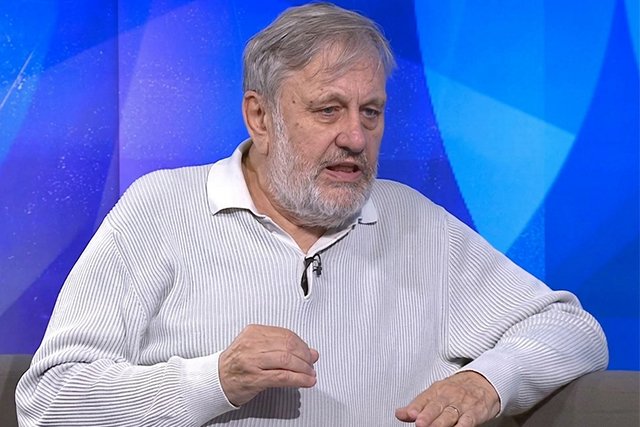
In an interview with BBC Newsnight’s Paddy O’Connell, Slavoj Žižek discusses his new book, Signs from the Future, arguing that Donald Trump is a symptom of democratic failure, the liberal international order is disintegrating, and the left must reconsider its political strategy, including his controversial case for “leftist authoritarianism”.
Slavoj Žižek believes the world is moving towards catastrophe, but that the knowledge of danger has not produced the political action needed to prevent it. Environmental destruction, artificial intelligence and the threat of a new global war are advancing alongside the weakening of international institutions, leaving governments and societies aware of mounting risks but unable to agree on how to respond. For the Slovenian philosopher, the central problem is not a shortage of information or competing political narratives. It is the absence of effective mechanisms for collective action.
Speaking to Paddy O’Connell on BBC Newsnight about his new book, Signs from the Future, Žižek describes humanity as caught between two necessities: a trajectory towards self-destruction and the need to organise a different political and economic order. Although he calls himself a “moderately conservative communist”, he rejects the idea that communism must mean abolishing private property and markets. His argument instead centres on stronger international cooperation, more effective state intervention and collective approaches to problems that individual countries cannot resolve alone.
“We know what we have to do but we don’t even have an idea. We don’t have mechanisms how to do this,” he says. The institutions and practices of international cooperation that developed alongside the post-war liberal order, he argues, are now disintegrating precisely when global coordination is most necessary.
Žižek draws on Antonio Gramsci’s observation that “the old is dying and the new cannot be born”, a condition in which, as the quotation continues, morbid phenomena emerge. But he questions the assumption that the present crisis is merely an interval before a more progressive system eventually takes shape. Rather than expecting capitalism’s decline to lead naturally to socialism, he warns that the world may be moving towards what he calls “a universalized morbidity”.
He also invokes the argument advanced by his friend Yanis Varoufakis that the emerging economic system resembles “digital or cloud feudalism”. Žižek accepts the central insight behind the term, even though he acknowledges disagreements over its precise meaning. What is emerging, he argues, is no longer simply global capitalism as it was previously understood, but a system in which a stronger state and large corporations exercise increasing control over markets. He sees this development as darker than the earlier model of global capitalism.
The political consequences are particularly visible, in his view, in the rise of Donald Trump and the crisis of the American left. Žižek rejects the idea that defeating Trump is sufficient to resolve the problems that produced his political success. “We should never forget that Trump is not the big enemy. Trump is a symptom and effect of the failure of precisely this old welfare state democratic America,” he says.
That assessment places substantial responsibility on the Democratic Party. Žižek argues that Democrats failed to understand the social and political conditions behind Trump’s electoral appeal, even though the administration of Joe Biden enacted policies he considers economically successful. “As to the inner politics, economy, and so on, Biden was very good. But obviously, it didn’t work,” he says.
Žižek says he supported Trump before his first election in the expectation that voters would recognise the dangers he represented. Instead, he argues, the Democrats learned too little from the outcome. His conclusion is deliberately provocative: “Democrats created Donald Trump.” He means that Trump’s rise cannot be understood independently of the failures and limitations of the political establishment that opposed him.
For the American left, Žižek sees the principal struggle as one between MAGA populism and the new left associated with democratic socialism. He argues that socialists should not isolate themselves in a separate party but should work within the Democratic Party, building political strength through local struggles. He points to Zohran Mamdani’s political approach in New York, alongside developments in California and Minnesota, as examples of the kind of activity that might alter the balance.
Yet Žižek doubts that better communication alone can reverse the left’s decline. He acknowledges the importance of political storytelling, praising Mamdani’s speech marking the United States’ 250th anniversary as a model of how American patriotism might be reconsidered. Rather than treating patriotism as a declaration of national superiority or exceptionalism, Mamdani, in Žižek’s account, presented American greatness as residing in an openness to others.
The left, Žižek argues, must also stop treating subjects such as family values and making money as inherently right-wing concerns. He contends that families and social relationships become especially important during crises because people cannot survive independently of others. At the same time, he argues that economic individualisation has weakened families and social spaces, while the spaces that remain are increasingly controlled.
“Don’t be ashamed of this,” he says when O’Connell asks whether the left needs a moral narrative. Žižek maintains that family values should be considered alongside social solidarity and socialism, rather than surrendered to political opponents. He also challenges what he regards as the left’s excessive suspicion of money, arguing that envy and resentment can distort its economic arguments.
He traces the origins of the left’s current decay to 1968, which he describes as the end of an earlier social-democratic and more radical left with a global vision. In its place, he argues, came a form of politically correct moralism that has failed to provide a compelling political programme. Nostalgia for an allegedly better past, meanwhile, has become a source of contemporary anger, although Žižek resists nostalgia as a political solution.
His criticism of Trump extends beyond domestic American politics to the future of the international order. Žižek calls the president a “liberal fascist”, a description that O’Connell challenges by asking whether the term obscures more specific analysis of Trump’s conduct and ignores the fact that tens of millions of Americans have elected him twice.
Žižek responds that fascism is a complex phenomenon and uses the term “soft fascism” to describe a broader political tendency. He argues that Trump’s approach to economic and international affairs involves unusually forceful state intervention, despite the rhetoric of some of his supporters. He also sees parallels between the political ambitions of Trump and Vladimir Putin, while describing China as pursuing a more refined strategy.
Žižek warns against a world divided into competing spheres of influence, with the United States dominating Latin America, Russia seeking control over Europe and China controlling the Far East. Such a three-way arrangement, he argues, would undermine the universal cooperation required to address environmental crises, artificial intelligence and the danger of war. His proposed response is not merely a stronger state within individual countries but a stronger global order capable of enforcing collective decisions.
Artificial intelligence, he says, is effectively unstoppable. He rejects what he regards as the naive belief that it can simply be contained through managerial or scientific decisions, arguing that its development has an internal logic that individual actors may be unable to control. He sees a similar predicament in environmental destruction and nuclear weapons: the risks are widely recognised, but recognition alone has not generated sufficient action.
For Žižek, the experience of the Covid pandemic demonstrated that governments possess greater economic powers than conventional market orthodoxy often admits. He points to subsidies for poorer people under Trump and Boris Johnson as examples of interventions that departed from established market rules without causing the market to collapse. The lesson, he argues, is that state action can be more extensive than previously assumed.
His most controversial proposal follows from his pessimism about whether public awareness can produce political change. Žižek doubts that people will simply awaken to the scale of the crisis through argument or education. Instead, he suspects that a shock, potentially involving a catastrophe more severe than Covid, might force societies to recognise the need for difficult measures.
Drawing on a line from the British film Munich: The Edge of War, he rejects hope as a substitute for action. “Hope is an excuse to leave to the others what you should do now,” he says, quoting a character in the film. “We would be much better without hope. I think we are not yet hopeless enough.”
Žižek describes the political response he favours as “leftist authoritarianism”, distinguishing it from populist authoritarianism. He argues that societies may need to accept tough measures during emergencies without necessarily celebrating them. The proposal reflects his view that existing democratic and international mechanisms are inadequate to confront the scale and urgency of current threats.
He ends by defending Europe’s need for greater political self-confidence. In a world increasingly organised around competing American, Russian and Chinese spheres of influence, he argues, Europe should not accept a permanent posture of self-reproach over its historical record. “The world needs European legacy more than ever,” he tells Newsnight.
Watch it here;