by Luxman Aravind
Sri Lanka’s economic catastrophe has been an apocalyptic warning of what unfettered fiscal mismanagement, political expediency, and economic illiteracy can result in. The policies of successive governments have created a grotesque theatre of debt dependency, stagnation, and bureaucratic inertia, where hollow populism has dictated economic strategy rather than pragmatic policy. If the nation is to avoid becoming a permanent debt vassal to its creditors and reclaim economic sovereignty, a radical overhaul is imperative.
The doctrine of fiscal conservatism must be aggressively pursued, eschewing the failed Keynesian indulgences that have kept Sri Lanka in a perpetual economic purgatory. The country’s public sector, one of the most bloated in Asia, has become an insatiable leviathan, devouring government revenue while yielding minimal productivity. A forensic economic audit must be conducted on all state institutions, with an ironclad commitment to purging inefficiencies, redundancies, and archaic bureaucratic practices. Performance-based remuneration should replace politically motivated wage hikes, and draconian cuts must be imposed on non-performing state entities. The sacred cow of the state-owned enterprise (SOE) model must be slaughtered—though privatisation should not be misused as an ideological tool to strip the nation of its profitable assets under the guise of economic liberalisation.
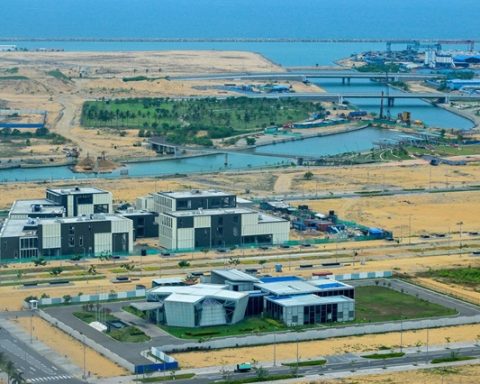
The government must strategically harness private sector partnerships to resuscitate loss-making state entities, while ensuring profitable national assets such as ports remain under state control to prevent predatory privatisation. The irony is that many private sector conglomerates are more eager to take over lucrative industries like ports, while abandoning struggling industries that genuinely require their expertise. This is where the government must shift its approach—prioritising privatisation for ailing sectors while fortifying national control over profitable enterprises. The privatisation myth must not become an excuse for asset-stripping, as has happened in many developing economies.
Drawing lessons from Argentina’s post-default recovery, Sri Lanka must embrace a floating exchange rate regime with controlled capital flows to stabilise the rupee without depleting foreign reserves. The peso crisis of Argentina was met with stringent capital control measures while allowing for gradual market-based adjustments, preventing speculative haemorrhaging. A similar model for the rupee could allow Sri Lanka to stabilise its currency without recurrent IMF bailouts that come with debilitating austerity conditions.
The obsession with traditional taxation mechanisms must be abandoned in favour of supply-side economic reforms. Taxing a diminished and overburdened private sector into oblivion is a suicidal approach that will only exacerbate capital flight. Instead, Sri Lanka must adopt territorial taxation—a model successfully implemented in Singapore and Hong Kong—where only domestic income is taxed while offshore earnings remain untapped, incentivising repatriation of wealth. Additionally, a flat corporate tax of 15% should be introduced to undercut regional competitors and attract foreign direct investment, providing a desperately needed capital influx into the economy.
An export-oriented economic model should be aggressively pursued, drawing from the post-1997 recovery of South Korea, which harnessed its industrial capacity to transform into a manufacturing and technology juggernaut. The government must facilitate a radical industrialisation drive, providing tax exemptions and subsidies for manufacturing sectors that have export potential. Special Economic Zones (SEZs), modelled after China’s Shenzhen experiment, should be established to attract multinational firms with investment-friendly regulatory frameworks, streamlined bureaucracy, and infrastructure incentives.
Energy security must be prioritised through an immediate liberalisation of the energy sector. The dependency on fossil fuel imports is a strategic vulnerability, and Sri Lanka must take a cue from Germany’s Energiewende by investing in decentralised renewable energy grids to reduce long-term energy import dependency. Private sector participation should be actively courted in power generation, breaking the monopolistic inefficiencies of the state-owned utilities.
On debt restructuring, Sri Lanka must abandon its servile posture towards international creditors and leverage its strategic geopolitical position to negotiate favourable debt settlements. The aggressive tactics deployed by Malaysia during the 1997 Asian Financial Crisis—where capital controls and selective debt repayment were implemented—must serve as a precedent. The government should pursue haircuts on bilateral debt rather than adhering to punitive IMF-imposed repayment structures, which stifle domestic economic growth. Simultaneously, sovereign debt should be restructured with GDP-linked bonds to ensure repayments remain contingent on actual economic recovery rather than arbitrary deadlines.
The welfare state must be reimagined. The current model of indiscriminate cash handouts and subsidies is a corrosive drain on national resources. Instead, Sri Lanka should adopt conditional cash transfers (CCTs), akin to Brazil’s Bolsa Família programme, which ties welfare benefits to education and health benchmarks. Such a paradigm shift would not only reduce long-term dependency on government support but also incentivise human capital development.
Education reform is paramount. Sri Lanka must transition towards a vocational-centric education system, modelled after Germany’s dual education system, where apprenticeships are integrated into the curriculum. The tertiary education sector should be liberalised, allowing private universities to establish world-class institutions that produce a globally competitive workforce rather than perpetuating an overproduced, underemployed graduate class.
Furthermore, a Sovereign Wealth Fund (SWF) should be established, mirroring Norway’s model, to reinvest profits from Sri Lanka’s mineral and maritime resources into long-term economic sustainability projects. This would allow the government to ring-fence critical national assets while generating passive revenue for future generations.
The post-crisis economic resurrection of Sri Lanka demands radical surgery, not palliative policy tweaks. The era of economic infantilism, where Sri Lanka waits for the next bailout or indulges in misguided protectionism, must end. The nation must summon the audacity to embrace brutal but necessary reforms, dismantle its archaic state structures, and reforge itself as a competitive, investment-driven economy. Failure to do so will not just condemn Sri Lanka to perpetual insolvency—it will entrench its status as a failed state in the global economic order.