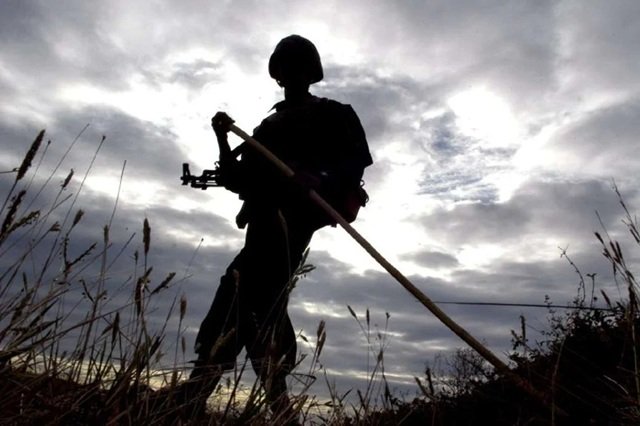
The Army also used mines extensively against the LTTE, particularly through deep-penetration units operating behind enemy lines. Such operations weakened the Tigers’ hold and became so formidable that the Norway-brokered 2002 Ceasefire Agreement included a specific clause addressing them.
At the conclusion of Sri Lanka’s successful war against the separatist Liberation Tigers of Tamil Eelam (LTTE) terrorists, in May 2009, the country faced two daunting challenges. One was rehabilitation of approximately 12,000 surrendered LTTE cadres and clearing the Northern and Eastern areas contaminated with various types of mines and unexploded ordnance.
Restoration of normalcy couldn’t have been achieved without proper rehabilitation of combatants as well as clearing the entire terrain of mines and unexploded ordnance to pave the way for speedy resettlement.
Although the eradication of the LTTE had been a combined security forces effort, the responsibility for the rehabilitation of the ex-LTTEers and clearing of landmines fell on the Army’s Lt. Gen. Jagath Jayasuriya, who succeeded the war-winning Army Commander, Sarath Fonseka, in July 2009. With Jayasuriya, the former Royal College boxing Captain, with a never say die attitude, at the helm, and those on the ground, tasked to carry out post-war operations, proceeded speedily and methodically. The international community essentially backed both projects. Sri Lanka couldn’t have achieved success without their support.
This was despite a section of the global community, leaning to the West exerting crude pressure on Sri Lanka, on the basis of unsubstantiated war crimes allegations, then President Mahinda Rajapaksa pressed ahead with both rehabilitation and mine clearing operations. Some of those who turned a blind eye to the military threat posed by the LTTE, and terrorism perpetrated by the group, continued to undermine Sri Lanka’s efforts, but a determined political leadership was in overdrive.
It would be pertinent to mention that the country, at that time, was in deepening political turmoil, consequent to the 2010 presidential election won by then incumbent President Mahinda Rajapaksa, and the arrest of the defeated common candidate Sarath Fonseka, mostly due to his foul mouth ahead of the 2010 parliamentary elections.
To pile on the pressure on those who pulled off the victory that the so-called experts said Sri Lanka was incapable of achieving by crushing the Tigers in the battlefield, in the following year, the United Nations Human Rights Council (UNHRC) serving as the cat’s paw of the spurned West, caused unprecedented turmoil when it blindly accused Sri Lanka of killing 40,000 Tamil civilians during the last phase of the offensive.
Instead of supporting post-war rehabilitation and resettlement, Geneva pursued a highly hostile campaign against Sri Lanka. The US and UK wholeheartedly backed the project to undermine Sri Lanka’s efforts to bring about reconciliation.
Against that background, let me discuss Golden Globe, Emmy, and Olivier Award-winning actress Rosamund Pike’s recent visit to Mannar and Mullaitivu minefields in support of Mines Advisory Group (MAG) engaged in clearing operations in Sri Lanka.
The British High Commission (BHC), on 7 August, issued a statement quoting High Commissioner to Sri Lanka Andrew Patrick as having said: “Sri Lanka’s progress towards becoming landmine-free is a remarkable achievement, made possible by the courage and dedication of Sri Lankan deminers, the leadership of the Government of Sri Lanka, and the support of international partners. The United Kingdom is proud to have supported this important work.
The BHC statement coincided with MAG Ambassador Rosamund Pike’s visit meant to mark the clearance of one million landmines since the end of war. According to the BHC, Pike’s visit underscored the remarkable progress made by Sri Lanka’s mine-action sector and the importance of maintaining momentum towards the country’s goal of becoming landmine-free.
Rosamund Pike was quoted as having said: “Having seen MAG’s work all over the world, I am always struck when the necessity for mine clearance and risk education follows civil war. There is a sense of reconciliation in restoring the land to safety. MAG’s programme in Sri Lanka inspires me for its courageous teamwork and moral integrity, providing superb training for deminers to do this dangerous work, with strict safety protocols and building a sense of family within the organisation.”
BR leads Uthuru Wasanthaya
Then Economic Development Minister Basil Rajapaksa, in his capacity as the head of the Presidential Task Force responsible for major resettlement, reconstruction, and development initiatives in the Northern Province, following the war, worked overtime to speed up the process. Whatever the accusations regarding corruption and abuse of political power directed at Basil Rajapaksa, the parliamentarian played a significant role in the much touted project called Uthuru Wasanthaya.
Corps of Engineers of the Sri Lanka Army spearheaded the effort. The others involved in mine clearing operations were DASH, HALO Trust, MAG, SHARP, DDG, NPA, Horizon, JCCP, MMIPE, RONCO, Sarvatra and FSD. The recovered items were categorised as anti-personnel mines, anti-tank mines, Unexploded Explosive Ordnance and small arms ammunition. At any given time of the hazardous operations, the Corps of Engineers had cleared more than double the recoveries made by all other agencies.
One-time Chief Field Engineer retired Maj. Gen. Udaya Nanayakkara told The Island that the country could quite rightly be proud of its achievements in post-war mine clearing, as well as rehabilitation of ex-combatants. The wartime Military Spokesman emphasised the pivotal importance in mine clearing and rehabilitation which he described as a prerequisite for meaningful post-war reconciliation.
In spite of constantly harassing Sri Lanka with fictitious and unsubstantiated war crimes allegations, the United Nations, too, grudgingly acknowledged the progress on the ground as the Rajapaksas sustained the momentum. However, there had been excesses on the part of the military and police.
The wartime Defence Secretary Gotabaya Rajapaksa threw his full weight behind the operations that President Mahinda Rajapaksa took a personal interest in both initiatives – namely rehabilitation of ex-combatants and mine clearing operations. They didn’t allow continuing political turmoil to derail post-war reconciliation efforts. Sri Lanka not only rehabilitated ex-terrorists and made the Northern and East land safe for resettlement, the political leadership ensured that the military-held areas were gradually released. During the 2009-2026 period, successive governments released nearly 70,000 acres. The military now retained the bare minimum land in line with overall security requirements.
The government ensured the participation of the international community in the projects. Senior Colombo-based diplomats and representatives attended the regular progress meetings of the National Mine Action (NMA) programme. The meetings were held under the leadership of Basil Rajapaksa.
A government statement quoted the UN Resident Representative, Subinay Nandy, as having told a progress review meeting of the NMA, in August 2012:
“Sri Lanka has achieved excellent results in the demining. The country can complete the demining process soon in continuing the present institutional setup and machinery. The work carried out by the Ministry and the centre in this humanitarian movement is tremendous and now Sri Lanka can share its demining experience with other countries,”
But, in spite of various predictions made by successive governments and external parties regarding early conclusion of mine clearing operations, work dragged on. Multiple assertions were proved wrong.
Although the rehabilitation of ex-combatants had been completed years ago, mine clearing activity that began earnestly, after the end of the war, continues even today, under the political leadership of the ruling National People’s Power (NPP) government.
Pike, during her short visit here, paid a courtesy call on Prime Minister Dr. Harini Amarasuriya. A selected group of persons were also invited to meet the actress at the British High Commissioner’s residence (Westminster House, Wijerama Mawatha) but, unfortunately, none represented the Army that spearheaded the operation and did the lion’s share of the work. The whole exercise seemed questionable as the notable achievement of clearing one million mines in Sri Lanka cannot be celebrated, under any circumstances, without the Army’s yeoman participation. In fact, the BHC statement, dated 7 August, conveniently left out the Army. Only a section of the media received an invitation to the special event at the HC’s residence where Pike declared that MAG and others cleared one million mines.
Sri Lanka should have celebrated the momentous occasion as the eradication of terrorism, once sponsored by India, with the able backing of a section of the Western countries, is undoubtedly the country’s greatest post-independence achievement. What made our government and the Army forget their responsibility to mark this occasion of immense national significance?
India, UK roles
Having launched the Sri Lanka destabilisation project, in the early ’80s, India introduced landmines as New Delhi stepped up pressure on the Sri Lankan military and police. Their agenda was clear. In line with their overall strategy to expand terrorist operations, the movements of armed forces and police had to be curtailed drastically.
The first major landmine blast, and small arms attack on two light vehicles in Tirunelveli, Jaffna, on the night of 23 July, 1983, set the country ablaze. The country’s then ceremonial Army couldn’t stomach the deaths of 13 men of the Light Infantry Regiment. The Army went on the rampage in the Thirunaveli area. In other parts of the country ordinary Tamil civilians were set upon by mainly Sinhala mobs, also comprising sprinklings of Muslims, especially from Colombo slums, more to get rich by grabbing whatever valuables belonging to fleeing Tamils. President JRJ administration virtually got paralysed by the audacity of the operation, targeting an Army patrol, and allowed the attacks on Tamil civilians that followed as if to assuage the rising anger in the South. Or, was it a deliberate way of warning the Tamils to behave by the President? Had the government promptly intervened and easily nipped the violence in the bud, a major catastrophe, that scarred the whole nation, could have been averted. The Government was so paralysed, deliberately or not, it was left to the duty conscious ordinary Sinhalese to save besieged Tamils by helping them to reach safety as often the police either turned a blind eye to what was happening or they simply failed to act or were busy helping looters
India achieved its despicable objective. Overnight, Sri Lanka’s security crisis received the attention of the West. The UK stepped in. Successive British governments turned a blind eye to senseless violence perpetrated by Indian-sponsored terrorists, gave them sanctuary and, most importantly, created an environment for separatist movement to engage in a massive fund raising campaign in the West that sustained the separatist project here.
The UK played a Jekyll-and-Hyde role that solidly backed the separatist movement, though its retired Special Air Services (SAS) personnel were allowed to train the paramilitary arm of the police, the Special Task Force, to counter the growing threat from terrorists. The UK went to the extent of giving British citizenship to one-time British High Commission employee, Anton Balasingham, who served as the theoretician to the LTTE terrorist movement. This writer interviewed him in Colombo in 1989.
The British knew that funds raised in the UK, in other European countries, and various other parts of the world, were used to procure armaments. Among the LTTE’s arsenal, various types of mines played a crucial role in the overall strategy. MAG and other British mine clearing organisations, like HALO Trust, launched mine clearing operations here consequent to the signing of the Norway-facilitated Ceasefire Agreement (CFA) that recognised an LTTE controlled region in the Northern and Eastern regions. The CFA came into being on 21 February, 2002.
Addressing the gathering at the BHC’s residence, Pike declared that MAG and others had cleared one million mines since the end of the war. The Sri Lanka Army, responsible for clearing more than half of the mines, etc., was simply ignored, other than MAG. Since the mine clearing operations began, 90 percent of the contaminated land had been cleared and, as Pike declared, just 21 square kms, or an area the size of half of the Colombo City, remained to be cleared.
As expected, Pike appealed for more funding for MAG. The world must not forget that India, that trained terrorists in the deployment of mines, and Western countries, including the UK, responsible for funding that enabled the acquisition of explosives and technology, should be held responsible for the deaths and injuries caused by them.
HALO Trust several years ago declared that it cleared over 60,000 mines from the Muhamalai frontlines, extending from Kilali to Nagarkovil, on the Vadamarachchi east coast. The Army, and the LTTE-held strongpoints, in this vital sector, with the largest concentration of mines, meant to prevent each other from breaking out. The HALO Trust claim of recovering over 60,000 mines in the Muhamalai sector underscored the gravity of the situation. The British mine clearing organisation is on record as having said that the cleared area in Muhamalai was roughly three times the size of the New York Central Park.
That HALO Trust statement is evidence of the unprecedented challenge faced by Sri Lanka in clearing mines. Those who repeatedly demand accountability on the part of Sri Lanka for unsubstantiated war crimes conveniently forgot that landmines were introduced by India and such operations were sustained by funding from the West. The UK must have been one of the largest funders, if not the largest funder, of the terrorist project here throughout the conflict. The UK involvement was so deep, the LTTE was allowed to operate freely, in the UK, even after the Tigers assassinated former Indian Prime Minister and Indian Congress Party leader Rajiv Gandhi.
How long those engaged in mine clearing operations here need to complete the job. Some of the mine clearing operators, who had been active here, terminated their operations years ago. Readers would be interested to know that Indian Sarvatra and Horizon groups, led by retired Indian military officers, were brought in by the then Minister Milinda Moragoda’s MMIPE. They moved in about a year after Norway arranged CFA and suspended operations as hostilities erupted following the 2005 presidential election that set the stage for Eelam War IV. Deployment of Indian mine clearing organisations cannot be discussed without taking into consideration that India introduced landmine warfare and they paid a heavy price when the LTTE used the same with devastating success against the Indian Army deployed here to implement the Peace Accord, signed in July 1987. Of nearly 1,500 Indian officers and men killed and nearly 3,000 others wounded here, among them there were probably hundreds of deaths and injuries due to mines.
Mine blasts shatter CFA
The LTTE suspended mine attacks following the 2002 CFA, arranged by Norway. That arrangement had the backing of the US, EU and Japan as well. Although the UK didn’t join Sri Lanka Peace Co-Chairs, the British backing for the Norway-led initiative was known. So much so, the British facilitated a secret meeting between UK citizen Balasingham and top level Norwegian facilitators, following the LTTE assassination of Foreign Minister Lakshman Kadirgamar, in August 2005.
The LTTE resumed mine attacks in December, 2005, just weeks after Mahinda Rajapaksa won the 2005 presidential election. A series of blasts in the Jaffna peninsula claimed the lives of 15 soldiers in early December, 2005. The Norway-led Sri Lanka Monitoring Mission (SLMM) commended the military for its restraint but it conveniently failed to condemn the LTTE. Australia was the only country that unreservedly condemned the mine attacks.
The LTTE mounted mine attacks outside the Jaffna peninsula. The Navy was also targeted in the northwestern Mannar region. The LTTE set the stage for Eelam War IV with mine blasts that threatened to overwhelm the military. The claymore mine and rocket propelled grenade attack on the Navy, in December, 2005, sent shockwaves through the military establishment. The LTTE stepped up pressure on the newly elected Rajapaksa government, struggling to cope up with the unexpected and extraordinary threat.
In the first week of January, 2006, the LTTE launched a suicide attack on a Navy Fast Attack Craft (FAC) off Trincomalee in Koddiyar Bay. Thirteen naval personnel on board perished in the attack.
Neither the LTTE nor its supporters ever expected the combined armed forces to sustain the offensive action for nearly three years. During that period, the LTTE suffered a spate of irreversible setbacks, leading to the collapse of their strongpoints, south of heavily mined Muhamalai frontlines. The Task Force 1/58 Division attacking northwards, from Paranthan, made the LTTE positions at Muhamalai untenable. Their minefields, meant to deter the Jaffna-based fighting formations, namely the 53 and 55 Divisions, were largely rendered useless and the collapse of the formations deployed at Muhamalai.
The LTTE, surrounded in the Vanni east and unable to open a sea escape route, due to heavy Navy presence, collapsed within months. Velupillai Prabhakaran’s death was inevitable. Had he survived under any circumstances, national reconciliation would never have been a reality. Rehabilitation of ex-combatants and successful clearing of mines enabled the post-war national reconciliation process, though the ITAK sought to derail the process at every turn. The Tamil Diaspora, too, targeted the national reconciliation process.
The alleged attempt to assassinate an ITAK parliamentarian, during the Yahapalana administration, emphasised the threat posed by those who still believed in violence. The group, hired by the Diaspora, planned to trigger a claymore mine blast, targeting Sumanthiran’s vehicle on the Soranpatru-Thaalayadi road, in the Jaffna peninsula. The Police Terrorism Investigation Department (TID) uncovered the plot. There hadn’t been any other incident in which any type of mine was used/or planned to be used in the post-war period.
Sri Lanka needs to remain in a high state of alert as there can be interested parties hell-bent on causing mayhem.