The cosmos, once the frontier of human imagination and scientific ambition, is now an active domain of geopolitical contestation. Space-enabled services are woven into the fabric of civilian and military life, dictating the pace of modern warfare and global security. The ongoing Russia–Ukraine War provides a stark illustration of how space technologies have evolved into instruments of strategic advantage, increasing unpredictability, ambiguity, and, ultimately, the potential for escalation. Despite this, the international community remains without a cohesive understanding of escalation risks in space—a dangerous oversight given the increasing militarization of this domain.
The Stockholm International Peace Research Institute (SIPRI) identifies four fundamental parameters to assess these escalation risks: the target, the capability used, the effect, and the consequences. This framework provides a systematic approach to evaluating space-related threats and their potential to trigger broader conflicts. It also informs recommendations aimed at minimizing the risks inherent in space warfare, urging a global reckoning with the responsibilities that come with leveraging outer space for military and strategic gains
A New Dimension of Warfare: The Military’s Increasing Reliance on Space
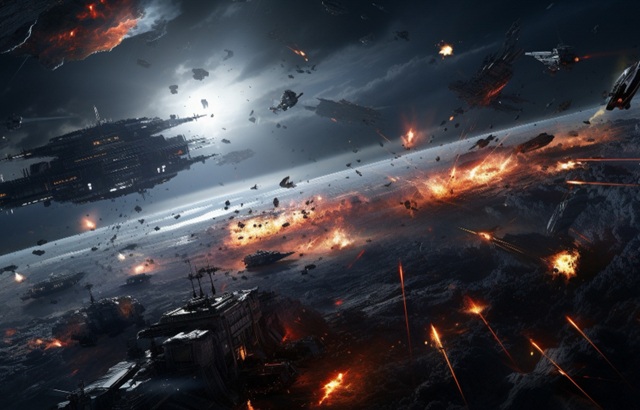
Modern warfare is no longer confined to land, air, and sea—it extends to the exosphere. Technological advancements in artificial intelligence (AI), cyberspace, and outer space have revolutionized military operations, allowing for precision targeting, enhanced surveillance, and the synchronization of complex combat systems. These technologies, while bolstering national defense strategies, have also deepened the scope for misinterpretation, miscalculation, and escalation
One of the most striking examples is the integration of commercial space assets into military operations. In Ukraine, commercial satellite constellations provided by private companies have been instrumental in enabling battlefield awareness and communications. Unlike traditional military assets, these commercial space systems exist in a legal and strategic gray zone—an ambiguity that adversaries could exploit to justify countermeasures, potentially triggering unforeseen escalation
The Fragility of Space Stability: Ambiguity and the Arms Race
The growing number of actors in space—ranging from state militaries to private enterprises—has created a competitive and unstable environment. Many states have developed capabilities to disable, disrupt, or destroy adversaries’ space assets. From cyberattacks targeting satellite networks to the testing of anti-satellite (ASAT) weapons, these actions erode the predictability that once defined space as a relatively stable domain
This unpredictability is exacerbated by the lack of a universally agreed-upon escalation threshold. What one state may perceive as a defensive maneuver—such as the positioning of a satellite in close proximity to another—could be seen by an adversary as a prelude to an attack. Without clear mechanisms for communication and de-escalation, these scenarios could rapidly spiral into direct confrontation
The Environmental and Civilian Costs of Space Conflict
Beyond its military ramifications, conflict in space carries profound consequences for civilians and the environment. Attacks on space systems could disrupt critical infrastructure such as GPS, financial networks, weather forecasting, and emergency communications. In the absence of international consensus on protecting civilian space assets, states may perceive non-kinetic cyberattacks or electronic warfare as acceptable strategies, further normalizing their use in conflicts.
The environmental toll of space warfare is equally alarming. Destroying satellites produces vast fields of orbital debris, jeopardizing the long-term sustainability of space activities. History offers cautionary examples: in 1978, the Soviet Union’s nuclear-powered Cosmos 954 satellite reentered Earth’s atmosphere, scattering radioactive debris over Canada’s Northwest Territories. The cleanup effort spanned years and required international cooperation—a grim precedent for the potential fallout of future space conflicts
The Parameters of Escalation: A Framework for Stability
Understanding and mitigating space escalation requires a structured approach. The four key parameters—target, capability, effect, and consequence—help evaluate the potential severity of a space-related incident.
- The Target
The strategic significance of the targeted space asset determines the gravity of an attack. Striking a nuclear command, control, and communications (NC3) satellite, for instance, would be profoundly escalatory, as it could be construed as an act of war against a state’s nuclear deterrent capabilities. Conversely, interfering with a commercial satellite may elicit a less severe response but could still provoke retaliatory measures
- The Capability Used
The means through which an attack is conducted also influences the perception of escalation. A kinetic ASAT strike, which physically destroys a satellite, is likely to be interpreted as more aggressive than a cyberattack that temporarily disrupts its function. However, even non-kinetic attacks, such as jamming or spoofing, can have severe implications if they interfere with military operations or civilian infrastructure
- The Effect
The immediate and lasting consequences of an attack shape its escalatory potential. If an action generates significant collateral damage—such as widespread space debris or disruption of global positioning systems—it is more likely to provoke retaliatory measures. Understanding these effects allows policymakers to calibrate their responses appropriately
- The Consequences
Finally, the broader geopolitical repercussions must be considered. An attack on a space system could have cascading effects, drawing multiple actors into conflict. If a satellite supporting humanitarian operations is targeted, for example, it could generate international condemnation and compel third-party states to intervene
Urgent Imperatives: Recommendations for De-escalation
To prevent space from becoming the next battleground, proactive measures must be taken to manage risks and establish clear norms of engagement.
- Limit Attacks on Strategically Significant Systems
States must explicitly define which space systems are off-limits in conflicts, particularly those linked to nuclear command and early-warning systems. Establishing political or legal commitments to protect such assets would reduce the likelihood of catastrophic escalation
- Foster Transparency on Critical Infrastructure
Governments should engage in bilateral and multilateral dialogues to identify space assets that provide essential services. Creating mechanisms for advance notification of maneuvers near critical satellites would help build trust and prevent miscalculations
- Define and Deter Highly Escalatory Acts
Characterizing specific space-related actions as particularly escalatory—such as nuclear detonations in orbit or attacks on humanitarian satellite services—can help establish red lines. International consensus on these issues would provide a foundation for de-escalation
- Strengthen Civilian Space Resilience
Governments and private actors should invest in redundancies and resilience measures for civilian space systems. This includes hardening satellites against cyber threats and ensuring backup communication networks in the event of disruptions
- Hold Private Actors Accountable
As commercial space enterprises play an increasing role in military conflicts, clearer frameworks for their accountability must be established. Spacefaring nations should ensure that companies providing critical space-based services adhere to international legal obligations
A Precipice Worth Avoiding
Space, once an untamed frontier, is now the domain of power politics, military strategy, and national security. The rapid weaponization of this domain presents existential risks that cannot be ignored. Without clear frameworks for mitigating escalation, humanity risks stumbling into conflicts that could have catastrophic consequences not only for warring states but for all spacefaring nations and future generations.
Recognizing and addressing these risks is no longer an abstract concern—it is an urgent imperative. The future of global security may depend on our ability to establish stability in the most volatile frontier of all.