


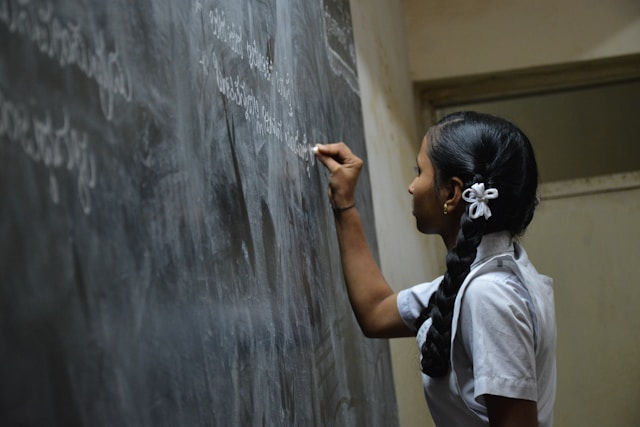
If you talk to a man in a language he understands, that goes to his head. If you talk to him in his language, that goes to his heart. ~ Nelson Mandela
International Mother Language Day (IMLD) falls on 21 February each year, and this year marks the silver jubilee of this special day.
Proclaimed by UNESCO and subsequently endorsed by the United Nations General Assembly, International Mother Language Day underscores the indelible role of language in fostering inclusivity and in the broader pursuit of the Sustainable Development Goals. Multilingual education is a linchpin of equitable educational access, ensuring the perpetuation of non-dominant, minority, and indigenous languages while simultaneously advancing lifelong learning opportunities for all.
Language constitutes an indispensable pillar of both education and sustainable development, serving as the principal conduit for the transmission of knowledge and the preservation of cultural identity. In a world where linguistic diversity manifests in approximately 8,324 languages, the inexorable forces of globalization and socio-political change have placed many of these languages in peril, threatening their continued existence. Given this reality, the imperative to safeguard the right to education in one’s mother tongue is fundamental to enhancing learning outcomes. Empirical evidence suggests that students instructed in a language they fully comprehend demonstrate superior cognitive engagement, retention, and analytical acumen. The provision of multilingual education—particularly in the context of minority and indigenous languages—establishes a critical nexus between pedagogy and cultural heritage, thereby fostering inclusivity and equity within societies.
The 25th anniversary of International Mother Language Day stands as a testament to a quarter-century of dedicated efforts aimed at preserving linguistic plurality and promoting mother tongues as vehicles of cultural continuity. This milestone reaffirms the crucial role of language preservation in fortifying cultural heritage, advancing educational efficacy, and contributing to societal harmony.
How did it Come About?
UNESCO proclaimed IMLD on 17 November 1999, with the first observance taking place on 21 February 2000. The adoption of this day was rooted in the tragic events of 21 February 1952 in Dhaka, Bangladesh (then East Pakistan), where students protesting for the recognition of Bengali as an official language were shot and killed. Their sacrifice underscored the profound emotional and political significance of mother tongues, setting in motion a global movement to safeguard linguistic heritage.
In the modern era, however, defining a “mother language” has become increasingly complex due to globalization, migration, and multicultural societies. Traditionally, the mother tongue is the first language a child is exposed to, often learned from the primary caregiver. Yet, in contemporary society, where interethnic marriages, multilingual households, and transnational mobility are commonplace, determining one’s mother tongue is far from straightforward.
The Complexity of Defining a Mother Language in a Multilingual World
Consider the case of a child born to a Sinhalese mother and a German father, residing in Australia, where the linguistic environment is shaped by the confluence of Sinhala, German, and English. What, then, would constitute this child’s mother language? The answer is neither singular nor absolute. If both parents interact with the child in their respective native tongues while the external environment is predominantly English-speaking, the child may develop a composite linguistic identity, wherein all three languages coexist with varying degrees of fluency and emotional attachment. The mother tongue, in this context, could be determined by the language in which the child feels most at ease expressing emotions, forming thoughts, and conceptualizing the world.
Similarly, a child born to Italian parents residing in Quebec, where Italian is spoken at home but French dominates the external linguistic landscape while English serves as an additional communicative medium, faces a similar conundrum. Should the mother tongue be Italian, given the familial heritage? Or should it be French, the language of education and social integration? Perhaps English, as the language of global interaction, will hold primacy in shaping the child’s cognitive processes. The fluidity of linguistic identity suggests that a rigid definition of mother tongue fails to capture the lived realities of modern multilingualism.
The Implications of Multilingualism on Education and Identity
The implications of multilingualism extend beyond mere linguistic categorization to issues of cognitive development, educational policy, and cultural continuity. Research has shown that early exposure to multiple languages enhances cognitive flexibility, problem-solving abilities, and metalinguistic awareness. However, challenges arise when educational systems fail to accommodate linguistic diversity, thereby disadvantaging children whose primary language of thought differs from the language of instruction.
UNESCO has long advocated for mother-tongue-based multilingual education, positing that instruction in one’s native language during early childhood enhances learning outcomes and facilitates deeper conceptual understanding. Yet, practical considerations, such as teacher availability, curriculum development, and sociopolitical resistance to minority languages, complicate implementation. In postcolonial societies, where linguistic hierarchies persist, the dominance of former colonial languages in education systems often marginalizes indigenous and minority languages, leading to cultural erosion and identity loss.
The Intersection of Language, Politics, and Cultural Survival
Language is inextricably linked to political power. The struggle for linguistic rights has historically been intertwined with broader movements for self-determination, national identity, and human rights. In Canada, for instance, the linguistic divide between English and French has shaped the country’s political landscape, with Quebec fiercely defending the primacy of French through legislation and cultural policies. In contrast, countries such as India embrace linguistic plurality by granting official status to multiple languages, reflecting the diversity of their populace.
Yet, globalization exerts a homogenizing pressure, privileging dominant languages such as English, Mandarin, and Spanish at the expense of lesser-spoken tongues. Digital communication, mass media, and international commerce reinforce linguistic consolidation, making it increasingly difficult for minority languages to survive. The extinction of a language signifies not merely the loss of words but the disappearance of an entire worldview, cultural expressions, and traditional knowledge systems.
The Role of International Mother Language Day in Preserving Linguistic Diversity
IMLD serves as a global platform to raise awareness of linguistic rights and promote policies aimed at language preservation. It calls upon governments, educators, and civil society to take concrete measures in supporting multilingual education, encouraging linguistic research, and fostering an appreciation for linguistic diversity.
In a world where approximately 40% of the 8,324 recorded languages are endangered, efforts to document, revitalize, and institutionalize minority languages are crucial. Indigenous languages, in particular, hold ecological, historical, and philosophical knowledge that, once lost, can never be recovered. Initiatives such as language revitalization programs, bilingual education models, and digital archiving play a pivotal role in countering linguistic extinction.
The Future of Linguistic Identity in an Evolving World
As the world becomes increasingly interconnected, linguistic identities will continue to evolve in ways that challenge traditional definitions of the mother tongue. Future generations may grow up with hybrid linguistic identities, shaped by personal experience rather than strict national or ethnic affiliations. This evolution need not be seen as a loss but rather as an enrichment, wherein multiple languages coexist and interact dynamically.
Ultimately, the essence of International Mother Language Day lies in fostering respect for linguistic diversity, ensuring that all individuals have the right to learn, communicate, and express themselves in the language that resonates most deeply with their identity. As societies navigate the complexities of globalization, migration, and technological advancement, the preservation of linguistic diversity remains an essential pillar of cultural heritage, education, and social inclusion.
Through collective effort, the ideals of International Mother Language Day can be realized, ensuring that future generations inherit a world where linguistic plurality is not only recognized but celebrated.
My Take
An apocryphal anecdote goes to say that Rabindranath Tagore once composed a song for Mahatma Gandhi in Tagore’s native Bengali, urging him to use his struggle as a means to unite humanity through a common spirit of justice and dignity. In a moment of humility, Gandhi acknowledged that while he could not claim to possess the literary brilliance of Tagore, he understood the power of language in mobilizing and uniting people, be it in Bengali or Urdu. This dialogue serves as an allegory for the essence of International Mother Language Day—a day that stands as a call to action, imploring societies to recognize the inextricable link between language, identity, and dignity. Just as Gandhi and Tagore understood that the soul of a people is embedded in its language, so too must the world today acknowledge that linguistic diversity is a universal heritage that must be preserved for the enrichment of future generations. By upholding the sanctity of all languages, humanity ensures that no culture, no identity, and no voice is ever rendered silent.












