by Satchi
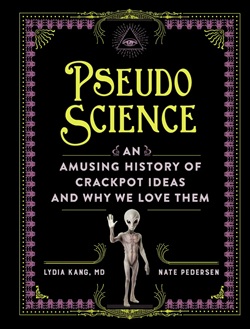
In Pseudoscience, Lydia Kang and Nate Pedersen present a fascinating exploration of the enduring allure of false scientific beliefs and the persistent myths that continue to shape human understanding. This engaging book dives into the history of pseudoscientific ideas, debunking theories that have captivated the human imagination for centuries. Blending humour with sharp analysis, Kang and Pedersen skilfully dissect some of the most bizarre, harmful, and surprisingly influential pseudoscientific claims throughout history.
The authors open with a powerful reflection on human curiosity and our vulnerability to unproven beliefs. Quoting Carl Sagan, they remind readers of the importance of evidence: “Really, it’s okay to reserve judgment until the evidence is in” (p. 15). This sentiment sets the tone for the book’s broader argument: while the human impulse to believe is natural, it is essential to differentiate genuine science from fiction. The introduction highlights the dangers of thinking with emotion rather than reason, cautioning that “thinking with anything besides my brain, as tempting as that might be, is likely to get me into trouble” (p. 13).
One of the book’s strengths lies in its thematic structure, categorising pseudoscientific ideas into sections such as Pure Nonscience, Aliens! Ghosts! Bigfoot! Atlantis!, Wishful Thinking, and Grifters, Nihilism, and Denialism. Each chapter dissects a specific myth or conspiracy theory, providing both historical context and scientific reasoning for its implausibility.

The chapter on Flat Earth is particularly compelling. The authors recount the extraordinary tale of Mike Hughes, a daredevil determined to prove the Earth was flat by launching himself into the sky via a homemade rocket. Hughes famously stated, “I really don’t believe in science. I believe in formulas, some math… I just want the raw truth” (p. 47). His tragic end underscores the dangers of clinging to unfounded beliefs, yet Kang and Pedersen approach his story with empathy and wit, noting how his quest for truth led him down a perilous path.
Kang and Pedersen delve deeply into the historical roots of the flat Earth belief, tracing its origins back to ancient civilisations and figures such as Aristotle. They highlight how erroneous beliefs can persist even when overwhelming evidence contradicts them, explaining that “Despite all scientific proof to the contrary, let’s be honest—the Earth really does seem kind of flat” (p. 34). This observation captures the book’s nuanced approach, acknowledging the intuitive appeal of pseudoscience while simultaneously dismantling it with logic and evidence.
Another particularly fascinating chapter explores Spontaneous Human Combustion, an idea that has fascinated the public for centuries. The book recounts the famous case of Countess Cornelia Zangheri Bandi in 1731, whose mysterious death left behind “a heap of ashes, two legs untouched, and a greasy and stinking moisture” (p. 102). The authors methodically debunk the theory of spontaneous combustion, offering a scientific explanation in the form of the wick effect, where the body fat acts as fuel for a prolonged burn. They note, “The horrific deaths attributed to spontaneous human combustion typically occur among people who are older, who are living alone, and who don’t have anyone nearby to help” (p. 118), subtly pointing out how loneliness and neglect contribute to these tragic events.
In the section on Wishful Thinking, Kang and Pedersen tackle popular yet unfounded beliefs such as astrology and cryonics. Their discussion on astrology is both entertaining and insightful, highlighting how this ancient practice has maintained its cultural relevance despite lacking scientific merit. They write, “Astrology appeals to our desire for control in an unpredictable world, offering explanations for events beyond our understanding” (p. 145). The enduring popularity of horoscopes, despite scientific dismissal, illustrates how pseudoscience can persist due to emotional and psychological factors rather than empirical evidence.
Equally intriguing is their analysis of Cryonics, the belief that freezing the human body can preserve life until future scientific advancements enable revival. The authors cleverly critique this idea, stating, “While the dream of eternal life is tantalising, cryonics remains a fantasy rooted more in science fiction than scientific fact” (p. 152). This chapter underscores humanity’s enduring fascination with overcoming mortality, a theme that runs throughout the book.
The authors also address darker and more harmful pseudoscientific beliefs in the section titled Grifters, Nihilism, and Denialism. Here, they tackle issues such as climate change denial and conspiracy theories surrounding the moon landing. They cite research indicating that “roughly 50 percent of the American population believes in at least one thoroughly debunked conspiracy theory” (p. 178), highlighting the pervasive influence of misinformation. The authors argue that these beliefs are often driven by psychological needs for control and identity, stating, “Staking a claim where you feel like you really know the truth… helps create your identity” (p. 180).
One of the book’s most enlightening aspects is its historical depth. Kang and Pedersen trace pseudoscientific beliefs across centuries, from ancient auguries to modern conspiracy theories. This historical perspective allows readers to see how pseudoscience often evolves with societal changes. For instance, the chapter on Perpetual Motion Machines reveals humanity’s age-old desire for unlimited energy. The story of Charles Redheffer, who falsely claimed to have invented such a machine, illustrates how fraudsters have capitalised on scientific ignorance for personal gain. The authors note, “The dream of perpetual motion persists to this day because it epitomises an urge we all have: to get something for nothing” (p. 223).
Throughout the book, Kang and Pedersen balance humour with gravity. While the tone is often light-hearted, especially in discussions of UFOs and cryptozoology, the authors never lose sight of the potential harm pseudoscience can cause. They remind readers that “Pseudoscientific ideas deployed to spread hate and suppress marginalised communities must be addressed with respect and seriousness” (p. 10). This acknowledgment of the darker side of pseudoscience adds depth and credibility to their analysis.
The book concludes with a powerful call for critical thinking and scientific literacy. Kang and Pedersen stress the importance of scepticism and evidence-based reasoning, urging readers to question information and seek out reliable sources. They write, “The next time pseudoscience feels like it’s raging all around you, pause for a minute, think with your brain, reserve judgment, and wait for that evidence to come in” (p. 195). This message is particularly relevant in today’s information-saturated world, where misinformation can spread rapidly through social media.
One of the most enjoyable elements of Pseudoscience is its accessibility. Kang and Pedersen write with clarity and wit, making complex scientific concepts understandable for a general audience. Their engaging storytelling, combined with meticulous research, creates a book that is both entertaining and educational. The inclusion of historical anecdotes, such as Charles Dickens’s fascination with spontaneous combustion and the humorous but tragic tale of Mad Mike Hughes, adds colour and depth to their analysis.
However, some readers may find the light-hearted tone diminishes the gravity of certain subjects, particularly in chapters addressing harmful beliefs like climate change denial. Yet, Kang and Pedersen strike a careful balance, using humour to engage readers without trivialising the potential consequences of pseudoscientific thinking.
Pseudoscience by Lydia Kang and Nate Pedersen is a captivating and insightful examination of humanity’s enduring attraction to unproven beliefs. With a perfect blend of humour, historical analysis, and scientific reasoning, the authors illuminate the dangers and absurdities of pseudoscience while encouraging readers to embrace critical thinking. As they poignantly remind us, “It’s okay to be uncertain. It’s healthy to be a little bit sceptical” (p. 199). This book is essential reading for anyone interested in understanding the human psyche, the evolution of scientific thought, and the importance of evidence in a world increasingly vulnerable to misinformation.