It is only a guess, but it could be more than that. Trump and Putin are engaged in negotiations over Ukraine and European security. The tea leaves say that this is being done in a separate channel, and neither side will reveal what is going on. The talks are far advanced, Zelensky is in Washington to be briefed on the deal, and Shoigu has been sent urgently to Beijing, partly to assure the Chinese.
We know this from interpreting what is going on.
The most important comes from President Trump. He says that the talks on Ukraine are “advanced” and that his counterpart, Vladimir Putin is “acting well.”
Officially there has been only one meeting between Russia and the United States concerning Ukraine and European security. That took place in Riyadh. Following comments made by Russian Foreign Minister Lavrov, the meeting was exploratory and no specific solutions were tabled by either side. Russia’s spokesman Dmitry Peskov has said that so far no specific proposals have been discussed by Russia and the United States.
We can rule out the meeting in Istanbul between representatives of the US and Russian diplomatic community. That meeting was the first of a series to try and resolve problems involving the US embassy in Moscow and the Russian embassy in Washington. One of the outcomes of the Riyadh meeting was to try and sort out diplomatic ties between the two countries.
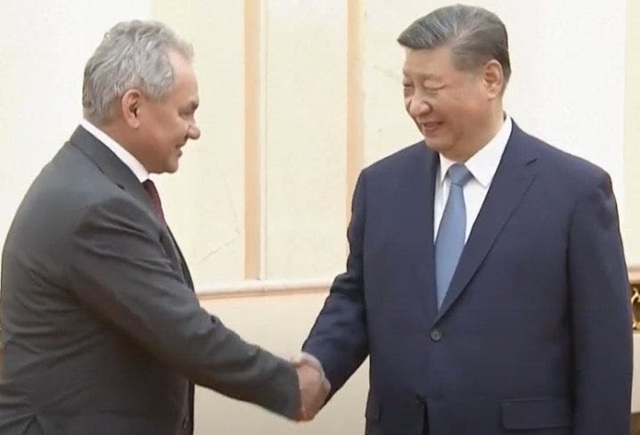
Riyadh also said that a special high level team would be formed “to negotiate a settlement to the war in Ukraine.” It is likely both sides did form such a team, but it isn’t clear who the team members are for either side. One signal of interest: Sergei Shoigu, the former Russian Defense Minister who now heads the Security Council of the Russian Federation, who was on an Asian tour, diverted to Beijing at the request of Russian president Putin. There he met with Chinese Foreign Minister Foreign Minister Wang Yi and afterwards with Chinese President Xi Jinping.
As a matter of protocol it is unusual for the President of a country to meet with a second-echelon official, but it seems Shoigu was bringing an important message to Xi. We know that Shoigu’s meeting was a follow-up to a phone conversation between Xi and Putin a day earlier in which Xi praised the Russians for “”positive efforts to defuse” the war in Ukraine.
There was no official or semi-official read-out of the Shoigu meetings. However, it is likely to have been focused on two things: that a deal with the US was quite advanced and that the deal on Ukraine, or even Europe, changes nothing in regard to the strategic alliance between Russia and China.
It is important to emphasize that Putin would not have diverted Shoigu to Beijing unless he wanted to make clear that all the talk in the US and Europe that Trump was looking to divide Russia from China was not discussed in any way with the United States, and that Putin wanted it to be crystal clear he was sticking with China. The choice of the head of the Security Council and the urgent way the meeting was arranged, indicates the importance of the conversation between Shoigu and Xi.
But the urgently arranged conversation was also an important indicator that progress in peace talks on Ukraine and, possibly on European security, was moving fast.
It also is revealing that President Trump in his meeting with French President Macron and with UK Prime Minister Keith Starmer also pointed out that Trump favored a European (not necessarily NATO) peacekeeping force, still undefined, as part of a Ukraine settlement. Officially the Russians have rejected such a force. It may be that now the Russians could accept a European force perhaps if it was enlarged, for example to include troops from China. This could have been a critical topic for Shoigu to discuss with Xi. It also seems that Trump would not be pushing such a force as part of any deal if he did not have some reason to do so. The Russians have not reacted in any negative way particularly regarding the Starmer meeting.
One collateral point: President Trump, more or less, rejected Starmer’s attempt to get Trump to agree to invoking Article 5 of the NATO Treaty if the deal with Russia failed. Trump did not agree, said the British could take care of themselves, and maybe in the worst case the US would consider helping them. But no NATO deal and no Article 5. In fact, Trump again reiterated that Ukraine would not become part of NATO, and he also said that he believed that Russian President Putin would honor any deal reached.
So, based on the evidence and the considerable “swirl” of diplomatic activity all focused on an impending peace deal for Ukraine, it is pretty clear that Russia and the US are close to an agreement. In that context it is worth adding that President Trump said that he was trying to get back as much land as possible as part of the settlement, but he did not hold out much hope for that.
As noted, we don’t know the channel being used by Russia and the US for these talks. The most secure means would be through the respective embassies in both capitals, as they have encrypted communications, even possibly secure voice and video. Or the conversations could be on a Starlink hookup, as it would be very simple for Elon Musk to provide the Russians with the terminals required. Perhaps we will find out, eventually.
Meanwhile, with Zelensky in Washington on February 28th, Trump will demand his cooperation. Zelensky may say yes, but it is far from certain he won’t run interference against a Washington-Moscow brokered deal. The latest attempt by Ukraine to assassinate Metropolitan Tikhon of Simferopol and Crimea on a visit to Moscow is indicative of Kiev looking for ways to kill any deal. Metropolitan Tikhon is regarded as Putin’s confessor, and killing him could potentially derail any peace deal.