
by Eric
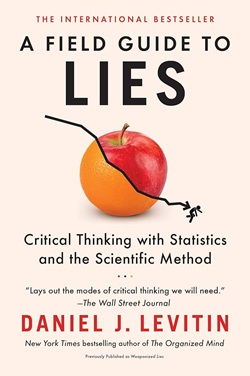
Daniel Levitin’s A Field Guide to Lies and Statistics masquerades as a beacon of enlightenment, purportedly equipping its readers with the tools to dismantle misinformation and navigate the deluge of data that saturates modern discourse. Yet, beneath its polished prose and didactic overtures, it is an exercise in self-congratulatory pedantry, riddled with inconsistencies, cherry-picked examples, and a disconcerting lack of self-awareness. One cannot help but wonder whether Levitin, in his quest to inoculate the masses against deception, has fallen prey to the very cognitive biases he claims to expose.
From the outset, Levitin postures as an enlightened gatekeeper of rational thought. “We’re far better off knowing a moderate number of things with certainty than a large number of things that might not be so.” An agreeable platitude, no doubt, but one that belies the book’s paradoxical reliance on uncritically accepted ‘truths.’ In his fervour to expose the ways statistics are manipulated, he frequently presents data without interrogating its foundational assumptions. The irony, so stark it borders on comedic, is that his very own presentation of statistical reasoning often exemplifies the same cherry-picking he decries.
Take, for example, his assertion that “more people have cell phones than toilets.” It is a stunning soundbite, one designed to provoke a visceral reaction, yet it hinges on an egregious misrepresentation of data. The original United Nations report cited did not claim that there were literally more mobile phones than toilets; rather, it noted that more people had access to mobile technology than to proper sanitation. The elision of ‘access’ with ‘ownership’ is precisely the kind of semantic sleight of hand that Levitin claims to abhor. If one of the principal tenets of critical thinking is recognising when language is being used to obscure rather than clarify, then Levitin, in this instance, is as guilty as the ‘lying weasels’ he so gleefully condemns.
His treatment of probability is similarly fraught with contradictions. He dissects the misuse of Bayesian reasoning in court cases with admirable precision, noting that “many innocent citizens have been sent to prison because of this misunderstanding.” The harrowing example of a surgeon who convinced ninety women to undergo mastectomies based on a catastrophic misinterpretation of conditional probabilities is a stark reminder of statistical illiteracy’s real-world consequences. Yet, while he relishes exposing the incompetence of medical professionals, he stops short of interrogating the broader systemic issues that incentivise such errors. It is a curious omission, one that suggests he is more invested in the optics of intellectual superiority than in the meaningful application of his principles.
Levitin’s overreliance on straw men is another glaring weakness. His critique of misleading graphs is undoubtedly valid—“the same fear of numbers that prevents many people from analyzing statistics prevents them from looking carefully at the numbers in a graph”—but his examples are almost laughably facile. Does anyone genuinely believe that a truncated y-axis is a malevolent conspiracy rather than a crude attempt at visual clarity? His insistence on painting all such instances as evidence of deliberate deception ignores the far more interesting question of whether our cognitive biases predispose us to accept certain forms of graphical representation without scrutiny. Instead of grappling with this complexity, he opts for a smug and superficial dismissal of those who fall for such ‘tricks.’
Even more troubling is his selective application of critical thinking. He extols the virtues of questioning authority, yet frequently invokes his own credentials as a neuroscientist to lend weight to his arguments. This inconsistency is particularly glaring in his discussion of expertise, where he argues that we should trust scientists over laypeople while simultaneously cautioning against blind deference to authority. This contradiction is never satisfactorily resolved, leaving the reader with the uneasy sense that Levitin’s prescriptions for critical thinking are contingent upon his own expertise being deemed unimpeachable.
The book’s concluding admonition—that we must all take responsibility for sifting truth from falsehood—is sound, if disappointingly trite. Yet, given the myriad ways in which Levitin himself fails to live up to his own standards, one is left questioning whether A Field Guide to Lies and Statistics is anything more than an elaborate exercise in intellectual posturing. It is a book that preaches the virtues of scepticism while demanding unquestioning acceptance of its own premises.
In the final analysis, Levitin’s work is emblematic of a broader trend: the fetishisation of ‘rationality’ as a cudgel with which to bludgeon the intellectually uninitiated. His relentless emphasis on individual responsibility in combating misinformation conveniently ignores the structural factors that make misinformation so pervasive in the first place. In his zeal to expose ‘bad statistics,’ he elides the role of power, ideology, and systemic bias in shaping the very narratives he seeks to critique.
It is not that A Field Guide to Lies and Statistics is entirely without merit. There are moments of genuine insight, and its breakdown of statistical fallacies is occasionally illuminating. But these flashes of clarity are overshadowed by its intellectual hubris, its failure to acknowledge its own blind spots, and its refusal to engage with the more uncomfortable implications of its subject matter.
In the end, perhaps the most damning indictment of this book is that it fails the very test it sets for others. It implores us to question, yet demands to be taken at face value. It seeks to expose the lies embedded in statistics, yet remains stubbornly oblivious to the ideological undercurrents shaping its own arguments. And that, ultimately, is the greatest lie of all.