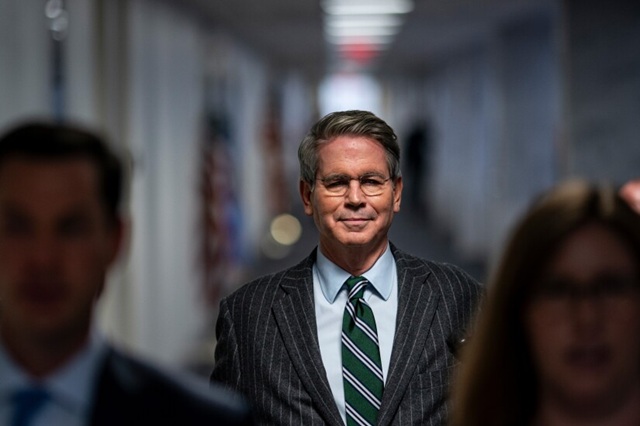
U.S. Treasury Secretary Scott Bessent has called on Canada to follow Mexico’s lead in imposing matching tariffs on Chinese imports, suggesting that such a move could help create a unified trade barrier across North America. The proposal, which Bessent highlighted in an interview with Bloomberg Television, is seen as a potential strategy to prevent looming U.S. tariffs on Mexican and Canadian exports.
“I do think one very interesting proposal that the Mexican government has made is perhaps matching the U.S. on our China tariffs,” Bessent said. “I think it would be a nice gesture if the Canadians did it also, so in a way we could have ‘Fortress North America’ from the flood of Chinese imports.”
According to Bloomberg, Mexican officials have expressed a willingness to impose higher tariffs on Chinese goods and increase imports from the U.S. in an effort to sidestep trade penalties threatened by President Donald Trump. Mexican President Claudia Sheinbaum’s administration is reportedly preparing to offer this concession as part of ongoing trade negotiations with Washington. The peso responded positively to Bessent’s comments, erasing earlier losses and stabilizing at 20.51 per U.S. dollar late Friday.
Trump has made aggressive trade measures against China a key part of his economic agenda, implementing an additional 10% tariff on Chinese goods in early February. These new duties add to the sweeping tariffs first imposed during his first administration and later expanded by President Joe Biden. More than $300 billion in Chinese imports remain subject to high U.S. tariffs due to allegations of intellectual property theft and unfair trade practices.
Canada Weighs Its Options
While Mexico appears open to aligning with U.S. tariffs, Canada’s response remains uncertain. Ottawa had already imposed tariffs on Chinese electric vehicles, steel, and aluminum last summer, largely to align with U.S. policy. However, a second wave of tariffs, initially promised in December, has yet to be implemented. Bloomberg reports that these additional duties—targeting critical minerals, semiconductors, and solar panels—could serve as a negotiating tool with Trump’s administration.
Mexico, meanwhile, is taking a more proactive approach. Officials are considering tariffs on Chinese auto imports, particularly on finished vehicles and car parts, areas where China has significantly expanded its market presence. The country has already begun imposing tariffs of up to 35% on Asian clothing imports as part of a broader effort to show alignment with U.S. trade priorities.
Trump has threatened to impose 25% tariffs on Mexican and Canadian exports starting March 4 if the two nations fail to take stronger measures against Chinese trade practices. The president has linked his tariff threats not only to trade concerns but also to broader issues such as the flow of fentanyl and migration into the U.S.
Security and Trade Talks in Washington
As trade negotiations continue, Mexico has also intensified cooperation with the U.S. on security issues. In a show of goodwill, Mexican authorities recently extradited 29 individuals accused of drug trafficking and other crimes to face charges in the U.S.
Mexican Foreign Minister Juan Ramon de la Fuente, alongside top military and security officials, met with U.S. Secretary of State Marco Rubio in Washington to discuss security collaboration, particularly on drug and arms trafficking. Rubio praised Mexico’s deployment of 10,000 National Guard troops and its recent major fentanyl seizures, calling them critical steps in securing the U.S.-Mexico border.
At the same time, Mexico’s Economy Minister Marcelo Ebrard and Finance Minister Rogelio Ramirez de la O met with their U.S. counterparts, including Bessent, to discuss financial measures targeting cartel activities and money laundering.
North America’s Trade Future at a Crossroads
With Trump’s March 4 tariff deadline approaching, Mexico’s willingness to align with U.S. trade policy presents a potential path to avoid steep levies on its exports. However, Canada’s position remains unclear, and its next move could determine whether the continent moves toward a unified trade front or faces heightened economic tensions.
Bessent’s vision of a “Fortress North America” suggests that the U.S. expects full cooperation from its neighbors in countering China’s growing economic influence. Whether Canada follows Mexico’s lead could have significant implications for North American trade relations in the months ahead.