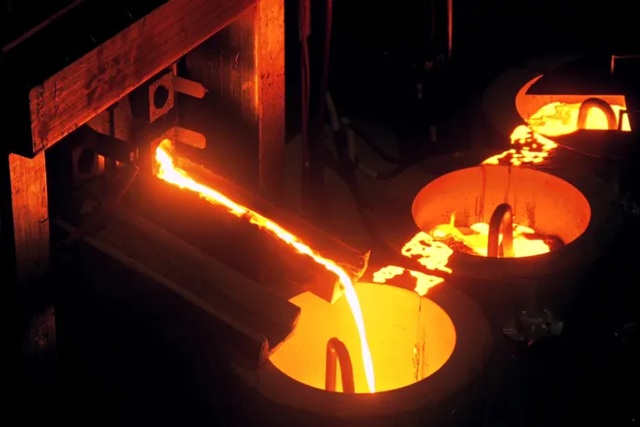
Boston Metal, a pioneering green-steel startup, has taken a significant step toward revolutionizing the steel industry by successfully running its largest reactor yet. The company’s process, which uses electricity rather than coal-based fuels, produced over a ton of steel in its latest test run. This milestone, exclusively reported by MIT Technology Review, brings Boston Metal closer to commercializing its climate-friendly technology.
Steel production is one of the world’s most polluting industries, with nearly 2 billion metric tons of steel produced annually, resulting in over 3 billion metric tons of carbon dioxide emissions. Boston Metal’s technology, known as molten oxide electrolysis (MOE), aims to eliminate these emissions by using electricity to extract iron from ore, rather than relying on carbon-intensive blast furnaces. If powered by renewable energy sources like wind, solar, or nuclear, this method could make steel production virtually emissions-free.
The startup initiated operations of its industrial reactor in January, with the latest successful run completed on February 17. The company had previously tested its technology on smaller scales before retrofitting its reactor for steel production. This new development marks a critical step in scaling up the process to industrial levels, which is essential for impacting the steel market.
Boston Metal’s method is vastly different from traditional steelmaking, which relies on coke, a coal-based fuel, to drive chemical reactions in blast furnaces. Instead, the company’s MOE process uses electricity to heat a mixture of iron ore and other materials to approximately 1,600°C (2,900°F). The result is iron that can be further processed into steel—while emitting oxygen instead of carbon dioxide.
“The volumes of steel everywhere around us—it’s immense,” said Adam Rauwerdink, senior vice president of business development at Boston Metal. “The scale is massive.”
A crucial challenge in Boston Metal’s scaling efforts has been refining its anode technology. The anode is a key component of the reactor, allowing electricity to flow through and drive the necessary reactions. While early versions of the technology used a single small anode, the latest industrial-scale reactor incorporates multiple larger anodes, making it more efficient and suitable for mass production.
With the latest milestone achieved, Boston Metal is now focusing on further refining its process and assessing production costs. The next step involves building an even larger system, expected to be operational by 2027. Unlike the current reactor, which takes about a month to produce a ton or two of material, the upcoming industrial-scale reactor will be capable of producing the same amount in a single day.
Ultimately, Boston Metal plans to license its technology to major steelmakers, positioning itself as a key player in the future of sustainable steel production. As the demand for low-carbon industrial processes grows, Boston Metal’s breakthrough could help decarbonize one of the most essential—and polluting—industries in the world.