
Until now, discussions of the potential economic problems created by the AI boom have mostly focused on the future. Will it destroy millions of jobs? Is there a bubble and will it cause a severe recession if it bursts? Will it destroy humanity? While these are doubtless very important questions, attempts to answer them are at best educated guesses.
We don’t have to guess, however, about one major effect of the AI boom, because it’s happening right now: Massive spending on data centers is crowding out investment in everything else in the economy.
“Crowding out” is a familiar term in economics, usually considered a consequence of government spending. When a government engages in deficit spending and the economy is at or near full employment, it drives up interest rates. That’s because, at near or full employment, the private sector is using all the available credit in the economy at the current interest rate. Therefore, in order to attract enough funds to satisfy its deficit, the government has to offer a higher interest rate. And this, in turn, leads to lower private investment. In effect, private investment is “crowded out” by the government deficit.
Note that this story only applies when the economy is near full employment. In the past, conservative claims about crowding out were widely invoked to justify fiscal austerity after the 2008 financial crisis, when all the world’s major economies were deeply depressed. Harsh spending cuts created severe slumps in Europe, while in the US Republicans compelled Obama to cut government spending, delaying full recovery from the Great Recession. In fact, when an economy is suffering from high unemployment, deficit spending doesn’t hurt private investment. Instead, it often leads to “crowding in”: government spending boosts the economy, and the private sector is more willing to invest when the economy is stronger.
However, given the situation we are in now, with relatively low unemployment and elevated inflation, crowding out is a legitimate concern. Yet it’s important to understand that the sources of crowding out aren’t limited to government spending. Surges in private spending, like the current immense AI boom, also drive up interest rates. And that is where we are now: the surge in AI spending is driving up interest rates and crowding out all other investment. Indeed, in my October 4 primer I argued that the AI boom is the main cause of soaring long-term interest rates.
Evidence of that crowding out is revealed by a recent article in the New York Times, which noted that the AI Boom is not being slowed by these soaring rates. Yet the spike in interest rates is being felt throughout the non-AI economy. In other words, all that money going into construction of datacenters and purchasing foreign produced semiconductors comes at the expense of investment in everything else.
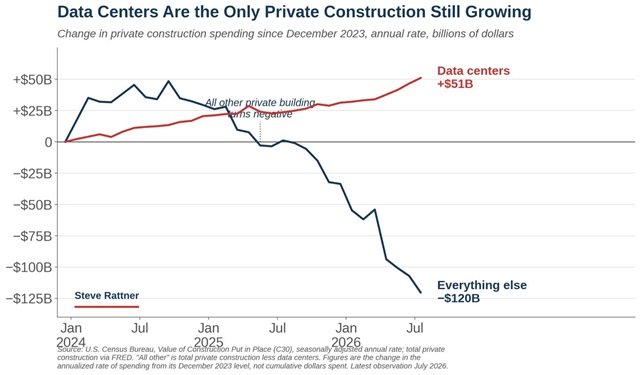
The chart at the top of this post, which I borrowed from Steve Rattner, clearly makes this point: construction of datacenters appears to be diverting funds and resources from the construction of housing, office buildings, and factories — more or less everything that isn’t AI-related.
That said, AI-related construction — building the structures that house datacenters — is only a fraction of the AI spending boom. Most of the money is going for equipment and software. In fact, that’s one main reason AI spending is so resistant to high interest rates: Borrowing costs matter much less for assets like GPUs, which depreciate rapidly in any case, than they do for long-lived assets like buildings.
Does this story hold if we focus on investment in equipment and software rather than construction? Yes.
Chart 2 shows my version of Rattner’s story. I look at business investment in “tech” — information processing and software — measured as a percentage of GDP. The blue line in the graph below shows how much that measure of tech spending has changed since the beginning of 2023. I compare that with the corresponding change in all other investment. This chart clearly reveals dramatic crowding out by tech spending of all other investment:
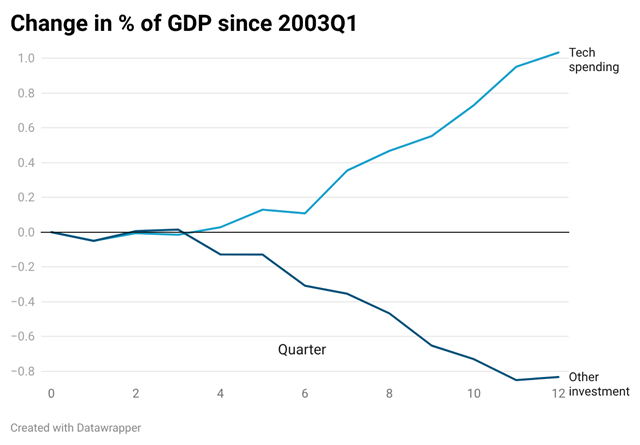
So the AI boom is crowding out everything else. While high interest rates are the main mechanism, there are also others: datacenters are gobbling up scarce electricity, and their demand for semiconductor chips has caused a “RAM apocalypse” of soaring chip prices that is hurting a wide range of industries such as autos and personal computers.
There are, as I see it, three main questions that we should ask about this AI-induced crowding out.
First, wasn’t it always thus? That is, isn’t this what always happens when a new technology drives an investment boom?
Surprisingly, the answer is no. Chart 3 shows the same calculation as Chart 2, but applied to the tech boom of the 1990s, and it doesn’t show any crowding out at all — in fact, non-tech investment rose:
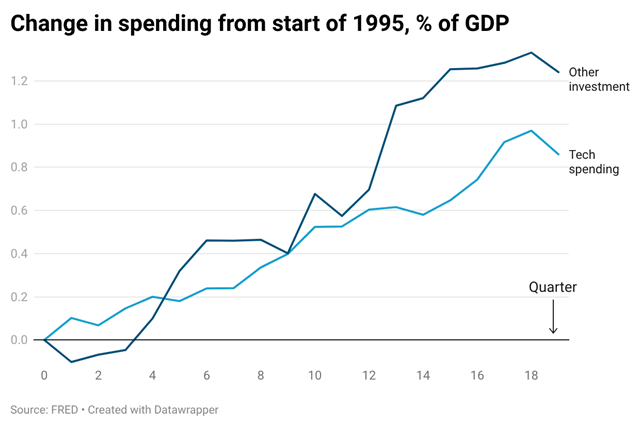
How was that possible? Most of the answer is that during the 90s boom America attracted very large inflows of investment from abroad, which effectively financed the tech boom even as other investment rose.
That isn’t happening this time. True, Donald Trump insists that he has brought in 20 quadrillion dollars of foreign investment, or something like that, but most of that alleged foreign investment surge is a figment of his imagination, and there’s no sign of such a surge in balance of payments data.
A second question is, shouldn’t we assume that the private sector knows what it is doing — that the reallocation of investment toward AI and away from everything else makes economic sense?
Definitely not. We shouldn’t assume that this reallocation of investment makes economic sense for the country as a whole. Through the tax code, and especially through changes in the tax code in Trump’s One Big Beautiful Bill, the data center boom is effectively being subsidized by taxpayer dollars.
Moreover, we shouldn’t assume that the private sector knows what it’s doing. There’s often a double standard when thinking about bad investments, in which public investments that go bad are treated as evidence that the government can’t do anything right, while private malinvestment is brushed off as no big deal.
Think about the $80 billion that Meta, formerly known as Facebook, spent on the “metaverse,” only to basically abandon the concept. A government program that spent $80 billion on a failed project would be the subject of endless Congressional hearings. Yet the waste from a failed private investment is equally real.
Finally, how much risk is the AI boom creating in the rest of the economy? Tales of financial stress caused by high interest rates are proliferating. For example, a report in yesterday’s Wall Street Journal was titled “The surge in rates is blowing up commercial real-estate deals.” There’s a growing sense among observers I talk to that the adverse financial fallout of the AI boom for private credit and other loosely regulated parts of the financial system may be larger than many realize.
So it’s clear that crowding out by the AI boom is happening on a very large scale. And unlike the risks of technological unemployment or a burst bubble, this isn’t a hypothetical risk. It’s happening right now.