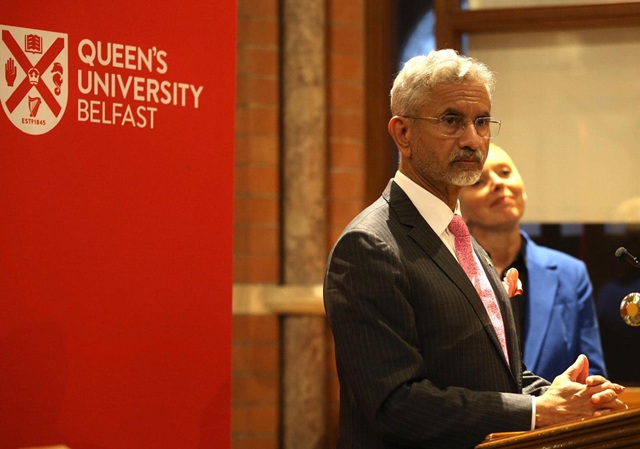
Indian External Affairs Minister S. Jaishankar, in an interview with the Financial Times (FT), offered a candid and sharp take on the shifting global order, India’s evolving foreign policy, and its complex relationships with key global players. Speaking over a South Indian breakfast at London’s Taj Hotel, Jaishankar reflected on Donald Trump’s return to power, India’s unwavering ties with Russia, the unpredictability of global diplomacy, and the challenges of a post-1945 world order that he sees as outdated.
The conversation took place against the backdrop of his grand diplomatic tour, which has seen him visit Washington for Trump’s inauguration, attend the Munich Security Conference, and host European leaders in New Delhi. Throughout, he has observed firsthand how the Western alliance is grappling with Trump’s foreign policy, which he believes aligns more with India’s long-standing advocacy for a multipolar world.
The West’s ‘Old Order’ is Overstated
Jaishankar, India’s longest-serving foreign minister since independence, dismissed nostalgia for the post-World War II global order, calling it biased and overdue for reform. “The virtues of the old order are somewhat exaggerated,” he remarked, arguing that the rules were heavily weighted in favor of Western powers, leaving emerging nations like India at a disadvantage.
However, he stopped short of advocating for a complete breakdown of international norms, warning that an anarchic world would be dangerous for all nations. Instead, he proposed a flexible and inclusive order, one that reflects contemporary power structures rather than those dictated by Cold War-era alliances.
India’s Pragmatism: Realism Over Idealism
A seasoned diplomat and a firm realist, Jaishankar dismissed romantic notions of diplomacy, emphasizing that India navigates the world as it is—not as it wishes it to be. “I got what I got. I’m a realist,” he stated bluntly.
This approach was evident when discussing India’s stance on Russia, despite Western pressure to distance itself from Moscow. India has continued purchasing Russian oil and maintaining defense ties, prioritizing national interest over ideological positioning. When pressed about Russia’s deepening ties with China, Jaishankar took the long view, pointing to 80 years of stable relations between India and Russia, even as Moscow’s ties with China, the West, and NATO have fluctuated.
Trump, Transactional Diplomacy, and Unpredictability
When asked about the return of Donald Trump, Jaishankar displayed a mix of caution and pragmatism, stating that India has always adapted to changing leadership in Washington. He acknowledged Trump’s nationalist and transactional style, but noted that diplomacy is inherently transactional: “At the end of the day, we all do transactions.”
While many U.S. allies express concern over Trump’s unpredictability, Jaishankar dismissed such fears, arguing that unpredictability is a strategic advantage in diplomacy. Drawing a comparison to cricket, he remarked, “The moment you become predictable, you’ve handed something over to the other side.”
On trade, he remained optimistic, predicting that India and the U.S. will reach a trade agreement in 2025, despite Trump’s past accusations that India is the “biggest tariff abuser.”
China: No Illusions About Cooperation
Jaishankar was firm when discussing China, India’s most pressing geopolitical challenge. Rejecting any improvement in ties without resolving their ongoing border tensions, he stated, “You can’t have a bad situation on the border and then a good situation in the relationship.”
While some Western analysts speculate that India may seek rapprochement with Beijing, Jaishankar dismissed such notions, insisting that India will not compromise on territorial sovereignty.
India’s Unique Global Positioning
India, he argued, holds a unique geopolitical advantage in today’s landscape—positioning itself as a power distinct from both the West and China. While it maintains strong ties with Washington, Tokyo, and Brussels, it also asserts its independent stance on global conflicts, such as the Russia-Ukraine war.
He reiterated India’s self-confidence in charting its own course, criticizing previous Indian elites for blindly imitating Western norms. “India today is more confident about being non-Western but not necessarily anti-Western,” he remarked.
A Fun Time to Be India’s Foreign Minister
As the conversation drew to a close, Jaishankar reflected on his eventful career and deep-rooted nationalism, emphasizing that he never hesitated when entering politics. “I was very comfortable with the politics of my party,” he said, reinforcing his alignment with Prime Minister Narendra Modi’s nationalist vision.
With India’s global influence rising, Jaishankar exuded a sense of strategic confidence, recognizing the country’s ability to play its cards well in a fluid geopolitical landscape. “Life is full of what-ifs. You don’t spend life worrying about what-ifs. You spend your life preparing for what-ifs,” he concluded.