In a pioneering study, researchers have successfully biosynthesized lignan glycosides—powerful antiviral compounds—using a synthetic yeast system, a breakthrough that could significantly boost the availability of these vital compounds for medicinal use. Lignans, low molecular weight polyphenolic compounds known for their potent antitumor and antiviral properties, are typically found in small amounts in medicinal plants. Their complex structures and limited presence make them difficult to extract and manufacture, presenting challenges for large-scale production.
The study, published in Nature Chemical Biology, was led by Prof. ZHOU Yongjin from the Dalian Institute of Chemical Physics of the Chinese Academy of Sciences, in collaboration with Prof. ZHANG Lei and Prof. CHEN Wansheng from the Naval Medical University. The researchers achieved the biosynthesis of lignan glycosides, an antiviral ingredient, in Saccharomyces cerevisiae—a strain of yeast commonly used in biotechnology.
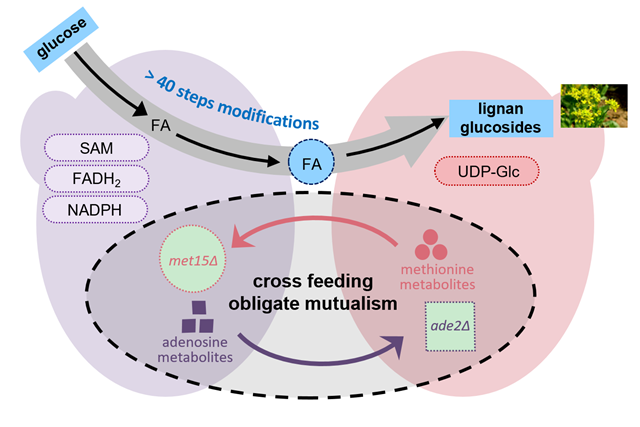
To overcome the challenges of traditional plant-based extraction and chemical synthesis, the team designed a synthetic yeast consortium inspired by plant metabolism. By mimicking the spatial and temporal regulation of plant biosynthesis, the team was able to construct a system with “obligated mutualism,” where different yeast strains shared metabolic tasks, thus dividing the biosynthetic process into distinct stages. This allowed for the effective reduction of side reactions caused by the broad substrate spectrum of enzymes such as 4-coumarate: CoA ligase, ultimately improving the efficiency of metabolic flux towards the production of lignan glycosides.
The researchers also engineered two auxotrophic yeast strains (met15Δ and ade2Δ), forming a mutualistic relationship in which they cross-fed metabolites, dividing the biosynthetic pathway into upstream and downstream processes. This innovative approach enabled the de novo synthesis of lariciresinol diglucoside, a key lignan glycoside, through over 40 enzymatic reactions.
Prof. ZHOU emphasized the significance of this achievement, stating, “Our work demonstrates that Saccharomyces cerevisiae auxotrophic strains spontaneously establish a mutualistic community for the heterologous synthesis of complex active ingredients in traditional Chinese medicine. This strategy is expected to be extended to the design of other stable cooperative yeast cell systems to accomplish complex bioengineering tasks.”
This research could pave the way for a more sustainable and efficient method of producing lignans and other valuable bioactive compounds, addressing the challenges of limited plant availability and complicated chemical synthesis. The team’s work is expected to have broad implications for the production of various natural products, particularly in the field of traditional Chinese medicine, where bioengineering holds great potential for creating a reliable and scalable source of important medicinal compounds.