by Our Economic Affairs Editor
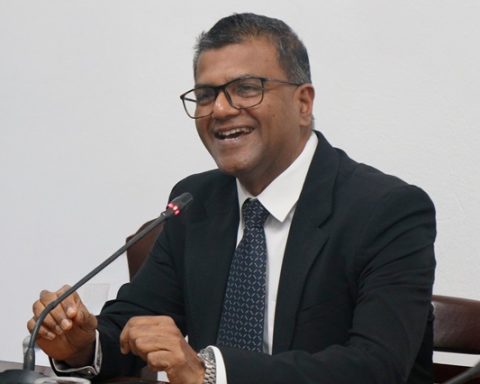
The spectres of debt, mismanagement, and corruption loom omnipresent, draining the nation of its vitality, eroding its institutions, and rendering its citizenry mere spectators to their own ruin. In this climate of existential peril, where every decision determines whether the nation ascends towards recovery or plummets into further abyss, there can be no room for compromise, no tolerance for duplicity, and certainly no patience for conflict-ridden opportunists whose allegiances are split between corporate behemoths and the national interest. It is thus an outrage of the highest order that Duminda Hulangamuwa, a man tethered to the ethically bankrupt multinational accounting leviathan that is Ernst & Young, continues to wield influence as the Senior Economic Advisor to President Anura Kumara Dissanayake. His continued presence in this position is a grievous insult to the Sri Lankan people, an affront to the principles of governance, and a fundamental threat to the nation’s recovery. He must step down immediately, not as a concession to political discourse, but as a moral imperative.
His audacity in dismissing legitimate concerns of a conflict of interest is as galling as it is absurd. The mere notion that an individual presiding over the Sri Lankan operations of a firm notorious for its complicity in financial chicanery across the globe could impartially shape national economic policy is an exercise in farcical delusion. Ernst & Young, the entity to which Hulangamuwa’s loyalty is unavoidably bound, is not merely another cog in the global financial machine—it is a corporation tainted by scandal, regulatory censure, and a cavalier disregard for ethical probity. Its infamy is richly deserved, for it has, time and again, facilitated the very fraud and financial manipulation that have brought economies to their knees.
From the Lehman Brothers debacle, where EY’s negligence helped precipitate the most catastrophic financial collapse of the modern era, to its abysmal failures in detecting the monumental Wirecard fraud in Germany, the firm’s complicity in economic malfeasance is irrefutable. Its role in the Satyam scandal, wherein it signed off on falsified financial statements that masked an egregious $1.5 billion fraud, showcased a stunning indifference to the foundational tenets of auditing. Its blatant failure to prevent Tesco’s profit inflation scandal, its reckless enablement of fraudulent revenue reporting at Brooge Energy, and its unforgivable dereliction of duty in allowing hospitals and care homes under its purview to collapse into financial chaos further illustrate a corporate entity that has long abandoned any pretence of fiduciary responsibility.
This is the firm to which Hulangamuwa has pledged his professional fealty. This is the firm whose interests will invariably colour his decisions, whose priorities will seep insidiously into the corridors of power through his tenure as Senior Economic Advisor. And yet, he expects the nation to believe in his impartiality. To accept that his stewardship of EY Sri Lanka does not compromise his ability to act solely in the best interests of the people. Such mendacity insults the intelligence of the public and betrays a fundamental misunderstanding of ethical governance.
A conflict of interest, by definition, exists when personal or financial entanglements compromise one’s ability to act with unimpeachable objectivity. In what universe does Hulangamuwa’s dual role not constitute a textbook case of such a conflict? His economic advice cannot be extricated from the reality of his corporate obligations. His decision-making cannot be immune to the gravitational pull of a global juggernaut whose financial stakes are inextricably linked to government policy, regulatory frameworks, and fiscal governance.
Even more alarming is his thinly veiled lament that private-sector professionals are unwilling to enter government due to its meagre remuneration. The implications of this statement are deeply insidious, for they reveal a worldview in which governance is not a duty but a transactional enterprise. A worldview in which national service is weighed against corporate gain, and where ethical considerations are subordinate to financial calculus. This is not merely an indiscreet remark—it is an indictment of his entire approach to public service. It betrays an implicit assumption that government is a space to be navigated only if lucrative enough, an ideology that runs counter to the very notion of civic responsibility.
It must also be noted that the global EY behemoth, of which Hulangamuwa is an operative, is no stranger to regulatory fines and punitive actions for its myriad transgressions. The firm’s disgraceful $100 million fine for its widespread ethics exam cheating scandal in the United States laid bare a culture of deceit at the highest echelons of the company. In the UK, its role in the collapse of NMC Health, where its incompetence allowed a £2.5 billion financial black hole to remain undetected, underscores its systemic failures. The firm has been subject to legal censure in Germany, Australia, Spain, and beyond—each instance reinforcing the inescapable conclusion that EY is not merely flawed but fundamentally untrustworthy.
Hulangamuwa’s continued presence in government is therefore not merely inappropriate—it is intolerable. Sri Lanka, already ravaged by corruption, cronyism, and economic sabotage, cannot afford yet another figure ensnared in the machinations of corporate self-interest masquerading as public service. His departure is not a matter of debate or discretion; it is a necessity. Every moment he remains in this role is an affront to the principles of governance and a glaring indictment of the administration’s failure to uphold ethical integrity.
The people of Sri Lanka, long subjected to the cynical manoeuvrings of the politically and financially privileged, deserve better than this. They deserve leaders whose fidelity is to the nation alone, untainted by divided loyalties or corporate allegiances. They deserve a government unpolluted by figures whose influence extends into the boardrooms of entities with documented histories of financial misconduct. They deserve economic advisors whose counsel is not coloured by the profit motives of multinational entities, whose past actions reveal an unswerving commitment to transparency, and whose ethical standing is beyond reproach.
Hulangamuwa does not meet this standard. His continued occupancy of this position is an insult to the very notion of accountable governance. If there remains a modicum of honour, if there exists any recognition of the irreconcilable contradiction at play, he must step down. Failing that, the onus falls on President Dissanayake to rectify this travesty. The weight of history, the suffering of the people, and the imperative of national recovery demand no less.