


by Nil
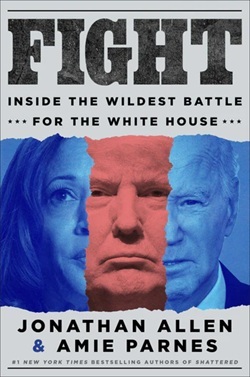
Politics, like war, is not merely about winning battles but about surviving them. Fight by Jonathan Allen and Amie Parnes is a gripping post-mortem of an America in turmoil, a nation embroiled in one of its most divisive elections, with its democracy hanging in the balance. From the relentless ambition of political giants to the backroom betrayals that defined the campaign, this book lays bare the raw, unfiltered reality of a system that thrives on chaos. With razor-sharp storytelling and deep investigative insight, Allen and Parnes deliver a damning account of an election season that tested the very soul of the United States.
Right from the opening chapters, the authors set the stage for an election like no other. The Republican camp, defined by its unyielding loyalty to Trump, was at war not just with the Democratic challenger but with itself. Trump, ever the populist firebrand, “railed against his own party’s hesitance, painting them as cowards unwilling to fight for America’s survival” (p. 23). His messaging, aggressive and unfiltered, was both his greatest strength and his Achilles’ heel. He thrived on controversy, understanding, as the book states, that “outrage is the currency of modern politics” (p. 47).
On the other side, the Democrats were burdened with their own internal struggles. The party, still reeling from past defeats, was torn between progressives demanding radical change and moderates clinging to a cautious, incremental approach. Biden, the man who emerged as the reluctant champion, carried the weight of history on his shoulders. “He wasn’t the revolution people wanted, but he was the stability they needed” (p. 88). His campaign, a mix of careful political calculation and genuine appeals for unity, was constantly undermined by questions about his age and stamina. As one strategist bluntly put it, “Every debate, every speech, every public appearance felt like a high-wire act without a safety net” (p. 116).
The authors provide a particularly scathing look at the Republican strategy of fear-mongering and misinformation. Trump’s inner circle understood the power of repetition. “If you say it enough times, it becomes the truth,” a senior aide admitted (p. 152). The infamous “Stop the Steal” movement wasn’t just a knee-jerk reaction to an electoral defeat; it was a carefully crafted narrative designed to sow doubt in the system itself. The book reveals how even some within Trump’s own team doubted the legitimacy of their claims. One campaign official reportedly confided, “We know this is bullshit, but it keeps the base engaged” (p. 193).
Yet, what makes Fight particularly engrossing is its willingness to go beyond the surface-level theatrics and examine the structural weaknesses in American democracy that allowed such chaos to unfold. The book doesn’t just blame Trump or his enablers; it critiques a media ecosystem addicted to sensationalism and a political culture that rewards demagoguery over competence. “Trump didn’t create the crisis,” the authors argue. “He merely exploited it better than anyone before him” (p. 217).
The Democratic campaign, while ostensibly a counterweight to Trump’s authoritarian impulses, was far from flawless. Harris, whose candidacy was supposed to invigorate the ticket, often found herself sidelined. The authors recount a particularly tense moment when a close adviser remarked, “She’s walking on eggshells, afraid to make a misstep that could be used against her” (p. 243). The internal friction between the Biden and Harris camps was evident, with one source admitting, “There was no trust. Every move felt like a political calculation rather than a partnership” (p. 267).
Then there was Election Night itself—a night that would stretch into weeks of legal battles, conspiracy theories, and political maneuvering. As the results trickled in, the divide between reality and fantasy became starker. “Trump knew he lost, but accepting defeat was never an option” (p. 299). His team scrambled for a strategy, cycling through every possible avenue to overturn the results. Some of his advisers entertained truly outlandish ideas, with one memo suggesting, “Seize the voting machines. Just do it” (p. 312).
Yet, despite the high drama and the unprecedented challenges, the transition of power—however fraught—ultimately happened. The book closes on a sobering note, warning that while this battle was won, the war for American democracy is far from over. “The system held, but only barely. Next time, it might not” (p. 351).
Fight is more than just a political book; it is a cautionary tale. It forces readers to confront uncomfortable truths about the fragility of democratic institutions and the ease with which they can be manipulated. Allen and Parnes do not provide easy answers or heroes. Instead, they lay out the brutal, often cynical calculations that drive American politics, leaving the reader to grapple with the unsettling realisation that the system, as it stands, may not be equipped to withstand the next storm.












