
by Durga
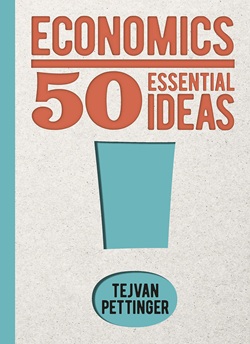
Tejvan Pettinger’s Economics: 50 Essential Ideas offers a compact yet incisive look at some of the most significant economic theories, bringing them to life with historical context, real-world applications, and a keen sense of how they continue to shape modern society. The book excels in making complex ideas accessible, yet it never oversimplifies them to the point of meaninglessness. Instead, it invites the reader to engage critically, questioning assumptions and reflecting on the real-world implications of economic principles.
One of the book’s strongest aspects is its refusal to treat economics as a purely theoretical discipline. Instead, it constantly reminds us that economics is deeply intertwined with history, politics, and human behaviour. Take, for instance, the discussion on liquidity traps: “Monetary policy is said to be like ‘pushing on a piece of string’—that is, it has no effect” (p. 30). This evocative metaphor captures the frustrating impotence of central banks in certain economic conditions, such as Japan in the 1990s or the global financial crisis of 2007–08. The phrase lingers in the mind, forcing one to reconsider the power (or lack thereof) of monetary policy in a crisis.
Pettinger’s approach is balanced—he does not champion any particular economic school dogmatically but presents multiple perspectives, allowing the reader to weigh the merits and shortcomings of each. When discussing Modern Monetary Theory (MMT), for example, he acknowledges its appeal: “if there are spare resources in an economy, such as some unemployment, the government should print money and create employment” (p. 42). This seemingly radical idea gains legitimacy when placed in historical context—MMT proponents point to Japan’s ability to sustain debt over 200% of GDP with little inflation. However, Pettinger does not ignore the criticisms: “There are many examples in history of governments whose creation of money has led to rampant inflation, from Weimar Germany to Zimbabwe” (p. 42). By juxtaposing these perspectives, the book forces the reader to think critically rather than passively absorb information.
One particularly compelling chapter examines the relationship between wealth and happiness. Traditional economists assume that higher incomes correlate with greater happiness, following the utilitarian tradition of Bentham and Mill. However, Pettinger challenges this assumption: “Are people happier due to this increase in real GDP?” (p. 42). The question is disarmingly simple yet deeply profound. He highlights that while economic growth has lifted millions out of poverty, the relentless pursuit of GDP growth may not necessarily lead to a happier society. He points to the paradox that, despite a ninefold increase in US real GDP between 1950 and 2022, overall happiness levels have remained relatively stagnant. This forces the reader to question whether economic policies should prioritise GDP growth or focus on broader well-being indicators such as life satisfaction, mental health, and environmental sustainability.
The book’s discussion on inflation is equally engaging. Pettinger examines why inflation is both feared and misunderstood, noting that “Printing money devalues the present value of bonds and savings, reducing the value of savings for many in the economy” (p. 42). He masterfully connects theory to lived experience, explaining how inflation erodes purchasing power, disproportionately hurting those on fixed incomes. Yet, he also highlights the perils of deflation, a scenario often overlooked in mainstream discourse. Japan’s experience is once again instructive: “During the 1990s and 2000s, Japan had a prolonged period of deflation… Even just by holding onto your cash, you will see a growth of 2% in real terms every year” (p. 30). The lesson here is clear: economic stability is a delicate balancing act, and simplistic narratives about inflation being universally bad do not hold up under scrutiny.
The book also shines in its discussion of financial crises, particularly its treatment of the 2007–08 global financial crash. Pettinger explains that excessive risk-taking, poor regulation, and financial innovation run amok created a perfect storm. However, he does not merely recount events—he delves into the deeper lessons, questioning whether reforms have gone far enough to prevent a future crisis. He critiques the reliance on monetary policy to stimulate growth post-crisis: “Quantitative easing didn’t cause inflation as some had feared, but it didn’t return the economy to normal growth” (p. 30). This is a sobering reminder that while emergency measures can stabilise an economy, they do not necessarily lead to long-term prosperity.
Another provocative discussion centres on government intervention. Pettinger highlights the ideological divide between free-market proponents and those who favour state intervention. The neoliberal argument suggests that markets are self-correcting and government interference distorts efficiency. Yet, as Pettinger points out, the reality is often more complex: “There are other concerns that increasing the money supply to finance government spending will crowd out the (potentially more efficient) private sector” (p. 42). This raises an uncomfortable but necessary question: should efficiency always be the primary goal of economic policy? Or should considerations such as income equality, job security, and environmental sustainability take precedence?
Perhaps the book’s greatest achievement is its ability to make abstract economic concepts feel relevant to everyday life. Pettinger frequently draws connections between theory and real-world events, making the book highly engaging. The discussion on fiscal policy, for instance, is not a dry exposition of government budgets—it is an exploration of choices that affect millions. He notes that while Keynesians advocate for increased government spending in a downturn, political realities often hinder such policies: “The idea of relying on tax rises to reduce inflation is politically naïve” (p. 42). This is a crucial insight—economics is not just about numbers; it is about power, ideology, and human behaviour.
Despite its strengths, the book does have some limitations. Given its concise format, some topics are necessarily treated with brevity. While this makes the book accessible, it occasionally leaves the reader wanting a deeper exploration of certain ideas. Additionally, while Pettinger does an admirable job of presenting multiple viewpoints, there are moments where the book could engage more critically with mainstream economic assumptions. For instance, while he acknowledges criticisms of GDP as a measure of progress, he does not fully explore alternative metrics such as the Human Development Index (HDI) or Genuine Progress Indicator (GPI). A deeper dive into these alternatives would have strengthened the discussion.
Economics: 50 Essential Ideas is an intellectually stimulating and highly readable introduction to economic thought. It succeeds in demystifying complex concepts while encouraging critical thinking. The book does not dictate what to believe; rather, it invites the reader to grapple with economic dilemmas, question assumptions, and appreciate the profound impact of economics on daily life. Whether one agrees or disagrees with certain ideas, the book fulfils its purpose—it provokes thought, challenges conventional wisdom, and reminds us that economics is far more than a dry academic discipline; it is a lens through which we understand the world.