Extract from the book “Read Between the Lines,” paragraph “Prison Diary” (pages 97 to 102):
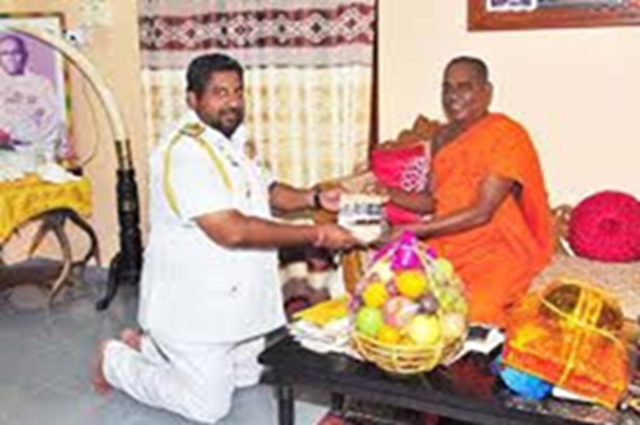
Even though I have declined visitors, I cannot refuse religious leaders who come to see me. The High Priest of Nagadeepa Temple, Jaffna, was the first to visit. He must have left Jaffna at night to arrive at Welikada by 11 a.m. Our brotherly relationship dates back to 1984. The present Chief Incumbent, then our “Podi Hamuduruwo,” is one year older than me.
I was a young Sub-Lieutenant when I was appointed Officer in Charge of the Naval Detachment in Nainativu. It was during this time that I first met Podi Hamuduruwo. My primary task was to provide protection to the Nagadeepa Raja Maha Viharaya and the two priests residing there. We also had an army platoon stationed with us to assist with land security.
Living in Nainativu was very difficult at the time. There was only one well on the island that provided drinking water. We had to bathe with salt water, as soap or shampoo could not be used. There was no electricity, except for a small generator that powered the perimeter fence at night. We had no freezers or refrigerators. An old patrol craft (P 110) from Karainagar delivered our victuals every other day. Podi Hamuduruwo used to joke that when the P 110 started its engines in Karainagar, the sound could be heard in Nagadeepa! It was such an old patrol craft with very noisy engines.
Nevertheless, we carried out our duties with utmost dedication and commitment. As the OIC, I made my own decisions, including offering Dana and Gilanpasa to the two priests daily from the victuals we received for our own consumption—a meritorious act that the navy continues to this day. Though there was no direct supervision, I was highly responsible and always set an example for my sailors.
Naval Base Karainagar was far away. I had to train my men and keep them in a state of battle readiness, knowing that in the event of an enemy attack, reinforcements would only arrive after 24 hours. I took these duties very seriously. After two months at the station, I took a short leave. Nagadeepa was my life.
After the attack on Sri Maha Bodhi on 14 May 1985 in Anuradhapura—where LTTE leader Lt. Col. Victor Fiyulas killed 146 innocent worshippers—it was clear that the next LTTE target would be the Nagadeepa Temple. We were aware of this and were determined to protect the temple and the priests at any cost. We patrolled the island at night and slept only a few hours during the day after lunch.
Podi Hamuduruwo was always with us. He was fluent in Tamil, having studied at the island’s school. He knew everyone, and the islanders respected him. Whenever they saw him, they would run towards him and worship him. He was respectfully known as “Podi Swami” by the locals.
According to the Mahavamsa, the chronological written history of Sri Lanka maintained by Buddhist monks, Nagadeepa is where Gautama Buddha visited on his second trip to Sri Lanka, five years after enlightenment, to settle a dispute between two Naga-tribe kings, Chulodhara and Mahodara. Thus, this temple is one of the most sacred in Sri Lanka.
As a Buddhist, I considered it my duty to protect the temple from enemies. It remains the greatest deed of my 38 years in uniform.
The High Priest of Nagadeepa, Rev. Nawadagala Paddumakitti Tissa Thero, the Chief Sangha Nayaka of the Northern Province, visited me in prison with his junior priest. I saw tears in his eyes. Our bond is unique, spanning from our younger days to the present. He witnessed my rise from Sub-Lieutenant to Admiral and was always there to bless me and my family. He never expected to see me in prison, especially in my final year in uniform. I had to comfort him.
After worshipping him, I said, “My dear Thero, Welikada Prison is much better than the living conditions we had in Nagadeepa in the 1980s.” A thin smile appeared on his face. His mind must have drifted to the time we spent together in Nagadeepa during those challenging years.
I had to convince him to cancel the silent protest he had planned to organise at Vihara Maha Devi Park on Sunday with one thousand monks. I did not want things to get out of control. My case was still in court, and I was on remand.
The junior priest accompanying the Nagadeepa High Priest informed me of the public support I was receiving on social media. However, I am an old-school person with no Facebook account! Sometimes, that is an advantage; sometimes, it is not.
I requested the Nagadeepa High Priest to visit my home and meet Yamuna to calm her down. She knew of our bond and deeply respected the High Priest.
Have you visited Nagadeepa? It is a beautiful boat journey from Kurikattuwan Jetty in Punkudutivu to the Nagadeepa Temple. From Jaffna town to Kurikattuwan Jetty (known as KKD Jetty), it takes about 35 minutes by road. The most beautiful time to visit Nagadeepa is after sunset, ideally on a full moon Poya day.
If you want to witness real ethnic and religious harmony in Sri Lanka, visit Nagadeepa and explore the island for a few days. The Nagapoosani Amman Kovil, the second-largest Hindu temple in the North, is also in Nagadeepa, about one kilometre from the Buddhist temple. At the southernmost point of Nagadeepa, there is a small mosque in a tiny Muslim village. The Muslim residents are primarily fishermen and lobster divers, likely descendants of pearl and chank divers from long ago.
On 1 October 1990, when LTTE terrorists gave an ultimatum to all Muslims in the Northern Province—more than 72,000 people at the time—to vacate their homes and businesses within 24 hours, this small Muslim community also prepared to leave. However, the Chief Incumbent of the Nagadeepa Temple at the time, the Most Reverend Brahmanawatte Dhammakitti Tissa Thero, a learned scholar from Balapitiya, requested the Muslims not to leave Nagadeepa and assured them of full protection by the temple and the navy.
The Muslim leaders in Nagadeepa decided to stay, and the Thero kept his promise. The navy assisted in transporting their fish and lobster catch to Colombo, and the temple provided financial aid when needed. The LTTE failed in their attempt to expel all Muslims from the North due to the brave actions of the High Priest. Their ethnic cleansing attempt failed!
Today, Sinhala, Tamil, and Muslim communities live in harmony on this small island, setting an example for the entire country and the world.
Who knows these stories other than the military personnel who protected these religious places under difficult conditions? I am grateful for the time I had in prison to write them down.