


by Our Economic Affairs Editor
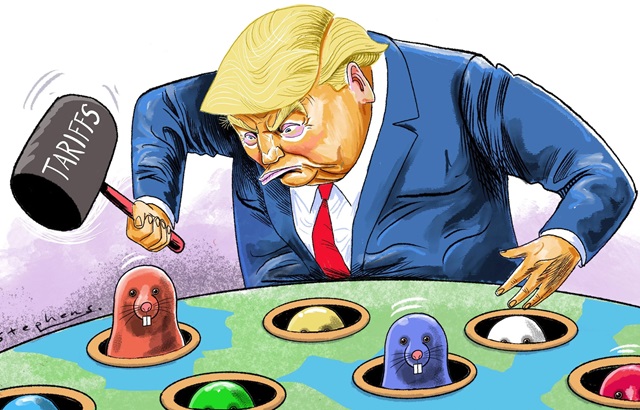
The mid-week announcement from the Trump administration to escalate tariffs on a broad swath of imports has sent shockwaves across the globe. For most, the implications of these sweeping tariffs are already troubling, but for Sri Lanka—a nation still scrambling to recover from a near-total economic collapse—the impact could be catastrophic. The island nation, despite its precarious state, stands as a symbol of the vulnerability of small economies caught in the crossfire of global trade wars, and the consequences of Trump’s protectionist policies could push it to the brink of irreparable damage.
Sri Lanka, like many other nations in the South Asian region, has long been reliant on its ability to maintain affordable access to global markets. As one of the smallest economies among nations impacted by the recent trade measures, it ranks high on the list of countries at risk from this tariff war, trailing only behind Vietnam and Laos. With $2.5 – $3.0 billion annual income from exports to the US, Sri Lanka is particularly vulnerable. The country, already teetering on the edge of bankruptcy and desperately trying to recover from years of mismanagement and austerity measures dictated by the International Monetary Fund (IMF), now faces an existential crisis.
President Dissanayake’s administration, eager to emerge from the ashes of economic collapse, faces a paradoxical challenge—how to rebuild a shattered economy when the winds of global trade are blowing in an entirely new direction. The tariff hikes proposed by Trump, intended to impose reciprocal duties on imports, are expected to send prices for goods—especially clothing and apparel—soaring. In Sri Lanka, where a significant portion of the economy depends on the garment industry, this increase in input costs could have devastating consequences, spiralling further inflationary pressures onto an already struggling population.
President Dissanayake’s response has been one of political paralysis and confusion. In a desperate bid to understand the crisis at hand, he appointed an “expert” committee to study the potential impacts of the tariffs and make recommendations on the government’s course of action. However, despite the well-meaning intentions of these so-called experts, the true failure lies not in the quality of advice that may be offered, but in the government’s inability to act decisively and in a timely manner. Some ministers within the administration, displaying a combination of ignorance and political immaturity, have failed to grasp the gravity of the situation. One junior minister was quoted saying, “Everything changed overnight; when I woke up, I saw what Trump had done.” Such statements reflect the poor understanding of international trade dynamics that runs deep within the Sri Lankan government.
The challenge lies not only in the tariffs themselves but in the overarching inability of the Sri Lankan leadership to take proactive steps to mitigate the economic risks. While other nations, such as Singapore, are closely monitoring the evolving tariff situation, Sri Lanka’s leadership seems content to criticise the opposition’s minor concerns while failing to address the reality of the impending disaster. Despite the government’s extensive diplomatic presence in the United States, not a single minister or senior diplomat has publicly acknowledged the looming economic nightmare that the tariffs will trigger. No concerted effort has been made to engage with the Trump administration or other stakeholders to explain Sri Lanka’s unique vulnerability, or to appeal for exemptions or special consideration for countries like Sri Lanka, which have limited economic clout.
The government’s approach thus far has been one of ad hoc, reactionary measures—too little, too late. Sri Lanka’s continued diplomatic presence in Washington, which incurs substantial costs, seems to be little more than an exercise in tokenism. The absence of a coherent strategy to address the crisis speaks volumes about the disarray within the government’s ranks. Sri Lanka’s political elite have, in a spectacular act of irony, found themselves caught in the very same situation that they once mocked. During times of economic prosperity and political stability, they dismissed the concerns of the opposition as mere noise, yet now, facing the stark reality of these tariffs, they are scrambling for solutions in the face of a full-blown economic disaster.
The tariffs, particularly the 10% baseline and additional duties targeting goods from Asia, will undoubtedly send shockwaves through Sri Lanka’s already fragile garment industry, which constitutes a significant chunk of the country’s foreign exchange earnings. The entire South Asian region, including Sri Lanka, has long been a critical manufacturing hub for the global clothing market, with brands and retailers relying on the region for low-cost production. However, with the imposition of tariffs, the costs of these goods are expected to skyrocket, making Sri Lanka’s exports far less competitive in international markets. For a nation that depends on its textile exports for survival, this is nothing short of a death knell.
Economists across the globe have already warned that the Trump tariffs will ignite a fresh round of inflation, destabilise the global supply chain, and put enormous strain on the US economy. But while the impact on large economies like China, Japan, and the European Union is substantial, it is the smaller, less diversified economies like Sri Lanka that will bear the brunt of these tariffs. The stark reality is that Sri Lanka’s economy is not equipped to absorb such shocks. The IMF’s stringent austerity measures, which have already slashed employee wages, reduced subsidies, and created widespread social unrest, have left the country with little room for manoeuvre.
Further exacerbating the issue is the absence of any meaningful diplomatic engagement. As global trade tensions intensify, other countries, notably China and the European Union, have begun to formulate plans for retaliatory measures. China, in particular, has voiced its firm opposition to the new tariffs, with its commerce ministry warning that “there are no winners in trade wars.” The European Union has also expressed strong condemnation, with its leaders calling the tariffs a “major blow” to global economic stability. Yet, where is Sri Lanka in this global conversation? Where is its voice, its strategy, its attempt to be heard amidst this cacophony of global trade war rhetoric?
In truth, Sri Lanka’s leadership has squandered the opportunity to position itself as a voice of reason in the global discourse. The government’s lack of foresight and its penchant for political grandstanding have left it isolated, with no clear path forward. In the face of global uncertainty, countries like Sri Lanka must learn to navigate the treacherous waters of international trade with a nuanced, informed approach. Unfortunately, the current administration seems more focused on appeasing its political base than confronting the challenges of a rapidly changing world economy.
As China and the European Union prepare for retaliation, and as the US economy faces the inevitability of higher costs and potential recession, Sri Lanka must ask itself: how much longer can the island nation afford to be a passive observer in global politics? The time for decisive action is now. But whether President Dissanayake’s administration will rise to the occasion remains to be seen. What is clear, however, is that without a shift in both policy and leadership, the tariffs imposed by President Trump could very well seal the fate of Sri Lanka’s already vulnerable economy.
In the face of such a dire predicament, Sri Lanka has a choice: to engage actively with global partners and join broader efforts to resist the Trump administration’s tariffs, or to remain a spectator, slowly suffocating under the weight of its own economic mismanagement. If history has taught us anything, it is that small economies like Sri Lanka cannot afford to remain passive in the face of global economic upheaval. The window of opportunity for meaningful action is rapidly closing, and unless President Dissanayake’s administration can overcome its internal divisions and political paralysis, Sri Lanka will find itself not just struggling to recover—but sliding further into economic oblivion.




Dear Nilantha bhai,
Good evening.
I read your insightful analysis with great interest. Your focus on the subject is both sharp and timely—well done.
However, the Colombo-based Institute of Policy Studies has raised concerns about the impact of President Trump’s import tariffs on Sri Lanka. The US is a crucial export market for Sri Lanka, and an increase in US tariffs could significantly harm exports, particularly in sectors like apparel, rubber, and plastics.
The proposed tariff hikes, along with retaliatory measures, may result in severe losses for Sri Lanka’s key industries. Furthermore, a trade war may suppress global demand, especially in the EU. Given Sri Lanka’s vulnerability, it’s vital to strengthen negotiations, maintain preferential tariffs, and pursue regional trade agreements like RCEP to mitigate risks.
I appreciate your work on this important issue.
Best regards.
–Anwar A. Khan