


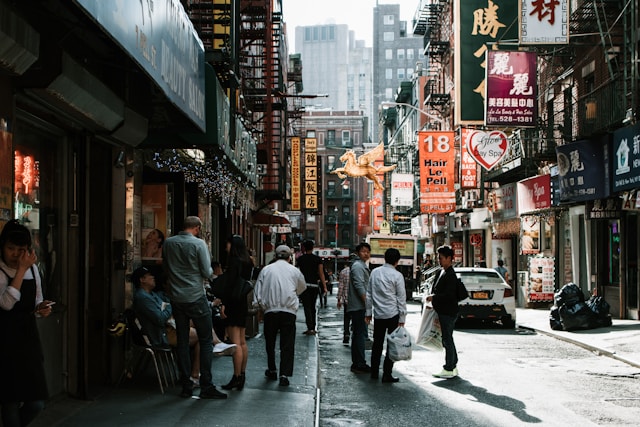
Small business owners in New York’s Chinatown are facing unprecedented challenges as the fallout from the U.S.-China trade war continues to wreak havoc on their operations. Many are scrambling to stockpile essential goods, fearing that steep tariffs imposed by President Donald Trump will push them out of business.
One such business owner is Andy Wang, who founded the Taiwan Pork Chop House 26 years ago. Wang, whose restaurant specializes in affordable dishes like pork chop over rice, has been buying up supplies ranging from rice wine to plastic containers, all sourced from China. “I have to stock up so I can keep operation costs stable for as long as possible,” Wang told the Financial Times in an interview surrounded by excess inventory in his restaurant basement.
Wang’s situation is far from unique. Thousands of Chinese American small businesses in the neighborhood are grappling with the worst-ever U.S.-China trade war, as President Trump’s aggressive tariff hikes—culminating in a 145 percent tariff on Chinese imports—continue to raise the cost of goods critical to their operations.
The impact of these tariffs is even more severe than the aftermath of the September 11 attacks, when Chinatown’s economy was decimated by a sharp drop in customer traffic, according to the Chinatown Partnership, a local advocacy group. “Tariffs will have a lasting and devastating impact on the Chinese American community,” said Wellington Chen, executive director of the organization.
Chinatown, home to the largest Chinese population in the U.S., relies heavily on imports from China. In fact, New York imports more goods from China than any other country besides Switzerland and Australia. Many Chinese American food retailers and catering businesses depend on affordable Chinese-made products to fill their shelves and kitchens.
“I charge an affordable price but am still able to make a profit by sourcing from China,” Wang explained. But with the price hikes resulting from the tariffs, this business model is quickly becoming unsustainable. With Chinese goods now subject to steep tariffs, the costs of ingredients and supplies that were once affordable are rising fast.
Some business owners, like Wu Jianxi, the general manager of C&A Supermarket in Flushing, a neighborhood with a large Chinese population, say they simply cannot pass on the full burden of the increased costs without losing customers. “There is no way our customers can accept prices going from $100 to $200 within such a short timeframe,” Wu said. “They will have to cut corners.”
The trade war’s impact on the supply chain is also evident in the sharp drop in transactions between New York wholesalers and Chinese suppliers. Several wholesalers have had to cancel orders or raise prices. Deng Long, the owner of Strong America Ltd, a New York-based trading company, said his Chinese partners stopped accepting new orders, citing the ongoing uncertainty of the tariff situation. “China seems to be ready to decouple from the U.S.,” he said.
Meanwhile, in a growing trend, several wholesalers have implemented higher prices and sales quotas due to dwindling inventory. “With a 145 percent tariff, I’ll be giving you Chinese products for free if I sell them at the original price,” Deng said.
In Chinatown and Flushing, the rising wholesale prices are trickling down to consumers. Six Chinese supermarkets confirmed to the Financial Times that they had raised prices on a range of products—from rice cookies to spices—by 10 percent to 50 percent since the tariffs were imposed. “We can’t live with a 145 percent tariff for a single day,” Wu said, predicting further price surges in the coming weeks as the market shifts to higher-priced, tariff-affected imports.
For now, the business owners are holding on, hoping to weather the storm of escalating tariffs and supply chain issues. But with inventories rapidly depleting and no end in sight for the trade war, many are wondering how much longer they can keep their doors open.











