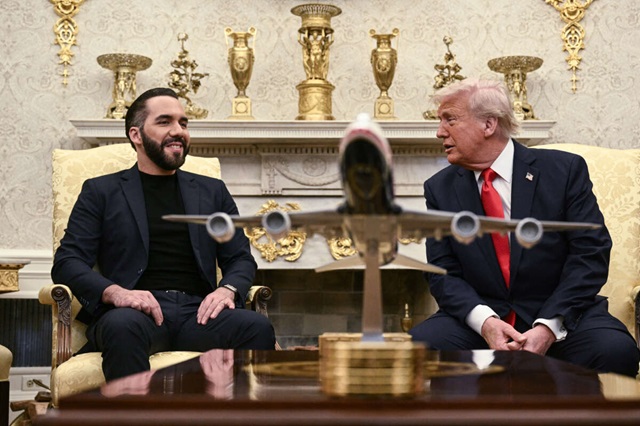
El Salvador’s President Nayib Bukele has proposed a controversial deal to swap 252 Venezuelan migrants recently deported from the United States for political prisoners detained in Venezuela. The offer, revealed by Financial Times, has ignited tensions with both the US and Venezuela, with human rights groups and politicians raising concerns over the legality and morality of the arrangement.
Bukele, who has cultivated a reputation as an authoritarian leader, suggested that the deported Venezuelans be repatriated to Venezuela under a “humanitarian agreement” in exchange for an equal number of political prisoners held by President Nicolás Maduro’s regime. “Your political prisoners haven’t committed any crime,” Bukele wrote on social media platform X, referring to Venezuela’s detainees.
The offer follows a controversial US deportation policy under the Trump administration, which has been accused of sending migrants to foreign prisons without trial. The migrants, some of whom had not been convicted of crimes, were deported to El Salvador despite a court order blocking the move. Among them was Kilmar Abrego Garcia, a man wrongfully deported due to an “administrative error,” according to court filings. His case, which has garnered public attention, led Democratic Senator Chris Van Hollen to travel to El Salvador and meet with Garcia’s family.
The Trump administration has argued that many of the deported Venezuelans are linked to criminal organizations like the Tren de Aragua, a gang the US designates as a “terrorist organization.” However, critics point out that many of these migrants have not been convicted or charged with any crime, casting doubt on the administration’s justification for their deportation.
Bukele’s proposal to swap these deportees for political prisoners has further fueled criticism, especially from human rights groups and Democratic lawmakers. Chris Van Hollen, in a statement following his meeting with Garcia’s family, decried the deportations as an abuse of migrants’ rights. The US Supreme Court recently ruled that the White House must facilitate Garcia’s return, but Bukele has refused to assist in the process, raising questions about the El Salvadoran leader’s willingness to cooperate on human rights issues.
If Maduro were to accept Bukele’s offer, it could ease the political pressure mounting on the Trump administration. The White House has been accused of denying due process to immigration detainees, and the Supreme Court’s temporary block on further deportations has placed additional scrutiny on the government’s handling of immigration policy.
The proposed swap could also serve as a diplomatic maneuver to sidestep the ongoing tensions between Washington and Caracas. Bukele’s government has had a longstanding relationship with the Trump administration, with the US praising the Salvadoran leader’s hardline stance on crime. However, the swap proposal raises uncomfortable questions about the ethics of trading individuals who are often imprisoned for their political beliefs.
The Venezuelan government, which has been battling both an economic collapse and an exodus of 7.7 million citizens due to political instability, did not immediately comment on the proposal. However, Bukele’s mention of key political prisoners—such as Roland Carreño, a journalist detained by the Maduro regime, and opposition leader María Corina Machado’s mother—adds a layer of complexity to the exchange. These individuals are seen as symbols of resistance against Maduro’s authoritarian rule.
The offer underscores the difficult geopolitical reality of a Venezuela under Maduro, where dissent is brutally suppressed, and the international community remains divided on how to address the human rights violations taking place. While Bukele’s proposal has generated mixed reactions, it highlights the intersection of immigration policy, political prisoners, and international diplomacy, with the Financial Times noting that this controversial exchange could have far-reaching implications for relations between the US, El Salvador, and Venezuela.