Editorial
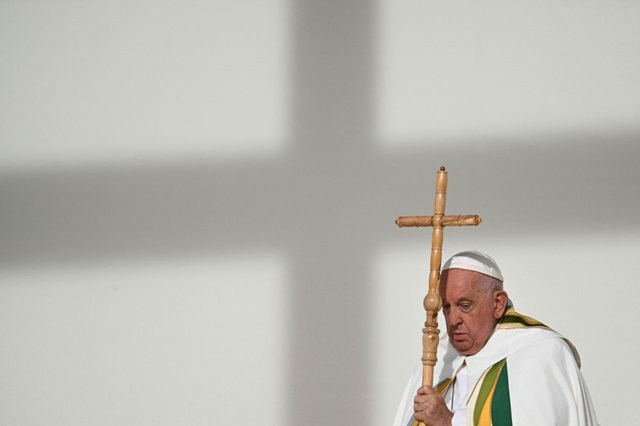
Pope Francis’s death today at the age of 88 marks the end of an epoch for the Catholic Church, one in which the often steadfast dogma of centuries was both challenged and reimagined. With his passing, the pontiff’s legacy calls for profound reflection — not just on his theological contributions, but on the seismic shifts in ecclesial praxis, the intersection of faith and society, and the contours of his radical vision of mercy and compassion. As we look back upon the pontificate of Jorge Mario Bergoglio, it is clear that his papacy was not one of mere continuity, but of monumental rupture: a rupture that, though polarising, may have irrevocably altered the future of the Church.
The Church has, in various ways, always been at the intersection of the sacred and the temporal, mediating between the eternal truths of salvation and the stark realities of human life. Yet, with Pope Francis, we witnessed a pontificate that sought to extend that bridge to the margins in ways few had dared before. From the early days of his papacy, Francis made clear that the Church’s mission was not confined to the halls of its institutions or the robes of its clergy, but was to be found in the lives of the poor, the oppressed, and the disillusioned. His oft-quoted declaration, “How I would like a Church that is poor and for the poor,” was not a mere rhetorical flourish, but an invitation to reimagine the very nature of ecclesial identity.
In his 2013 apostolic exhortation Evangelii Gaudium, Francis called for a radical shift in the way the Church engages with the world. Drawing on the ecclesiological and social insights of Vatican II, he criticised the Church’s obsession with self-preservation, which, he argued, had rendered it increasingly irrelevant in the face of the world’s real crises. “I prefer a Church which is bruised, hurting, and dirty because it has been out on the streets,” he proclaimed, invoking a vision of a Church that was not afraid to embrace the messiness of life and, by extension, the suffering of its people. This was a radical call, echoing the words of St. Augustine, who in his Confessions acknowledged the difficulty and the necessity of bearing the burdens of the world, “so that we may take part in the joy of the saints.” But where Augustine’s vision of the Church was one of spiritual ascent, Francis’s was one of incarnational solidarity, a Church immersed in the world’s trials, identifying with the broken and the marginalised.
Yet, it was precisely this ecclesial re-orientation that created the most profound controversy of his papacy. In his emphasis on mercy, Pope Francis was constantly seen as threatening the Church’s doctrinal foundations. His call for more inclusive pastoral practices, particularly in relation to divorced and remarried Catholics, those in same-sex relationships, and the broader LGBTQ+ community, put him at odds with the conservative factions within the Church, who accused him of abandoning sacred tradition in favour of an overly permissive, secularised agenda. His assertion that “Who am I to judge?” in relation to LGBTQ+ Catholics was perceived by many as a radical departure from traditional Church teachings on sexual ethics. Yet, in this, Francis was no mere liberal progressive. His appeal was to the higher moral and theological imperatives of agape, the self-giving love that Christ embodied and to which all Christians are called. This love, he contended, does not look away from human suffering, but draws near to it in its many forms — a notion that, while controversial, was undeniably rooted in the gospel.
It is not enough to view Francis’s tenure merely through the lens of these controversies. His contributions to the moral and theological life of the Church were, in many ways, deeper and more subversive. His 2015 encyclical Laudato Si’ on the environment stands as one of his most enduring legacies. In it, he argued that the ecological crisis was not simply a scientific or political issue, but one of profound spiritual significance. Drawing heavily from the Sermon on the Mount and the Gospel of Creation as seen in both the Old and New Testaments, he linked the degradation of the earth with the degradation of human dignity. “The Earth, our home, is beginning to look more and more like an immense pile of filth,” he wrote. This was an urgent theological summons to re-examine humanity’s relationship to creation, to understand that “we are all in the same boat.” In his pontificate, Francis transcended the boundaries of traditional moral discourse, placing human responsibility for the environment at the heart of Christian social teaching. In doing so, he aligned himself not with the partisan politics of his time, but with a vision of creation as a sacred trust, one that should be preserved not just for future generations, but for the glory of God.
Yet, for all his profound engagement with the world’s ills, Pope Francis remained deeply aware of the tensions inherent in his papacy. He was a man who understood that the Church was not merely a social institution or a political body, but the very corpus Christi, the living body of Christ, which was in constant need of purification and reform. This is perhaps most evident in his approach to the clerical sexual abuse crisis, which, in its systemic scale, exposed the contradictions within the Church’s own moral teaching. Francis’s efforts to bring transparency, accountability, and justice were deeply significant, but his attempts to balance these reforms with the protection of the institutional Church have often been met with mixed reactions. Some have lauded his attempts to confront the darkness within the Church, while others have criticised him for failing to enact the bold structural reforms necessary to prevent further abuse.
The tension between these two spheres — the radical openness to mercy and the need for institutional integrity — was perhaps best captured in his oft-quoted words: “No one is saved alone; we are all in the same boat.” Francis’s insistence that mercy must be the guiding principle of the Church’s response to the world’s wounds did not mean the abandonment of justice, but rather its reconfiguration in the light of the gospel. The paradoxical nature of mercy — as both inclusive and purifying — permeated his entire papacy. In his own words, “The Church must be a place of mercy freely given, where everyone can feel welcomed, loved, forgiven, and encouraged to live the good life of the Gospel.”
As his health declined in the latter years of his papacy, there were inevitable speculations about his resignation, following the example of his predecessor, Pope Benedict XVI. Yet Francis, ever the paradox, refused to step aside, even as his physical and emotional energy waned. His decision to continue in office was in many ways an act of profound theological courage, a refusal to retreat from the crucible of public service and the weight of the papacy’s responsibilities. This decision can be seen as an extension of his deeper theological understanding that suffering and sacrifice are not to be avoided, but embraced in the service of others.
In his final days, as he lay in hospital, Francis’s health became a poignant metaphor for the Church itself: fragile, imperilled, and yet still alive with the possibility of renewal. His passing, occurring as it did in the wake of his final reflections on mercy, will no doubt evoke much debate about the legacy of his papacy. Was his attempt to redefine the Church’s mission a prophetic vision of a more inclusive, merciful institution, or was it a fatal compromise with the demands of modernity? Did his attempts to reconcile traditional doctrine with the exigencies of a changing world reveal the vitality of the Church’s message, or did they expose its theological incoherence?
In his death, Pope Francis leaves the Church with more questions than answers. Yet, this may very well be his most significant gift to the world: the invitation to engage with the tensions of faith in a manner that is not satisfied by easy answers, but seeks the deeper truths that lie beneath the surface. In this way, Pope Francis’s papacy will not be remembered simply for the controversies it stirred or the reforms it instigated, but for the radical way in which it challenged the Church — and the world — to live more fully in the likeness of Christ.