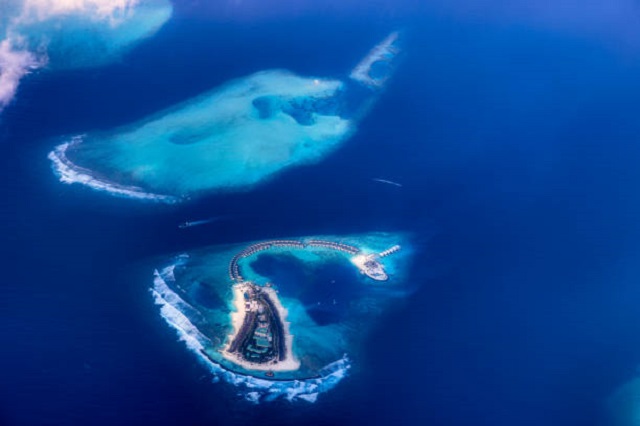
As climate change accelerates and sea levels rise, the Maldives, the world’s lowest-lying nation, is facing an existential threat. More than 90% of its islands have experienced severe erosion, and by mid-century, much of the country could become uninhabitable. In a bid to combat this crisis, a groundbreaking project is underway to harness the power of ocean currents to build and protect the nation’s islands, offering an alternative to traditional dredging methods that have long been used to reclaim land.
The Maldives’ coral atolls, which dot the Indian Ocean, are not just geological formations but the result of centuries of natural processes, with coral growing over thousands of years and shifting ocean currents pushing sand into new islands. However, these currents are unpredictable, sometimes building new sandbanks or washing them away in a matter of weeks. As the impacts of climate change intensify, finding ways to preserve these islands has become a critical concern for the country’s 500,000 residents.
One of the most innovative approaches to this problem is the Growing Islands project, which aims to capture moving sand in strategic locations to rebuild beaches and create new land for future generations. Located just south of Malé, the capital, the project is testing a new technology called the Ramp Ring. This structure consists of six submerged geotextile bladders that form a 90-meter-long ring in the En’boodhoofinolhu Lagoon. Deployed in December 2024, these bladders have already begun to show promising results. By February 2025, underwater images revealed that sand had accumulated up to a meter and a half on the surface of the bladders, demonstrating how passive structures can quickly replenish beaches.
Skylar Tibbits, an architect and founder of the MIT Self-Assembly Lab, which is spearheading the project, describes the success of the Ramp Ring as a significant breakthrough. “There’s just a ton of sand in there. It’s really looking good,” he says. The Self-Assembly Lab, known for its work in creating material technologies that can “self-assemble” using natural forces like gravity and sunlight, has been testing various methods in the Maldives since 2017. The Ramp Ring is the largest and most ambitious of these tests, designed to capture sand year-round, regardless of shifting seasonal currents. This omnidirectional capability marks a significant improvement over previous structures, which were only effective during specific seasons.
The Growing Islands project represents a more sustainable approach to coastal protection compared to traditional methods like dredging. Dredging, which involves pumping sand from the seabed and spraying it onto beaches, has been the primary technique used for land reclamation in the Maldives since the 1990s. While effective in the short term, dredging has several downsides: it leaves behind dead zones where sand has been extracted and creates plumes of sediment that damage marine ecosystems. Last year, the Maldivian government placed a temporary ban on dredging to prevent further harm to coral reefs, which are already under threat from rising ocean temperatures.
Holly East, a geographer at the University of Northumbria, calls the Growing Islands project an exciting alternative to dredging, though she emphasizes the importance of carefully siting the structures to avoid disrupting natural sand flows that help build the islands’ coastlines. Tibbits and his team are conducting long-term satellite analysis of the En’boodhoofinolhu Lagoon to better understand sediment flows and to refine their approach. They are also developing a predictive coastal intelligence platform, called Littoral, which will provide real-time data on where erosion is likely to occur and where new protective structures like the Ramp Ring should be placed.
The Growing Islands initiative has garnered support from a range of partners, including the National Geographic Society, MIT, and the Sri Lankan engineering group Sanken. It has also received backing from tourist resort developers who stand to benefit from more sustainable coastal protection methods. In 2023, the project received a major boost from the U.S. Agency for International Development (USAID), which provided a $250,000 grant to fund the construction of the Ramp Ring and to help scale the project. However, with the termination of most USAID contracts following the inauguration of President Trump, the project now faces the challenge of finding new partners to continue its work.
Despite these challenges, the Growing Islands project represents a promising model for how natural forces can be harnessed to address the pressing challenges of climate change and rising sea levels. As the Maldives looks for ways to safeguard its future, the success of projects like this could offer valuable lessons for other low-lying nations facing similar threats.