With the funeral of Pope Francis set for Saturday, the Catholic Church is witnessing a profound departure from centuries of tradition. The late pontiff, known for his humility and reformist zeal, has orchestrated a final farewell that reflects the values he championed in life — simplicity, fraternity, and pastoral care over regal spectacle.
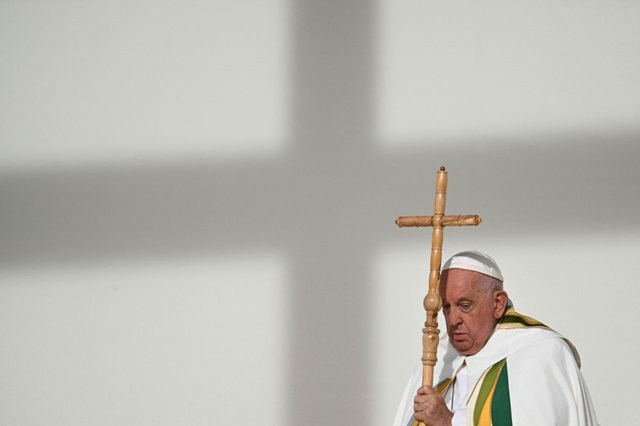
In stark contrast to the elaborate ceremonies of his predecessors, Francis lies in state at St. Peter’s Basilica without papal regalia or the towering catafalque once customary for deceased popes. His body rests low to the ground, devoid of the triple-tiered crown that once symbolized the Church’s worldly power — a crown last regularly used by Pope Pius XII, who died in 1958.
As reported by the Financial Times, Francis will be interred not in the traditional crypt beneath St. Peter’s, but in the basilica of Santa Maria Maggiore, his favored church in Rome. There, his grave will be marked by a simple stone inscribed “Franciscus.” The choice of a single wooden coffin, rather than the traditional triple-nested ones of cypress, lead, and oak, is a further break from past rituals.
“Pope Francis wanted to testify that in his life, and in death, he was faithful to the evangelical message: the message of poverty, simplicity and fraternity towards everyone,” said historian Daniele Menozzi, a scholar of church history.
Historically, papal funerals have often resembled royal pageants. From the Middle Ages to the early 20th century, popes lay in state atop lofty biers, flanked by guards and clergy in vivid regalia, their deaths followed by days of public mourning and tightly choreographed rites. These ceremonies reinforced both the pope’s temporal authority and the unbroken continuity of the Church.
That began to change after 1963, when reforms initiated by Pope John XXIII and later popes sought to align church rituals more closely with modern sensibilities. But Pope Francis has taken the most radical steps yet to dismantle the vestiges of the Church’s monarchical past.
“The medieval papacy is now finished,” said Agostino Paravicini Bagliani, honorary professor of medieval history at the University of Lausanne. “The pope is no longer a temporal ruler. We are now in a time of more complete abandonment of the old symbolism, and an emphasis on what it takes to be a religious man.”
Symbolic rituals have also been pared back. Francis’s papal ring was smashed and his apartment sealed by the camerlengo, Cardinal Kevin Farrell — rites preserved from earlier centuries but performed with minimal fanfare.
Even among past popes, some funerals were marred by controversy. Pius XII’s 1958 death was notorious for a botched embalming that led to his body decomposing visibly while on display, overpowering a Swiss Guard. That debacle marked the end of elaborate funeral science experiments and, symbolically, the close of a gilded era.
Earlier still, the church saw violent reactions to unpopular pontiffs. The 9th-century Pope Formosus was posthumously exhumed and put on trial, while Renaissance popes like Alexander VI faced riots and desecration. Such dramatic episodes underscore the evolving role of the papacy — once deeply intertwined with political rule — now reshaped into a spiritual office grounded in pastoral leadership.
“This funeral is not about power, but about witness,” said Archbishop Diego Ravelli, who oversees apostolic ceremonies. The Vatican last year approved new simplified rites for future pontiffs, at Francis’s behest.