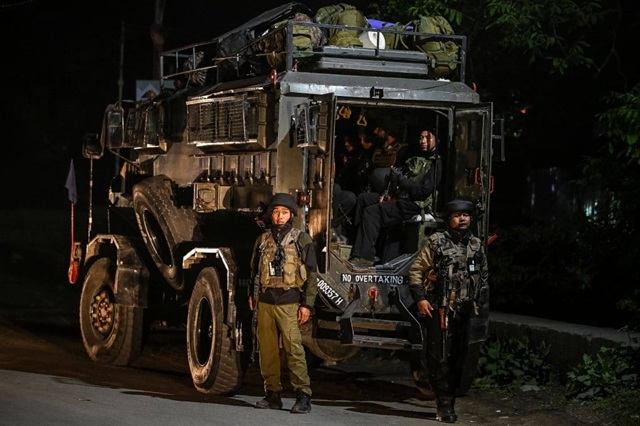
Tensions between India and Pakistan have surged to their highest levels in years after troops exchanged fire across the disputed Kashmir border for a third consecutive night, officials confirmed on Sunday.
The renewed clashes come after a brutal attack on April 22 in Pahalgam, a popular tourist destination in Indian-administered Kashmir, where gunmen killed 26 civilians — the deadliest assault on civilians in the region in a quarter-century. India has blamed Pakistan for supporting “cross-border terrorism,” a charge Islamabad has firmly denied, dismissing any links to the attack as “frivolous” and warning against potential retaliation.
India’s military reported that Pakistani forces initiated “unprovoked” small arms fire along the Line of Control (LoC), the de facto border dividing Kashmir. Indian troops responded “effectively,” according to the military. Pakistan has not issued any public statement regarding the latest exchanges.
Amid rising hostilities, India has escalated its security measures. The Indian navy on Sunday released footage of missile-firing drills aimed at demonstrating the country’s long-range precision strike capabilities, although the locations were not disclosed. Meanwhile, Indian security forces continue an intensive search for the perpetrators behind the Pahalgam attack.
Indian police have issued wanted posters for three suspects — two Pakistanis and one Indian — allegedly linked to Lashkar-e-Taiba, a Pakistan-based group designated as a terrorist organization by the United Nations. The investigation has been formally handed over to India’s National Investigation Agency (NIA), specializing in counterterrorism operations.
“The eyewitnesses are being questioned in minute detail to piece together the sequence of events that led to one of the worst terror attacks in Kashmir,” the NIA said in a statement on Sunday.
Pakistan’s Prime Minister Shehbaz Sharif has offered to participate in a “neutral, transparent and credible investigation” into the Pahalgam incident, but Indian officials remain skeptical. According to The Indian Express, senior Indian government sources have hinted that a military response is being discussed, with “the nature of the strike” still under deliberation.
On the ground in Kashmir, Indian authorities have intensified their crackdown on suspected militant support networks. Over the weekend, Indian forces demolished the family home of one suspect, Farooq Ahmad Tadwa, in Kupwara district. This demolition marks the ninth such action targeting alleged militant properties since the Pahalgam attack, a police official said.
In addition to military and security measures, New Delhi has announced sweeping diplomatic steps: suspending the Indus Waters Treaty for water-sharing with Pakistan, shutting down the Wagah-Attari border crossing, downgrading diplomatic relations, and canceling visas for Pakistani citizens.
Islamabad retaliated by expelling Indian diplomats and military advisers, cancelling visas for Indian nationals — except Sikh pilgrims — and sealing the border crossing from its side. Protests erupted in Pakistan, including demonstrations in Lahore where banners featuring Indian flags and Prime Minister Narendra Modi’s image were burned.
During his monthly radio address on Sunday, Modi vowed that the victims of the Pahalgam attack “will get justice.” He accused “terrorists and their patrons” of plotting to “destroy Kashmir again” through orchestrated violence.
The United Nations has called for “maximum restraint” from both sides and urged peaceful dialogue to resolve the crisis. However, the current trajectory marks a worrying escalation not seen since 2019, when a suicide bombing in Kashmir led to deadly Indian airstrikes inside Pakistan, nearly sparking full-scale war between the nuclear-armed neighbors.
Kashmir remains a flashpoint between India and Pakistan since their independence in 1947, with both countries claiming the region in full but controlling separate parts of it. The ongoing hostilities threaten to further destabilize a region already marred by decades of violence and unrest.