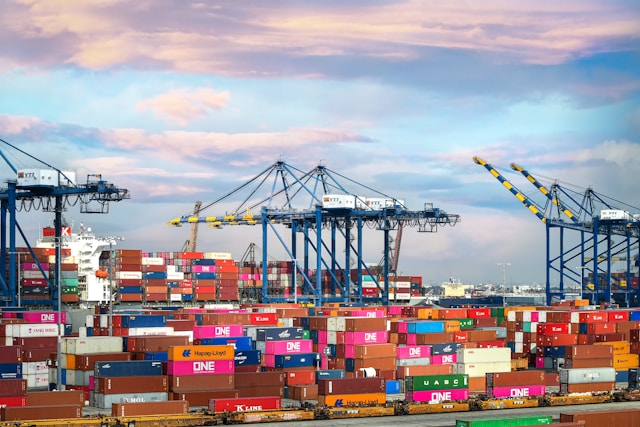
The Port of Los Angeles, the largest container port in the United States and the country’s leading gateway for imports from China and other Asian economies, recorded its busiest three-month period on record between July and September, as strong consumer demand and changing trade conditions sustained cargo volumes despite continued uncertainty over tariffs.
The port handled almost three million twenty-foot equivalent units (TEUs) during the quarter, according to executive director Gene Seroka, who announced the figures at a media briefing on Friday. TEUs are the standard industry measure of cargo capacity based on a single 20-foot shipping container.
“If there was ever a time for a drum roll, this is it,” Seroka said. “July through September was our best quarter in port history at almost three million TEUs. Stretch it back to June, and we moved almost four million container units. That’s the strongest four-month stretch that we’ve ever had.”
Seroka attributed the increase to several factors, including lower tariffs than in 2025, strong consumer demand ahead of the festival season and continuing operational challenges at the Suez and Panama canals. Imports through the port rose 19 per cent year on year in September, while exports increased by 10 per cent.
Despite the overall growth, outbound cargo volumes remained weaker than normal. “Outbound volumes remain softer than normal, which reflects the ongoing challenges facing American farmers and manufacturers,” Seroka said.
China remains the port’s largest source of imports, although its share has declined substantially in recent years. Chinese goods accounted for approximately 60 per cent of imports through Los Angeles in 2018, but that proportion is projected to fall to 40 per cent in 2026. Vietnam ranks second among the port’s sources of imports, reflecting a wider shift in the geography of US trade.
Data from the Office of the United States Trade Representative show that US imports from China totalled US$308 billion in 2025, a decline of nearly 30 per cent. Imports from Vietnam increased by 42 per cent over the same period.
However, the changing figures do not necessarily indicate that supply chains have become independent of Chinese manufacturing. Willy Shih, a professor at Harvard Business School, said countries such as Vietnam and Mexico had experienced substantial growth in exports to the United States while continuing to rely on Chinese intermediate goods.
“So companies, in some sense, are rearranging the final assembly step while the upstream dependence remains,” Shih said during the Los Angeles port briefing.
His assessment highlights the distinction between changing the location where goods are assembled and reducing dependence on the components and materials used to manufacture them. Although companies have diversified their production and export routes, Chinese inputs remain part of supply chains serving the American market.
Shih also questioned whether recent diplomatic engagement between Washington and Beijing had provided businesses with sufficient certainty to plan their operations. Following last month’s summit between Chinese President Xi Jinping and US President Donald Trump in Washington, he described the economic outcomes as modest, arguing that both governments had postponed resolving important disputes.
The two countries agreed to extend their Busan trade truce until 10 January 2027, two months beyond its original expiry date of 10 November. They also launched a Board of Trade mechanism covering non-sensitive products worth up to US$30 billion on each side that would be eligible for tariff reductions.
Xi and Trump are scheduled to meet again next month at the Asia-Pacific Economic Cooperation gathering in Shenzhen, Guangdong province, in southern China, followed by another meeting at the Group of 20 summit in Miami, Florida, in December.
Despite these diplomatic initiatives, Shih said the two governments continued to approach economic relations differently, with Washington adopting what he described as a transactional approach and Beijing pursuing a strategic one. The difference, he argued, left traders uncertain about the durability of the arrangements governing bilateral commerce.
“People need a longer horizon where they can have some stable framework, a stable set of rules to engage in their planning,” Shih said. “So until our leaders get together and get some stability, we are just going to have to be in an environment where people are planning contingencies and creating options.”