Editorial
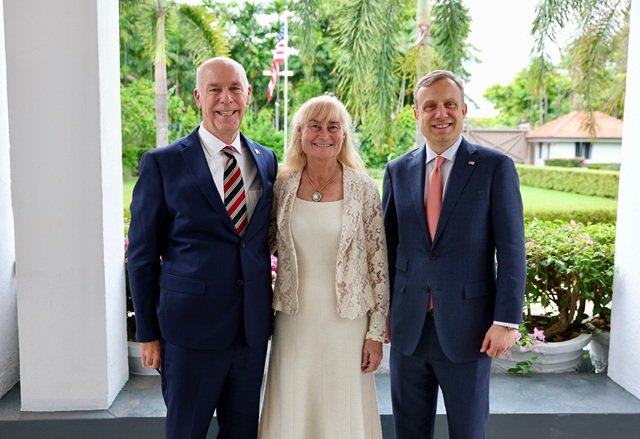
Greg Gianforte’s visit to Sri Lanka this week was presented as a mission to expand trade, critical-mineral cooperation and security ties. Montana’s Republican governor met officials responsible for industry, defence and trade, alongside the US ambassador and Montana National Guard chief Brigadier General Trent Gibson. The official account highlighted Sri Lankan vein graphite, Montana’s mining expertise, agricultural exports, industrial hemp, disaster response, maritime and air-domain awareness, port resilience and possible US Coast Guard cooperation. These subjects concern resources, markets and the Indian Ocean’s strategic geography. A mission framed around mutual benefit should prompt a harder question: what does partnership mean when the parties possess unequal economic and military power?
Montana is marketed through mountains, wilderness, ranches and frontier independence. Its landscape is beautiful; its history is not innocent. Before the United States claimed the territory, Indigenous nations including the Piikuni of the Blackfeet Confederacy, the Apsáalooke or Crow, Salish, Pend d’Oreille, Kootenai, Assiniboine, Gros Ventre, Northern Cheyenne and Lakota maintained their own societies and territorial authority. American expansion did not enter an empty land. It entered homelands, then used military force, treaty changes, settlement and federal law to transfer control.
One atrocity was the Marias Massacre of 23 January 1870. US Army troops commanded by Major Eugene Baker attacked a Piikuni camp led by Chief Heavy Runner. The Montana Historical Society records almost 200 deaths, mostly women, children and elderly people; many victims were sick with smallpox, while able-bodied men were away hunting. Heavy Runner was shot despite presenting papers identifying him as friendly to white Americans. Soldiers burned tipis and possessions and seized horses, worsening survivors’ prospects in winter. Montana newspapers initially hailed Baker before testimony challenged the official account. The gap between military victory and slaughtered families is stark.
Violence also operated through deprivation. In winter 1883–84, the Blackfeet faced catastrophic famine after the buffalo economy collapsed and government rationing failed. An account preserved by the American Archive of Public Broadcasting describes ration cuts, delayed supplies and spoiled food. The often-cited estimate is nearly 600 deaths, around a quarter of the Piegan population discussed in historical accounts. It is an estimate, not a perfect census. Authorities helped destroy a way of life and failed to provide reliable alternatives. Policy, neglect and loss of food sovereignty converged.
Land was taken through law as well as violence. The Dawes Act of 1887 divided communal tribal lands into individual allotments and opened surplus land to non-Native settlement. Across the United States, Indigenous landholdings fell from about 138 million acres in 1887 to 48 million by 1934, according to federal records. In Montana, Blackfeet territory was reduced through successive agreements. In 1895, the United States negotiated the purchase of roughly 800,000 acres along the reservation’s western edge; ratified in 1896, the agreement transferred land later incorporated into Glacier National Park. The park’s ecological splendour is real, but its history is incomplete if conservation is celebrated while Indigenous dispossession becomes a footnote.
The boarding-school system attacked continuity between generations. Federal authorities removed Native children from families and sought to suppress Indigenous languages and identities through assimilation. A 2024 US Department of the Interior investigation identified at least 973 deaths of Native children at federal Indian boarding schools nationwide. This is not a Montana-only count and does not measure the full damage to families. The deaths and assimilationist purpose show why the system cannot be described merely as education.
These histories do not make Gianforte personally responsible for nineteenth-century crimes. Elected governor in 2020 and re-elected in 2024, he is a contemporary leader. The question is what his administration does with inherited inequalities. Does consultation with tribal governments translate into authority over land, water and sacred places, or are Indigenous nations invited to comment after decisions are made? Historical acknowledgement matters only when it changes present practice.
That test should apply to Sri Lanka too. Gianforte’s office says officials explored graphite research, processing and value-added development, and stronger links between Montana pulse producers and Sri Lankan importers. They also discussed disaster-response training, maritime and air-domain awareness, port resilience and possible Coast Guard cooperation. The announcement describes opportunities, not confirmed mining investments, export contracts or a new military-basing agreement. Sri Lanka should demand clear terms. Will graphite be processed locally, creating skilled jobs, or exported while higher-value stages happen elsewhere? Will agricultural imports benefit consumers without unfairly damaging local farmers? Which commitments will be public and independently reviewable?
The security dimension requires scrutiny. Sri Lanka and Montana have cooperated through the US National Guard’s State Partnership Program since 2021. On 14 November 2025, Sri Lanka’s Ministry of Defence announced a memorandum formalising cooperation involving the Montana National Guard, US Coast Guard District 13 and Sri Lankan armed forces, including disaster response, maritime awareness and professional military education. This public agreement does not prove a secret loss of sovereignty or abandonment of non-alignment. But transparency is essential. The government should publish security agreements, disclose operational or information-sharing commitments and clarify parliamentary oversight. Claims that undisclosed agreements have surrendered neutrality require documentary evidence. Citizens still have a right to ask what has been signed, what remains confidential and why. The public deserves evidence, not reassurance or geopolitical guesswork alone.
Non-alignment cannot mean refusing every partnership. Disaster training can save lives; ports need protection; trade and research can create opportunities. The danger begins when cooperation becomes dependency, sensitive information is shared without safeguards, or a smaller state’s choices are shaped by a powerful partner’s priorities. Sri Lanka’s Indian Ocean location guarantees outside interest. The answer is neither hostility to Washington nor unquestioning trust, but a transparent policy applying the same standards to the United States, China, India and every other partner.
Montana’s history offers a warning. Its story of opportunity grew alongside Indigenous dispossession; gains for some accompanied losses of land, food systems and cultural security for others. That does not make every trade proposal exploitative. It shows why mutual-benefit claims must be tested against ownership, power and consequences. Sri Lanka should neither romanticise a visiting governor’s home state nor reduce him to its darkest past. It should ask what this history teaches about consent, sovereignty and accountability.
A respectful partnership requires more than ceremonial meetings. It requires fair contracts, technology transfer, protection for local livelihoods, scrutiny of security arrangements and consultation with affected communities. It also requires honest acknowledgement of Montana’s massacres, starvation and forced assimilation. Justice measures whether trade is fair. Security is not merely interoperability between armed forces; it includes protection from secret commitments and decisions made beyond public scrutiny. Gianforte’s visit should be judged not by diplomatic warmth, but by the documents published, benefits reaching ordinary people and Sri Lanka’s freedom to decide for itself.