The Indian government will carry out a massive nationwide civil defence drill on Wednesday, marking its most extensive preparedness exercise since the 1971 war with Pakistan, as military tensions reach alarming levels following a deadly terror attack in Kashmir last month.
The Home Ministry has directed states and federal territories to conduct coordinated mock drills, which include testing air raid warning sirens, blackout protocols, evacuation plans, and civilian emergency response training. The drills are being conducted in the aftermath of a terror strike in Jammu and Kashmir that killed 26 people on April 22 — one of the deadliest attacks in the region in years. Though officials have avoided directly naming Pakistan in connection with the drills, the timing and scale underscore India’s rising concerns about potential escalation.
A senior official from the Home Ministry, speaking on condition of anonymity, said the exercises are meant to boost civil preparedness nationwide, without elaborating on whether they were a direct response to the Kashmir attack. The exercises are expected to include schools, workplaces, and transportation hubs, with the public urged to participate in what many are calling a “nationwide war mock drill.”
The attack in Pahalgam, which targeted tourists in Indian-administered Kashmir, has sharply deteriorated already fragile diplomatic ties between New Delhi and Islamabad. India blamed Pakistan for backing the militants responsible, an allegation Islamabad strongly denies. In the days that followed, India expelled Pakistani diplomats, suspended visa services, closed border crossings, and even halted a key water-sharing agreement.
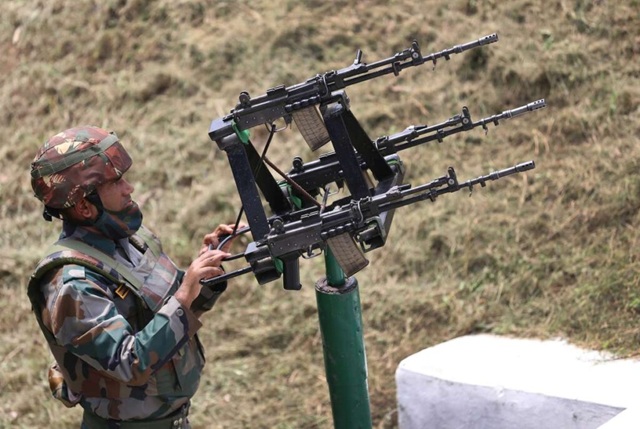
Cross-border shelling at the Line of Control (LoC) has continued nightly for 11 consecutive days, breaking a ceasefire agreement reached in February 2021. Pakistani ministers have warned that any Indian military action would be met with force, heightening fears of a broader conflict.
Pakistan has responded militarily and diplomatically. On Monday, it conducted its second missile test in three days, launching the short-range Fateh surface-to-surface missile, following the earlier test of the Abdali ballistic missile with a range of 450 kilometers. Pakistani Prime Minister Shehbaz Sharif declared that the successful tests demonstrate the nation’s readiness to defend itself.
The current wave of hostility has triggered international alarm. United Nations Secretary-General António Guterres has warned that relations between the two nuclear-armed neighbors are at their “boiling point” and urged both sides to exercise “maximum restraint” to avoid a military confrontation that “could easily spin out of control.”
The United Nations Security Council held a closed-door session on Monday, requested by Pakistan, to address the growing crisis. Pakistan used the meeting to urge the UNSC to take measures to maintain peace and security in the region.
India’s diplomatic response has also gained support from allies. Russian President Vladimir Putin held a call with Prime Minister Narendra Modi to condemn the Kashmir attack and express solidarity with India in its “fight against terrorism.” The Russian embassy in New Delhi confirmed both leaders reaffirmed the need for an “uncompromising” stand against terrorism.
The rising tensions have been amplified by a flurry of nationalist sentiment on Indian social media, where many users have shared images and videos of local schools and institutions participating in pre-drill activities. Posters and messages urging public involvement in the upcoming drills have been widely circulated by supporters of the ruling Bharatiya Janata Party (BJP).
However, critics on Indian social media have accused the government of using the mock drills as a diversion from domestic challenges and ongoing unrest in the region. Still, government officials maintain that the primary aim is to ensure civilian safety in the event of external threats.
The drills come amid broader instability along the 740-kilometer LoC dividing Indian and Pakistani-administered Kashmir, a flashpoint that has fueled three wars and numerous skirmishes since the partition of British India in 1947. Both nations claim Kashmir in full but administer separate portions.
As tensions continue to escalate, both sides appear to be hardening their positions, with little indication of diplomatic resolution in sight. While global leaders call for de-escalation, the situation on the ground remains volatile and unpredictable, with millions of civilians on both sides bracing for what could come next.