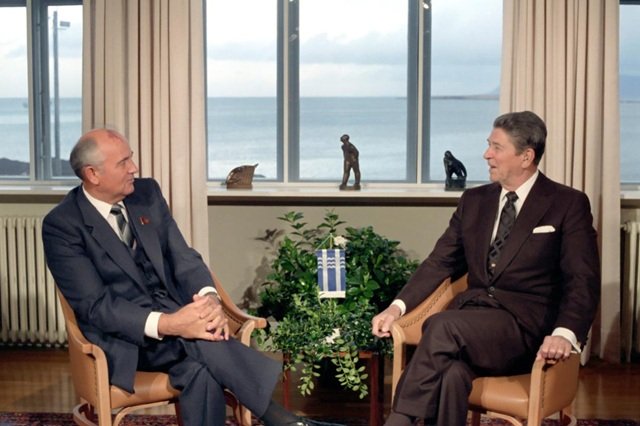
President Ronald Reagan seriously considered a Soviet proposal to eliminate all nuclear weapons by the year 2000, challenging the view that Washington dismissed the initiative as propaganda, according to declassified documents released by the National Security Archive to mark the 40th anniversary of the Reykjavik Summit.
The records reveal that Reagan and Soviet leader Mikhail Gorbachev shared a genuine interest in nuclear abolition, but that their ambitions confronted deep divisions within the US administration, disagreements over missile defence and opposition from important American allies. Although Washington ultimately declined to embrace the Soviet programme in its entirety, the initiative prompted an extensive reassessment of US arms-control policy and contributed to the negotiations that culminated in the Intermediate-Range Nuclear Forces (INF) Treaty in December 1987.
The National Security Archive’s latest release brings together previously classified correspondence, policy assessments, intelligence reports and minutes of high-level meetings documenting the American response to Gorbachev’s proposal. The collection includes Gorbachev’s letter to Reagan dated 14 January 1986, the president’s formal response of 22 February, confidential assessments by senior defence and arms-control officials, and records of consultations with governments in Europe and Asia. Together, the documents show how a proposal regarded by some officials as a Soviet propaganda exercise became the subject of serious debate at the highest levels of the American government.
The initiative followed the Geneva summit of November 1985, the first meeting between American and Soviet leaders in more than six years. Reagan and Gorbachev had declared in their joint statement that “nuclear war can not be won and should never be fought”. Yet progress on arms control subsequently stalled. Gorbachev’s January 1986 initiative was intended to revive the negotiations through a detailed programme for eliminating nuclear weapons, an objective he believed Reagan’s publicly expressed commitment to a nuclear-free world might make achievable.
The origins of the proposal lay in the spring of 1985, shortly after Gorbachev became Soviet leader. Marshal Sergei Akhromeyev, chief of the General Staff, initiated work on a comprehensive nuclear abolition programme with Deputy Foreign Minister Georgy Kornienko and General Nikolai Chervov, who headed the General Staff’s Legal and Treaty Department. Selected military experts were instructed to develop the plan, which remained known to relatively few people until late 1985.
According to accounts cited in the National Security Archive’s publication, some of the Soviet officials who drafted the initiative expected the Americans to reject it. Andrey Grachev, Gorbachev’s spokesman and biographer, described the planners’ calculations as partly strategic: a proposal for total abolition could strengthen Moscow’s negotiating position even if Washington refused to accept it. General Viktor Starodubov recalled Akhromeyev’s reasoning that “if by any chance the Americans accepted the idea, the Soviet side would be able to make full use of its advantage in conventional weapons.”
Gorbachev, however, saw the initiative as more than a negotiating manoeuvre. He approved the programme in late December 1985 and announced it publicly on 15 January 1986. Its three-stage framework envisaged an initial 50 per cent reduction in strategic nuclear weapons over five to eight years, alongside the elimination of all medium-range nuclear weapons in Europe. From 1990, Britain, France and China would join the process by freezing their arsenals, while nuclear powers eliminated tactical weapons and banned nuclear testing. The final stage envisaged the elimination of all remaining nuclear weapons from 1995. The plan also called for a ban on space weapons and strict adherence to the Anti-Ballistic Missile (ABM) Treaty.
Reagan’s private response was considerably more receptive than the attitudes of several senior officials. After a lengthy meeting with Secretary of State George Shultz and national security adviser John Poindexter on 15 January, the president wrote in his diary that “we’d be hard put to explain how we could turn it down”. Following a National Security Planning Group meeting on 3 February, he recorded his opposition to dismissing the initiative without serious consideration: “Some wanted to tag it as publicity stunt. I said no. Lets say we share their overall goals & now want to work out the details. If it is a publicity stunt it will be revealed by them.”
Paul Nitze, a senior US arms-control adviser, recalled Reagan’s first reaction after he and Shultz briefed the president on Gorbachev’s letter: “Why wait until the year 2000 to eliminate all nuclear weapons?” Reagan repeatedly drew attention to the Soviet leader’s decision to establish a specific deadline, which he believed made the proposal more credible.
Shultz emerged as the administration’s most prominent advocate of engaging with the Soviet initiative. In a speech to the State Department’s arms-control group on 17 January, he directly challenged officials who opposed the president’s objective. “The president of the United States doesn’t agree with you, and he has said so on several very public occasions both before and since the last election,” he said. “He thinks it’s a hell of a good idea.”
Shultz argued that Washington should develop its own comprehensive response rather than allow the proposal to be dismissed as propaganda. In his view, the Soviet initiative offered an opportunity to reshape the terms of negotiations while advancing Reagan’s ambition. He also believed that eliminating nuclear weapons could alter the strategic balance, arguing that the Soviet Union’s status as a superpower depended substantially on its nuclear and ballistic missile capabilities.
Defence Secretary Caspar Weinberger and Kenneth Adelman, director of the US Arms Control and Disarmament Agency, strongly opposed a more ambitious response. Weinberger described Gorbachev’s initiative as “a largely unhelpful and propagandistic posture struck by Mr. Gorbachev”. He argued that Moscow was attempting to divert American attention from the Strategic Defence Initiative, or SDI, and undermine its prospects of success. Adelman similarly described the plan as “largely propaganda”, warning that Gorbachev was using Reagan’s vision of a nuclear-free world as leverage to constrain the missile defence programme. Assistant Secretary of Defence Richard Perle was also a determined opponent. According to Shultz’s memoirs, Perle called the president’s dream of a nuclear-free world “a disaster, a total delusion”.
The dispute was not confined to Washington. Reagan’s administration consulted European and Asian governments before settling on its response, and the resulting reports exposed considerable concern about the consequences of nuclear abolition for Western security. British Prime Minister Margaret Thatcher strongly opposed an arrangement that could eliminate the American nuclear umbrella on which she believed deterrence depended. Other allies worried that abandoning nuclear weapons would leave conventional military imbalances unresolved and weaken the cohesion of the North Atlantic Treaty Organisation. West German Chancellor Helmut Kohl was an exception, supporting both total nuclear elimination and the removal of intermediate-range missiles from Europe.
The internal debate also centred on whether Washington should modify its position on SDI and the ABM Treaty. Shultz favoured greater flexibility, while Weinberger and other defence officials opposed concessions that might constrain American missile defence research. At a National Security Planning Group meeting on 3 February, officials eventually backed an intermediate approach: reframing the Soviet proposal in American terms and pursuing negotiations on intermediate-range nuclear forces without abandoning existing US positions on nuclear and space defence.
Reagan’s formal letter to Gorbachev on 22 February described the Soviet proposals as “significant and positive”. It offered a framework for 50 per cent reductions in strategic nuclear forces and the elimination of intermediate-range missiles, but did not accept the complete three-stage abolition programme. Washington maintained that further reductions would have to take account of conventional military imbalances, regional conflicts, verification and the future of SDI. The administration’s public diplomacy guidance also shifted attention away from immediate total abolition towards conditions that would have to be met before the United States could seriously contemplate a nuclear-free world.
The delay and limited scope of the American response left Gorbachev frustrated. On 4 April, during a meeting with US congressmen Dante Fascell and William Broomfield, he complained that Washington had failed to test his intentions by engaging seriously with the proposal. Fascell acknowledged the limits of the American position, telling Gorbachev: “The reality is such that the United States is not ready, for some reason—either political or military, I don’t know—they are not capable to make the big leap, which you are calling for, at this time.”
Nevertheless, the initiative continued to influence American policy during the months before Reykjavik. Internal reviews examined nuclear strategy, verification, missile defence and the possibilities for deeper reductions. By June, Shultz was arguing that the United States needed to be seen as participating actively in the process, declaring at a high-level meeting that the “stage was set for something dramatic”.
Gorbachev’s subsequent letter of 15 September 1986 provided the impetus for the Reykjavik summit, which he had initially envisaged as a relatively brief, face-to-face meeting in Iceland or London. The October summit did not deliver the comprehensive nuclear abolition agreement sought by the two leaders, but the negotiations helped prepare the ground for the INF Treaty signed in December 1987, which committed the United States and the Soviet Union to eliminate an entire category of ground-launched intermediate-range missiles.