China has taken a major leap in space technology by launching the first batch of satellites for its ambitious space computing constellation, aiming to create the world’s first supercomputer operating entirely in orbit. This groundbreaking project promises to revolutionize data processing by addressing a critical bottleneck in satellite communications.
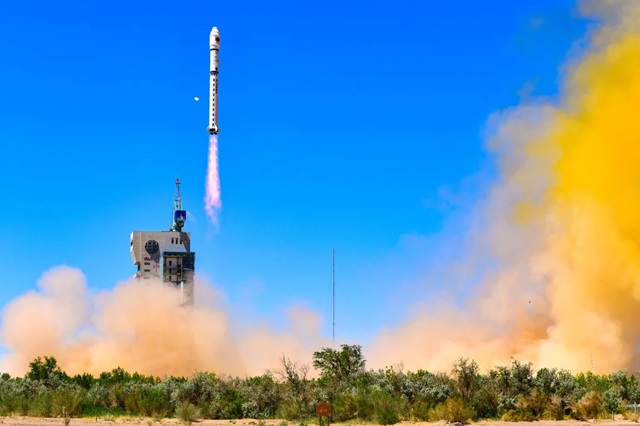
On Wednesday, twelve satellites equipped with intelligent computing systems and advanced inter-satellite communication links were successfully launched aboard a Long March 2D rocket from the Jiuquan Satellite Launch Centre, according to China’s state media outlet Guangming Daily.
These satellites form the initial segment of the Three-Body Computing Constellation, an innovative space-based infrastructure developed by Zhejiang Lab. Once fully operational, the constellation is expected to achieve an astonishing total computing power of 1,000 peta operations per second (POPS)—equivalent to one quintillion operations per second—making it competitive with the world’s most powerful ground-based supercomputers. For context, the United States’ El Capitan supercomputer currently holds the top spot with 1.72 quintillion operations per second.
The constellation’s design enables real-time, in-orbit data processing, drastically reducing reliance on Earth-based ground stations. Currently, less than 10 percent of the data collected by satellites makes it back to Earth due to limited bandwidth and transmission delays. This new system will process massive amounts of raw data directly in space, offering faster and more efficient analysis for applications like astronomical observations and satellite communications.
Jonathan McDowell, a Harvard astronomer and space historian, commented on the growing trend of cloud computing in orbit, noting its environmental benefits. “Orbital data centres can use solar power and radiate their heat to space, reducing the energy needs and carbon footprint,” he said. With data centers worldwide consuming over 1,000 terawatt hours of electricity annually—comparable to Japan’s total electricity use—space-based solutions could alleviate the environmental impact of Earth-bound data centers.
The twelve newly launched satellites each boast computing capabilities of up to 744 trillion operations per second. Linked by high-speed laser communication systems capable of 100 gigabits per second data transfer rates, the network currently operates at 5 POPS combined computing power with 30 terabytes of on-board storage. The satellites also carry an AI model with 8 billion parameters, enabling sophisticated processing of satellite data on the fly.
This project is the result of collaborative efforts involving Zhejiang Lab, Guoxing Aerospace (which developed the intelligent satellite platforms), and HiStarlink, a laser communication startup responsible for the optical data terminals.
China’s Three-Body Computing Constellation represents a significant milestone in the global space race, positioning Asia at the forefront of a new era in orbital computing and data management. With the first substantial flight test now complete, the future of space-based supercomputing is officially underway.