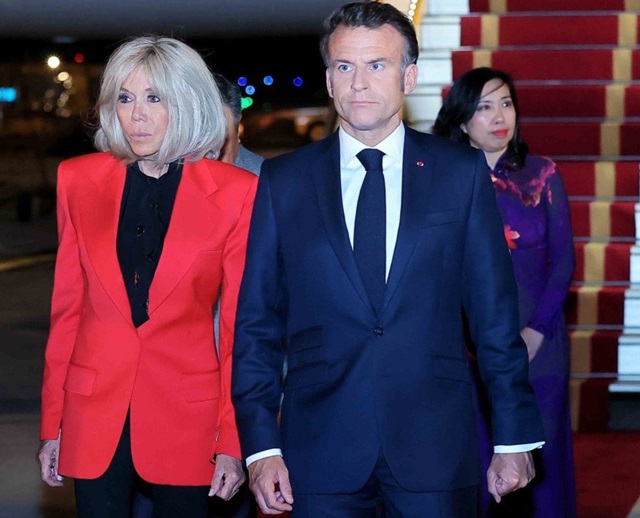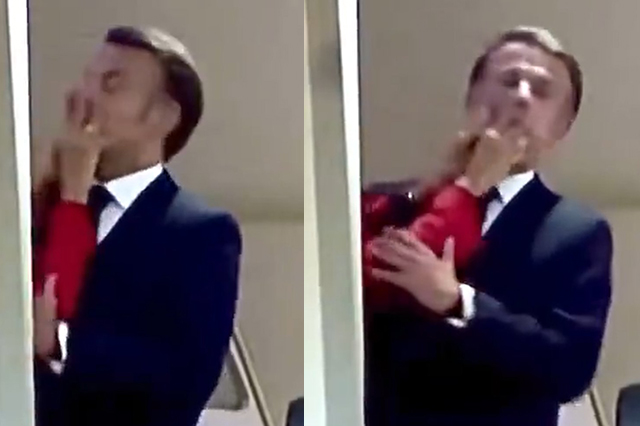
Oh, to be shoved in public by one’s wife, on foreign soil, in front of cameras, with one’s existential dignity crumpling like a pressed shirt in humid Hanoi. The Macrons touched down in Vietnam with all the fanfare expected of a diplomatic visit — until Brigitte’s hands, like two swift instruments of marital reality, reached out and reminded her husband, and the world, that no matter how presidential one may feel, one is never truly off the leash.
Was it aggression? Playfulness? A French version of, “darling, your head’s in the way”? We may never know. But in that brief moment — that blink in time — Brigitte’s double-handed “shoveling” of Emmanuel’s unsuspecting face delivered more than a physical nudge. It delivered a metaphysical one. The type that says: You may command a republic, monsieur, but you will always be second-in-command on the home front.

And what a performance it was. Emmanuel’s body, moments before the Incident, was the picture of calm — relaxed wrists, a neutral face, the serenity of a man who believed the next few seconds would belong to predictable protocol. But alas, as with the assassination of Julius Caesar or the time Theresa May danced on stage, the universe often tosses in a twist we didn’t know we needed.
Brigitte, with both hands, executed what can only be described as a ceremonial repositioning. The face-shove — not quite a slap, not quite a caress — seemed to be loaded with centuries of conjugal miscommunications. It recalled, oddly enough, Catherine the Great’s fondness for dispatching former lovers into retirement with gifts and a firm goodbye. Or perhaps it was more like Eleanor of Aquitaine, who once raised armies against her husband Henry II when he failed to appreciate her advice.
And Emmanuel? Ever the statesman, he responded not with rage, nor retaliation, but with what body language analysts are calling a “pacifying gesture” — the touching of his own nose, the grasping of furniture like a drowning man reaching for flotsam. His attempt to offer Brigitte his arm down the stairs, while she, in the grand tradition of silent power, declined, was a ballet of social discomfort more elegant than any staged at the Opéra Garnier.
Then there was the handshake. A palm-down, dominant grip offered to a waiting official. A silent scream: “I am still man! I am still president! I command planes and protocols, if not personal space!” But even this assertion was undermined by the photo that followed — clenched white-knuckle fist, jaw tight with the tension of one who has just been reminded that absolute power does not extend into economy class, nor into marriage.
In the end, one must ask: was this a tragedy, or comedy? A Shakespearean moment of domestic farce, or just a glitch in the choreography of modern power couples? To those watching in disbelief: remember that history is full of such moments. Napoleon may have crowned himself Emperor, but Josephine’s disapproval could strip a room of joy faster than any Russian winter.
And so, let us not mock but marvel. Marvel at the fragility of power, the poignancy of human gesture, and the enduring mystery of marital diplomacy. For in that shove — in that gentle but firm rearrangement of face — we saw not just the decline of personal space, but the entire philosophical truth of public life: that no matter how high we rise, our greatest reckoning comes not from our enemies, but from those who sit beside us on the flight.
Vive la France. Vive le couple.