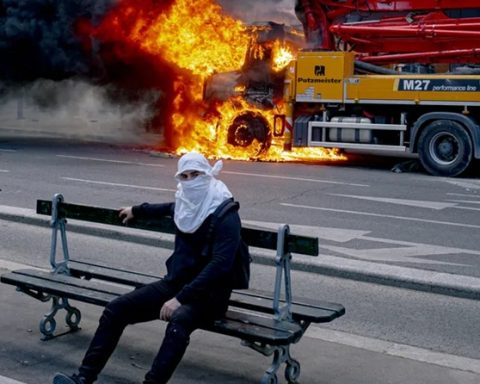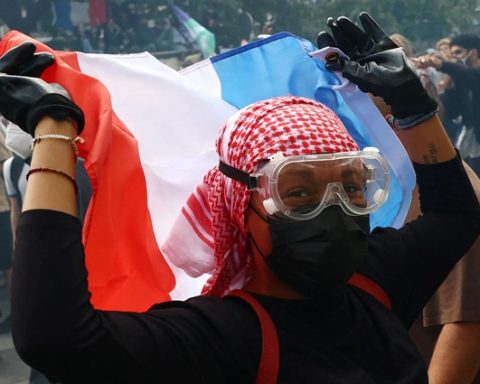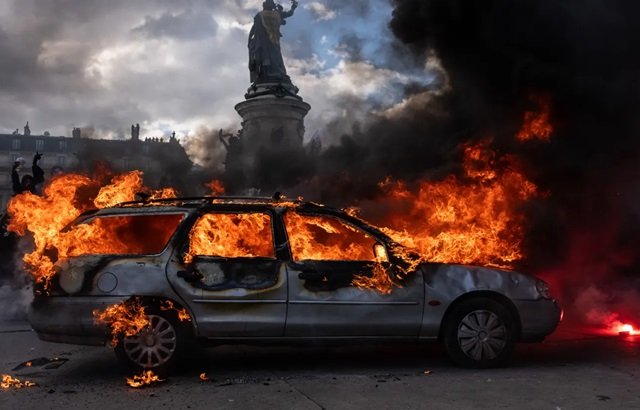
France faced its worst unrest in years over the weekend as demonstrations against the rising cost of living and declining public services escalated into violence, intensifying pressure on President Emmanuel Macron and his minority government ahead of a crucial parliamentary vote on the 2027 budget.
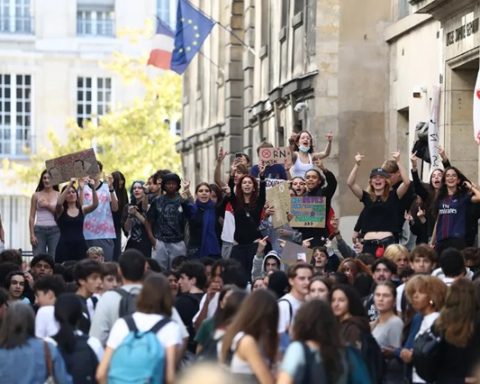
Around 550,000 people took to the streets in cities across the country on Saturday, including approximately 110,000 in Paris, according to authorities. While hundreds of thousands demonstrated peacefully, violent groups clashed with police, looted shops, damaged public buildings and set fires. The interior ministry reported nearly 2,400 arrests and said almost 1,000 police officers and gendarmes had been injured.
The unrest comes as Prime Minister Sébastien Lecornu’s government attempts to secure €54 billion ($61 billion) in fiscal savings through its 2027 budget, seeking to narrow France’s widening deficit. The National Assembly is scheduled to vote formally on the bill’s first section on Tuesday, placing the government’s spending plans under renewed scrutiny as public anger spreads.
France has struggled in recent years to contain government expenditure and manage a mounting debt burden. National debt reached a record €3.6 trillion in the second quarter, equivalent to 119% of gross domestic product, while rising interest rates have increased the cost of servicing it. The proposed savings have become a focal point for wider dissatisfaction over living standards and public services.
The latest demonstrations followed a month-long student movement protesting teacher shortages, deteriorating school infrastructure and inadequate conditions in secondary schools and universities. Trade unions and other groups subsequently joined the mobilisation, broadening the movement beyond education and linking local grievances to national economic policies.
The demonstrations also brought together former Yellow Vest protesters, climate activists and farmers, reflecting the breadth of opposition to the government’s approach. However, violent groups targeted police and public institutions, with damage reported in several major cities.
In a televised address on Sunday evening, Macron condemned what he described as “unbridled” violence and pledged an “uncompromising” response. Questioning the destruction, he said: “Nothing justifies it, nothing explains it, nothing excuses it.” He blamed agitators from ultra-left fringe groups and other offenders for exploiting the demonstrations.
Macron stopped short of declaring a state of emergency or imposing a curfew. Instead, he said regional prefects and mayors would be given powers to prohibit certain gatherings when necessary to protect public buildings and local businesses.
The president also ordered a review of possible failures in intelligence gathering and police preparedness. He asked the government to convene students, teachers, lawmakers, trade unions and business leaders during the coming week to develop “concrete proposals” addressing the crisis.
The scale of the destruction was particularly severe in Limoges, in central France, where the town hall, a 143-year-old building, was set ablaze and largely destroyed in an arson attack. Mayor Guillaume Guérin told Reuters that the incident involved a clear, premeditated intention to burn down the building, adding that people inside had feared for their lives.
In Marseille, protesters forced their way into the city hall, while a tourist office in Lyon was set on fire. Interior Minister Laurent Nuñez said several hundred shops had suffered considerable material damage. In Bordeaux, Mayor Thomas Cazenave reported that as many as 100 stores had been looted.
One protester died of cardiac arrest during demonstrations in Paris, police said, without providing further details. Police used tear gas and stun grenades on Sunday afternoon to disperse a rally at Place de la République, where bicycles were also set alight.
The economic consequences have added to the government’s challenges. Economy Minister Roland Lescure promised support for business owners affected by the riots, while warning that those responsible would be held accountable and required to repair the damage.
The violence has also sharpened political attacks on Macron, whose remaining months in office are increasingly marked by fiscal constraints and social discontent. Marine Le Pen, the far-right opposition leader and a frontrunner in next year’s presidential campaign, described the government as “running on fumes, exhausted and disoriented”.
Jean-Luc Mélenchon, the far-left leader who is also running for president, urged Macron to respond to the demands of protesting high-school students, warning that France could be heading towards “events that will eventually become uncontrollable”.