by Our Diplomatic Affairs Editor
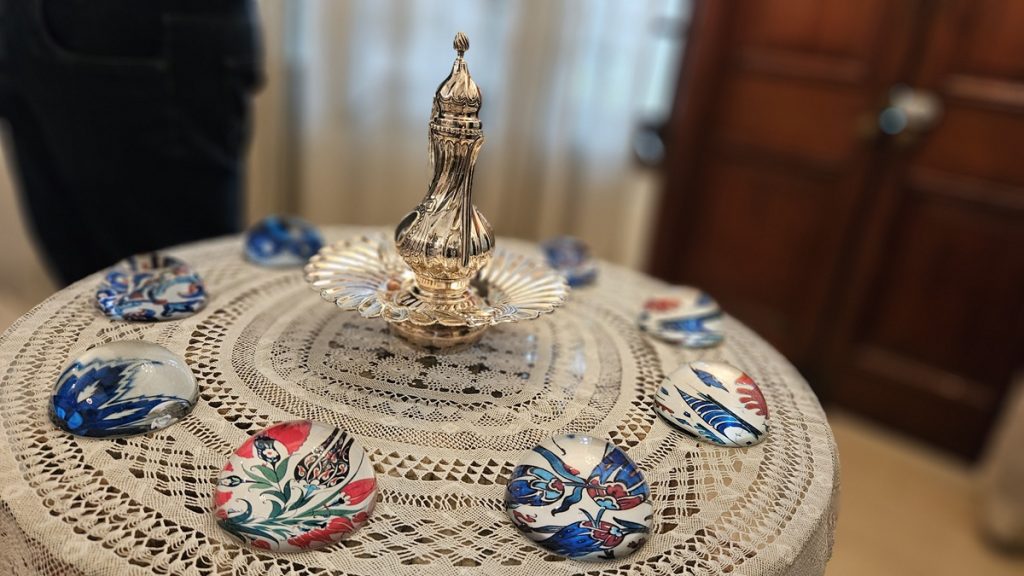
Tucked away in one of Colombo’s quieter quarters, the Turkish Ambassador’s residence reveals itself not through ostentation, but through quiet elegance and curated cultural depth. The whitewashed colonial villa—modest in its exterior but resplendent within—opens into a world that carefully balances diplomacy with domestic intimacy. Inside, rooms are filled with finely chosen Turkish antiques: copper samovars gleam under natural light; traditional oil paintings depicting Anatolian landscapes hang beside embroidered wall hangings; and Iznik ceramics are placed with studied intentionality on shelves and consoles. The furniture—deeply polished wood and earth-toned upholstery—speaks not only of comfort, but of a culture anchored in heritage. It was in this environment of visual warmth and aesthetic restraint that Turkish Ambassador Semih Lütfü Turgut received his guests for a commemorative event in honour of World Breakfast Day, an annual celebration recognised by UNESCO on the first Sunday of June.
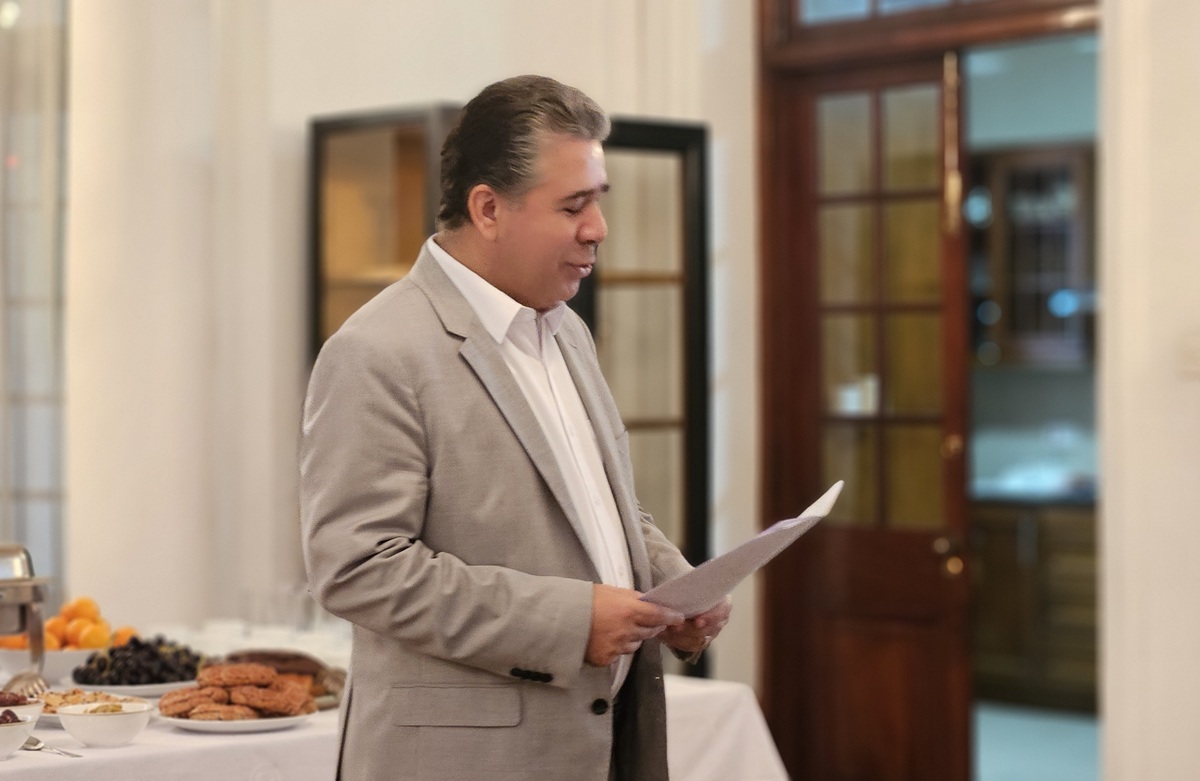
Ambassador Turgut, a diplomat of the old-school mould, received us with a quiet friendliness that revealed itself more in gesture than in words. Clad in an impeccably tailored suit, he spoke with a soft gravity—each sentence weighed, never hurried, never superfluous. “Usually,” he remarked with a subtle smile, “you are attending events to get information, to get pictures. But please, just enjoy your breakfast. This is your room.” In that one phrase—this is your room—he subtly inverted the traditional architecture of power, extending the home’s domain outward into hospitality, making the invited not visitors, but guests in the truest Turkish sense.
This was not merely a breakfast; it was kahvaltı—a term that literally means “before the coffee,” yet evokes much more than temporal sequence. As the Ambassador explained, “It’s not just about nourishing your body, it’s about nourishing your soul and connecting with love.” That sentiment would prove more than rhetoric, as the assembled table soon revealed a philosophical conviction behind the meal—an offering, not just of food, but of worldview.
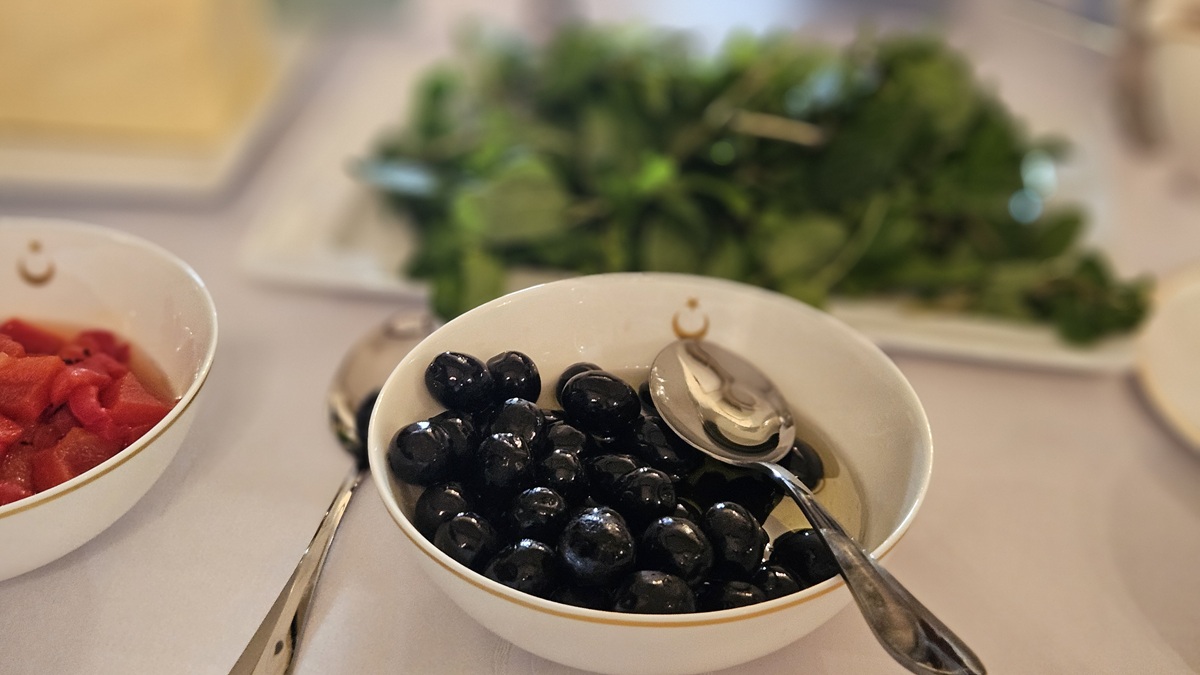
The buffet table was both abundant and meticulously arranged, a landscape of culinary symbolism. There were slices of beyaz peynir (white cheese) beside wedges of smoked and braided cheese, accompanied by green and black olives in varieties too many to count. “We have nearly 50 different types of olives,” the Ambassador remarked with quiet pride. Alongside them lay tomatoes, cucumbers, leafy herbs, and sweet grapes—“an abundance of fresh vegetables,” as he noted, essential to the Turkish breakfast’s identity. This was no random assemblage of items; each plate carried the signature of regionality, history, and social practice. “We have over 200 kinds of cheese,” he added, “though people outside Türkiye rarely know this. The French are known for their cheese, but we have cheese as well—many kinds.”
It is a mistake, common in the modern mind, to think of food as merely functional or merely indulgent. Anthropologists have long insisted on food as a bearer of social codes and symbolic meanings. Claude Lévi-Strauss argued that “cooking establishes the boundary between nature and culture.” In this case, kahvaltı served to dissolve the boundary between guest and host, East and West, ritual and nourishment. The breakfast itself was a kind of linguistic act—less verbal than symbolic—speaking fluently of Turkish values: generosity, connectedness, and slowness in a world that often forgets the virtue of time.
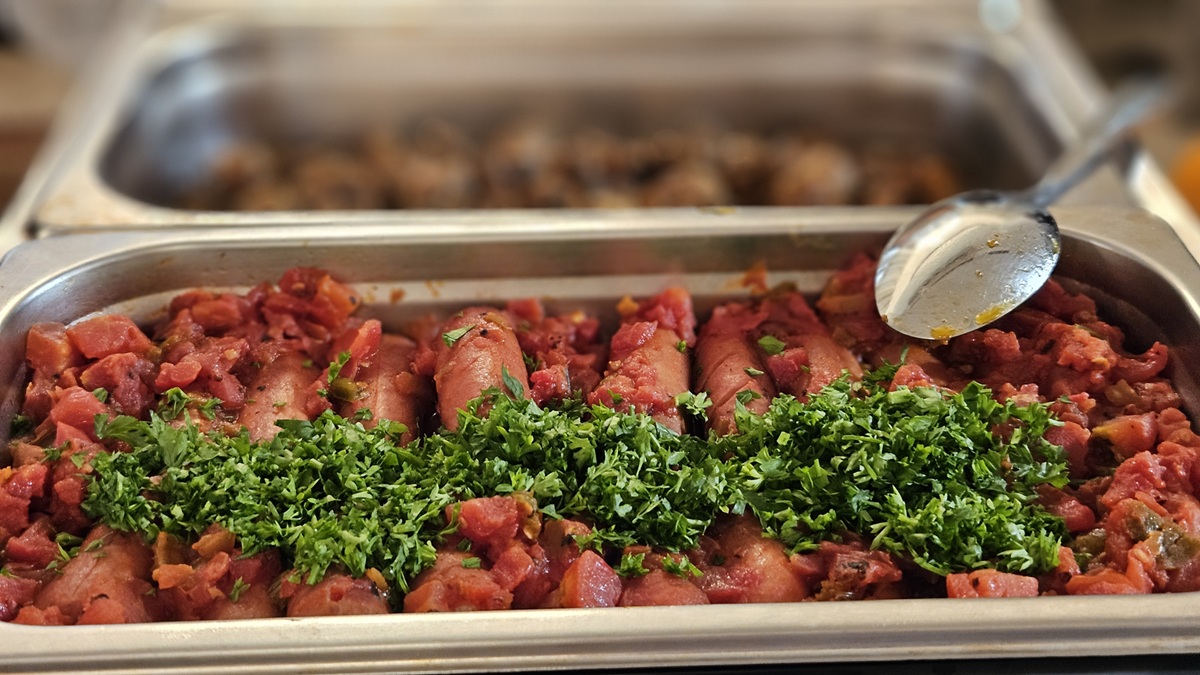
The centrepiece of the spread was the menemen—a Turkish-style scrambled egg dish prepared with tomatoes and peppers. The version offered was without onions, in keeping with the Ambassador’s personal preference. “There is a huge debate in Türkiye,” he said, “about whether menemen should have onion or not. Even the gastronomy experts on TV debate it.” The room responded with laughter, but the point was made: even the simplest dish is a locus of identity and opinion. Culinary detail, in this context, is never trivial—it is a dialect of culture.
Then came the breads and pastries: flaked börek, buttery poğaça, and the ever-iconic simit, whose golden crust was encrusted with sesame seeds. “Please try the simit,” the Ambassador encouraged us, “thanks to Barista Café, it is now available here in Colombo.” Brought in especially for the event, the simit, with its satisfying crunch and chew, served as a symbolic bridge between Istanbul and Sri Lanka, between diplomatic residence and coffeehouse.
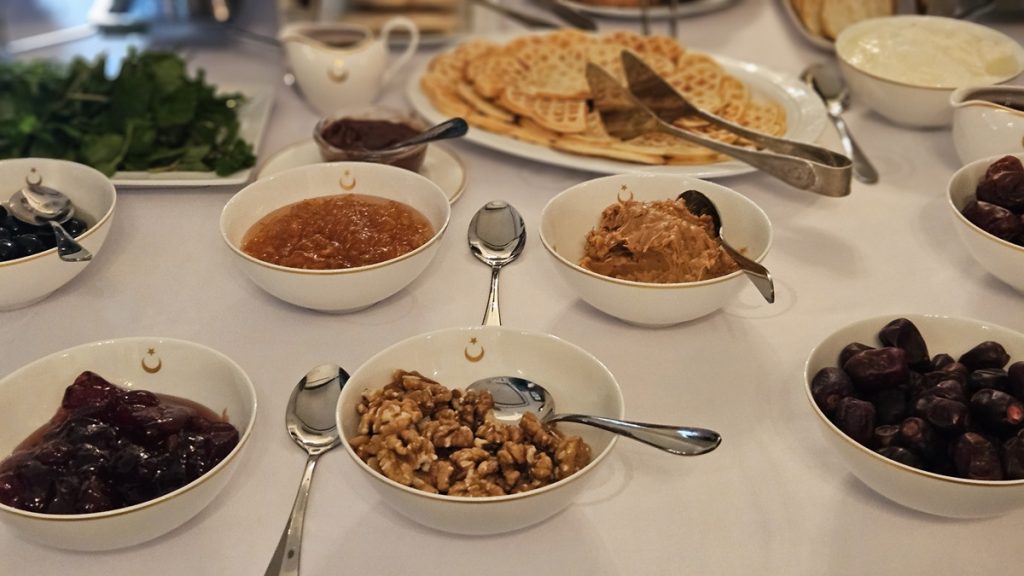
One could not fail to notice the philosophical architecture of the breakfast. It was not constructed to be eaten quickly or in silence. Rather, as Ambassador Turgut put it, “Kahvaltı is not rushed. It’s a leisurely affair, often stretching for more than an hour, two hours—especially on weekends. It’s a time for family and friends to talk, to laugh, to simply be together.” In a world calibrated increasingly by algorithms and deadlines, this insistence on slowness is a radical act. Turkish breakfast becomes, in this view, a pedagogy of attention—teaching us to linger, to listen, to live.
To accompany this ritual was the omnipresent çay—Turkish tea, poured into tulip-shaped glasses, its reddish hue glowing in the late morning light. “Tea is more than just a drink for us,” the Ambassador said. “It’s a companion throughout the meal. It facilitates conversation.” In that statement lies the essence of the Turkish breakfast—it is not merely consumed, it is shared. It facilitates communion, in the sacred sense of the term.
This emphasis on food as a medium of hospitality and diplomacy is deeply rooted in Turkish history. During the Ottoman Empire, banquets were not merely social indulgences but political instruments. The late Ottoman diplomat and historian Ahmed Cevdet Pasha once noted that “food was often the language through which policy was whispered.” Ambassador Turgut’s gathering was perhaps less about policy and more about presence, but the principle remains: culture is the most enduring diplomacy.
Even the spatial dynamics of the event—an open room with flowing conversation, informal groupings of guests moving from dish to dish—invited a particular mode of interaction. No stage, no agenda, no directives—just the quiet authority of tradition and the natural levelling effect of shared food. For that morning, there was no boundary between host and guest, journalist and diplomat. There was only the table.
In reflecting upon the event, one cannot help but be reminded of the philosopher Hannah Arendt, who observed, “The essence of human rights is the right to have rights,” and among those, the right to belong. The Turkish breakfast hosted by Ambassador Turgut was an act of creating temporary belonging. To be fed so generously, to be welcomed so sincerely, was to be included—not merely in the cultural ritual of Türkiye, but in the emotional architecture of its hospitality.
By noon, the guests began to slowly depart, many pausing to thank the Ambassador personally. There were no speeches made in farewell, no ceremonial departures. Just the lingering taste of honey on bread, the warmth of tea still on the tongue, and the quiet resonance of a space that had become, even briefly, shared.
As we left the residence, the words of Rumi echoed unbidden in my mind: “With life as short as a half-taken breath, don’t plant anything but love.” What was served that day—cheese, olives, bread, tea—was prepared with cultural pride, but also, unmistakably, with love. And in the hands of a careful, quietly persuasive diplomat, it became something even more enduring than a meal—it became a memory.