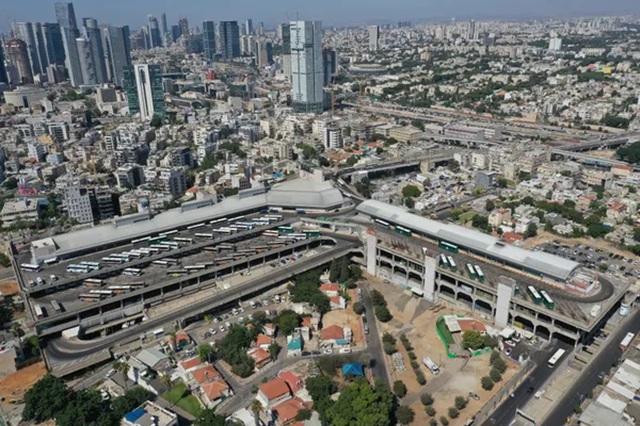
In the midst of escalating tensions and missile barrages between Israel and Iran, an unexpected site has emerged as a rare safe haven for thousands of vulnerable residents: the long-forgotten underground bomb shelter beneath Tel Aviv’s notorious Central Bus Station. As Haaretz reported in a revealing exposé, this subterranean structure, sealed off for nearly three decades, has been hastily reopened to serve as a public refuge—though not the nuclear-proof fortress many had once believed it to be.
Often described with derision—“an eyesore,” “the monstrosity,” or “Tel Aviv’s white elephant”—the sprawling brutalist complex has long stood as a symbol of unfulfilled urban ambition and social neglect. Yet today, it is once again at the center of national attention, not for its architecture or controversies, but for the promise of protection it offers in the shadow of war.
Capable of sheltering up to 16,000 people, the bomb shelter beneath the station reopened just days ago after being left flooded and derelict for years, in direct violation of Israel’s civil defense laws. Though still riddled with issues—pools of standing water, lack of signage, no proper sanitation, and minimal lighting—it remains one of the only accessible fortified spaces for thousands of residents in the impoverished Neve Sha’anan and Shapira neighborhoods nearby.
The reopening comes as Iran continues its unprecedented campaign of missile and UAV strikes on Israeli territory, many targeting cities and civilian infrastructure. In wealthier areas of the country, residents can retreat into reinforced “mamad” rooms built into modern apartments. But in older, neglected districts like south Tel Aviv—where much of the housing predates Israel’s 1993 shelter mandate—safe options are few and far between.
According to data from the Israel Builders Association cited by Haaretz, 56 percent of homes in Israel lack proper shelter access, with that number soaring in low-income communities. Public shelters, known as miklatim, are supposed to fill the gap, but nearly half are unusable or inaccessible. In Bedouin villages, the situation is even more dire—about 120,000 citizens lack any shelter access whatsoever. Unsurprisingly, most of the casualties in recent Iranian strikes have occurred among populations without access to protective infrastructure.
Behind the red, blast-resistant doors of the bus station’s underground shelter lies a relic of Cold War paranoia—concrete tunnels, enormous ventilation systems, and dated emergency supplies. Though rumors persist that it was once intended as a nuclear bunker, city officials have downplayed that claim. “Maybe it was originally designed that way, but it’s definitely not hermetically sealed now,” a Tel Aviv Municipality spokesperson told Haaretz.
The shelter’s current condition, and the haste with which it was reactivated, have drawn scrutiny. While Nitsba Holdings, the real estate company that owns the station, claims full cooperation with city authorities, local guide and activist Heela Harel sees the reopening as another chapter in a broader pattern of neglect. “The story of the Central Bus Station is the story of a reality that never lived up to its vision,” she told Haaretz. “They’ve been known to use bullying tactics to push out the few remaining store owners who refuse to leave.”
Originally envisioned as the largest transit hub in the world, the Central Bus Station was the brainchild of real estate tycoon Arie Piltz, with a maze-like design intended to force passengers through multiple shopping levels. By the time it opened in 1993—three decades late—it had already become synonymous with dysfunction. Over the years, it morphed into a haven for marginalized communities: asylum seekers, foreign workers, artists, and activists.
Even now, the shelter beneath the station reflects that mix. Some residents bring their own plastic chairs and tents to wait out missile alerts; others linger just a flight or two below street level, unwilling to venture to its darkest depths. “They mostly go down a flight or two. That’s enough,” one weary security guard told Haaretz.
While the reopening of the shelter offers a sliver of hope and safety in a fraught moment, it also highlights the stark disparities in Israeli civil defense preparedness—and the systemic neglect faced by some of the country’s most vulnerable populations. As sirens continue to wail over Tel Aviv, and fears of nuclear escalation with Iran linger, the so-called “nuclear shelter” in the city’s most infamous building stands as both a lifeline and a reminder of a nation’s broken promises.