In a landmark 6–3 decision, the U.S. Supreme Court delivered a major legal victory to President Donald Trump, ruling that lower federal courts lack the authority to impose nationwide injunctions on presidential executive orders — a move that could significantly reshape how federal policies are challenged in the judiciary.
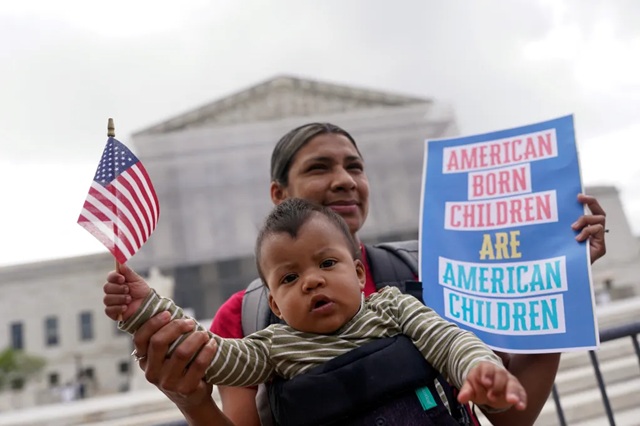
The case centered on Trump’s controversial executive order to end birthright citizenship for children born in the U.S. to undocumented immigrants. While the court did not rule on the constitutionality of the policy itself — a question likely to be taken up in the court’s next term — it determined that federal district courts overstepped their authority by issuing blanket injunctions that applied beyond the immediate plaintiffs in the case.
A Ruling with Broad Implications
Writing for the conservative majority, Justice Amy Coney Barrett argued that federal courts are meant to resolve disputes for the parties before them — not serve as general overseers of the executive branch. “Federal courts do not exercise general oversight of the executive branch,” she wrote. “When a court concludes that the executive has acted unlawfully, the answer is not for the court to exceed its power, too.”
The ruling marks a significant interpretation of the Judiciary Act of 1789, reaffirming that district courts cannot block federal policies nationwide without explicit Congressional authority. The decision effectively allows Trump’s birthright citizenship directive to proceed — for now — though its legality remains unresolved.
Trump Celebrates Decision, Critics Sound Alarm
President Trump hailed the ruling at a White House press conference, calling it a “giant win” for democracy. “Radical left judges overruled the rightful powers of the president,” he said. “This decision is a warning and a course correction.”
On his Truth Social platform, Trump posted: “GIANT WIN in the United States Supreme Court! Even the birthright citizenship hoax has been, indirectly, hit hard.” He reiterated his claim that the 14th Amendment — long held as the foundation for birthright citizenship — had been misinterpreted, calling it a tool for “scamming our immigration process.”
But critics, including the court’s liberal justices and immigrant advocacy groups, warned that the ruling opens the door to sweeping executive power with fewer checks.
In a scathing dissent, Justice Sonia Sotomayor wrote: “No right is safe in the new legal regime the court creates. Today, the threat is to birthright citizenship. Tomorrow, a different administration may try to seize firearms from law-abiding citizens or prevent people of certain faiths from gathering to worship.”
According to estimates presented by the plaintiffs — a coalition of 22 Democratic attorneys-general and immigrant rights groups — more than 150,000 babies born annually would be denied U.S. citizenship under Trump’s order.
Broader Context: Courts, Immigration, and Presidential Power
Since returning to office in January, President Trump has signed over 160 executive orders, including aggressive moves to deport undocumented immigrants and reconfigure the federal bureaucracy. Many of these actions have been met with immediate legal challenges, and district court judges have often issued nationwide injunctions to pause enforcement.
Trump administration officials have decried what they call “activist judges”, accusing them of obstructing the will of the voters and slowing policy implementation.
Following the decision, Attorney General Pam Bondi praised the ruling as a “necessary correction” to judicial overreach. “Today, the Supreme Court instructed district courts to STOP the endless barrage of nationwide injunctions against President Trump,” she wrote on social media.
What’s Next?
While the ruling curtails judicial resistance to executive orders, it does not resolve the constitutional question of whether the children of undocumented immigrants born in the U.S. are entitled to citizenship under the 14th Amendment. That issue is expected to return to the court in its next session in October.
The ruling also came on the final day of the court’s term, during which it made other controversial decisions — including allowing parents to withdraw children from classes discussing LGBTQ+ topics, and upholding a Texas law requiring adult websites to verify users’ ages.
As legal battles over immigration, civil rights, and executive power intensify, Friday’s decision could set a precedent limiting how far federal judges can go in checking presidential authority — even amid sweeping and divisive policy shifts.