Iran’s Islamic Revolutionary Guard Corps (IRGC), the country’s most powerful military and political institution, is grappling with one of the most significant crises in its history. Following a devastating 12-day conflict with Israel earlier this year that resulted in the deaths of several top commanders and extensive damage to Iran’s strategic military infrastructure, the IRGC finds itself under unprecedented internal and external pressure.
A report published this week in The Times (UK) offers a detailed account of the IRGC’s challenges, portraying the organization as increasingly stretched — militarily, politically, and ideologically. The British paper likens the IRGC to a combination of the Waffen-SS, the Comintern, and a mafia — a reflection of its deeply entrenched power, transnational reach, and opaque financial dealings.
Losses at the Top
Among the IRGC’s most notable losses were General Mohammad Bagheri, Iran’s chief of staff; Hossein Salami, the IRGC’s commander-in-chief; and Amir Ali Hajizadeh, head of its aerospace division. Israel has claimed responsibility for neutralizing more than 75 percent of Iran’s missile launchers, a significant blow to Tehran’s deterrent capabilities.
In a symbolic response, Iran launched a limited missile barrage against a U.S. base in Qatar — an attack that reportedly came with advance warning to avoid escalation. But while Iran’s leadership has presented these developments as evidence of “resistance,” many analysts believe the recent events have exposed vulnerabilities within the Islamic Republic’s power structure.
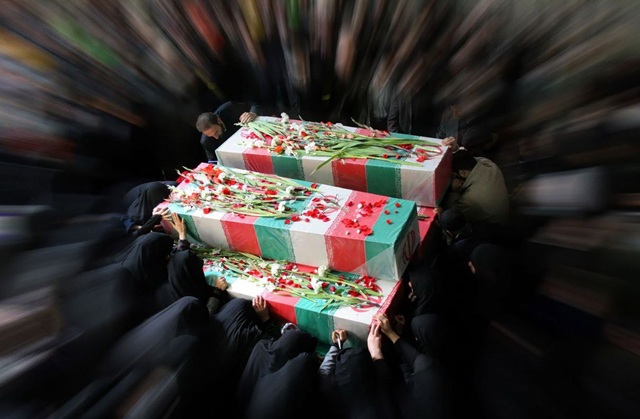
Supreme Leader Ayatollah Ali Khamenei, 86, has publicly redefined the concept of victory. “To defy is to win,” he said during a national broadcast earlier this month, echoing rhetoric rooted in Iran’s revolutionary and religious worldview. The IRGC has embraced this messaging, using funeral ceremonies and mass mobilizations to portray fallen commanders as martyrs and rally public sentiment.
Strategic Setbacks
Despite these efforts, the psychological and operational damage from the Israeli air campaign is palpable. Military installations were destroyed, command chains disrupted, and Iran’s air defenses were visibly outmatched. Compounding the embarrassment was the apparent presence of Israeli operatives inside Iran prior to the attacks, a fact which has raised serious concerns about intelligence lapses.
The Times article highlighted that the IRGC’s grip on national security — long considered ironclad — has begun to show signs of strain. Iranian intelligence has arrested hundreds of people in recent weeks on suspicion of espionage, with six reportedly executed. Emergency deployments have also been made to restive border regions such as Kurdistan and Baluchistan, indicating growing anxiety within the regime about internal instability.
A Tarnished Legacy
Founded by Ayatollah Ruhollah Khomeini in the wake of the 1979 Islamic Revolution, the IRGC was originally envisioned as a force to protect the revolution from internal and external threats. During the brutal Iran-Iraq war of the 1980s, it gained legitimacy through sacrifice, including the notorious “human wave” attacks carried out by teenage volunteers from its affiliated Basij militia.
Today, however, the IRGC’s image is far more controversial. Once known for its austere, ideological purity, the corps is now associated with corruption, elite privilege, and violent repression. Many of its senior commanders have amassed wealth and power, with family members living abroad in countries such as Canada and the UK — a stark contrast to the revolutionary ethos of earlier generations.
Protests against the regime, such as those sparked by the death of Mahsa Amini in 2022, have only sharpened public criticism. The IRGC played a central role in quelling the unrest, which left hundreds dead and thousands imprisoned. “They are no longer seen as defenders of the nation — they are seen as the regime’s enforcers,” said an Iranian academic based in Europe, speaking on condition of anonymity.
The Soleimani Shadow
The loss of Qassem Soleimani in 2020 — the charismatic commander of the IRGC’s Quds Force — continues to cast a long shadow. Revered by many as a strategic mastermind who extended Iran’s influence across Iraq, Syria, and Lebanon, Soleimani’s assassination in a U.S. drone strike ordered by then-President Donald Trump was a major setback. His funeral in Tehran drew over a million mourners, a level of public reverence unmatched by current IRGC figures.
Since then, Iran’s regional standing has diminished. The “Axis of Resistance” — the network of Iranian proxies and allies — has come under sustained Israeli attack, particularly since the Hamas-led assault on Israel on October 7, 2023. With Hezbollah, Iraqi militias, and even factions in Syria weakened, Tehran’s ability to project power through non-state actors has been compromised.
Succession and the Future
As Ayatollah Khamenei’s health declines, speculation is mounting over the future direction of the Islamic Republic. His son Mojtaba Khamenei is widely believed to be a potential successor, though his candidacy remains controversial. Analysts warn that loyalty within the IRGC may not automatically transfer to the younger Khamenei or any future clerical leader.
“The real power struggle may be between the clerics and the men in green,” The Times noted, referring to the IRGC’s prominent role in the political and economic fabric of the country. As the group’s influence grows, so too does the possibility that Iran could evolve into a more overt military-security state, with the Guard playing a dominant — and potentially destabilizing — role.
Meanwhile, Iran’s nuclear ambitions remain cloaked in ambiguity. While the government insists its program is peaceful, the international community remains unconvinced. With talks stalled and mutual distrust high, the potential for renewed conflict remains.
For now, the IRGC continues to assert its strength. Its new commander, Mohammad Pakpour, has vowed a swift and forceful response to any future aggression. “Our fingers are on the trigger,” he warned in a recent speech.
But behind the bravado lies a complex reality: a force that is both feared and faltering, revered and reviled — and whose future may be as uncertain as the republic it was created to defend.