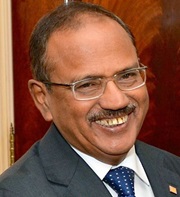
Editor’s Note: NSA Ajit Doval’s recent address at the 62nd Convocation of IIT Madras was far more than a ceremonial speech—it was a powerful invocation of history, duty, and national ambition. He didn’t merely urge the graduating class to excel in their careers; he delivered a stirring appeal to align their personal success with the resurgence of the nation. Following are excerpts from his address.
I often tell my colleagues, sometimes to their discomfort, that we in India are living through the most consequential quarter-century in a thousand years. That’s not a throwaway line. It’s not romantic nationalism. It is a sober assessment — both a privilege and a burden. And I believe, with everything I have seen, studied, and lived through, that those who are young today — especially those with the rare gift of a premier technical education — are the principal protagonists of that epochal shift.
I recently had the honour of speaking to the graduating class at the Indian Institute of Technology, Madras. As I stood there, looking at a sea of young minds who had just crossed the threshold into a world of possibility, I did not feel tempted to recite generic words of encouragement. Instead, I felt compelled to lay bare the deeper context — to remind them that they were not just joining the workforce or becoming engineers. They were entering history, at a moment when history might finally, after centuries of waiting, turn in our favour.
Let me explain what I mean.
The Long Interruption
For a millennium, India was — for the most part — denied the normal process of national development. No country has an uninterrupted rise, of course. Every civilisation suffers wars, setbacks, famines, and internal strife. But India was not simply interrupted. We were derailed. Colonised. Fragmented. Our institutions dismantled. Our self-confidence eroded. Our agency stolen.
What other country had to fight — not just to develop, but first to decolonise its mind?
When Japan began its rapid modernisation in the 19th century, it did so as an independent state. When the West industrialised, it did so on the backs of its own — and sometimes others’ — resources. Even when countries like China or Korea rose, they did so under the control of their own national governments, able to chart a course based on their own civilisational imperatives. India was denied that luxury. Our renaissance was delayed not by lack of talent, but by the theft of sovereignty.
We are, today, only the third or fourth generation in our history to have a shot at building our country on our terms. And yet the speed at which we are recovering — economically, socially, even psychologically — is astonishing. That recovery, however, is not inevitable. It demands vigilance, resolve, and most of all, a clear-eyed sense of what time it is in our civilisational clock.
The Compressed Revolution
In the West, industrial modernity unfolded over three centuries — agriculture gave way to manufacturing, then to services and digital economies. Their politics matured gradually, their education systems expanded, their cities grew in sync with their industries.
India does not have that luxury of time. We are being asked to compress all of this into a few decades.
We are not just building a modern economy; we are building it while still solving the problems of mass poverty, of health access, of linguistic diversity, of caste discrimination. We are integrating digital platforms into villages that lacked electricity a decade ago. We are pushing space missions while still expanding school enrollment. This simultaneity is both our curse and our gift.
It means we cannot copy anyone’s model. Our development cannot be an emulation; it must be an innovation.
This is why institutions like IIT Madras matter so much. Not just because they produce engineers — that is secondary. What they really offer is a space where a uniquely Indian modernity can be imagined, tested, and scaled.
When I look at the young minds graduating from such places, I do not see employees-in-waiting. I see historical agents — citizens with the technical literacy and moral imagination to make this compressed revolution succeed.
Knowledge With a Compass
But brilliance alone is not enough. We have never lacked intellect in this country. What we have sometimes lacked is direction.
In the last 75 years, India has built extraordinary institutions. Our democratic architecture, our judiciary, our scientific labs, our electoral systems — these are miracles on a global scale. But we are entering a phase now where institutions alone are not sufficient. We need what I call a “civilisational compass.”
It is not enough for our brightest minds to chase careers abroad, or to innovate for problems defined elsewhere. We need a rooted intelligence — one that knows why India matters, and what India means. Not just as a GDP number or a market size. But as an idea, a consciousness, a civilisation with something unique to offer the world.
I told the students in Chennai: if you leave India, do not leave it behind.
This is not an argument against migration. Talent will move — as it should. But consciousness must remain tethered. I want our best minds to carry India with them — in their ethics, their choices, their ambitions. Too often, we have exported brilliance but lost the benefit of that brilliance to foreign systems. We have cheered the success of Indians abroad — as CEOs, inventors, Nobel laureates — but we must now start asking: how do we make India the centre of that excellence?
How do we ensure that we are not simply a talent supplier to the world, but a shaper of the world’s future?
A Moment Like No Other
Let me be blunt.
The next 25 years will decide what India will be for the next 1,000.
That is not a metaphor. That is my sober estimation based on decades of geopolitical analysis. The global order is in flux. China is aging. Europe is in demographic retreat. The West is introspective. New technologies are disrupting every norm — from warfare to finance to knowledge creation.
Into this vacuum steps India — young, democratic, technologically capable, and culturally coherent. If we do not rise now, we may not get another chance for centuries. History is generous, but it is not infinitely patient.
What does this mean for a graduating student? It means you must think of your career not just in personal terms, but in national terms. I am not asking for blind patriotism. I am asking for strategic self-respect.
Ask yourself: how will my skills serve the larger Indian project? How will I build systems, companies, research, or art that enhances India’s sovereignty, prosperity, and dignity?
If you are working in AI — ask how India can lead responsibly in this domain. If you are in materials science — ask how we can reduce import dependence. If you are in climate engineering — ask how your work can help not just India but the Global South.
This is not a burden. It is a privilege. To be born in a time where you can be part of something so vast, so rare, so vital — that is a kind of grace.
The Inner Game
But perhaps the greatest challenge is not technical or even economic. It is emotional.
I worry that too many of our brightest minds suffer from a subtle inferiority complex — a legacy of colonial modernity. We are too quick to assume that good ideas come from the West, that excellence lies elsewhere, that our role is to follow, not to lead.
That must end.
India is not a country that needs to “catch up.” We are a civilisation that needs to remember.
Remember who we are. Remember what we once knew — about ethics, about systems, about balance. Remember that we were solving problems of sustainability and public health long before these terms existed. We do not need to be defensive. We need to be awake.
And for that, we need a new kind of elite. Not just credentialed — but conscious. Not just smart — but wise. Not just employable — but indispensable to the Indian journey.
That is my hope. That is my challenge. And that is the speech I delivered — stripped of flattery, full of urgency — to the graduating class at IIT Madras. I now extend it to every young Indian reading this column.
This is your time. Not metaphorically, not rhetorically — literally.
The future is being written now. And you are holding the pen.