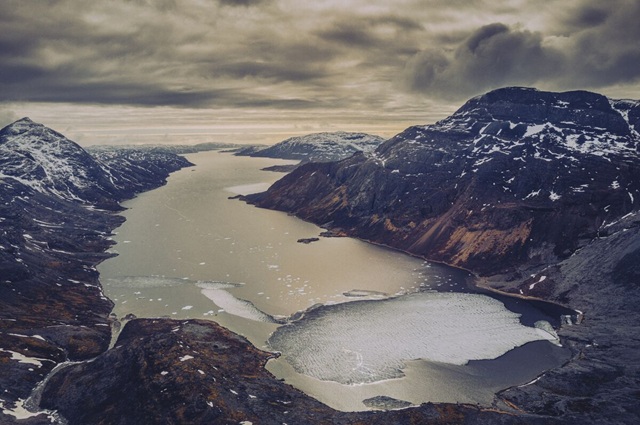
Greenland’s icy, mineral-rich landscape has once again captured Washington’s attention — and a former U.S. Green Beret with close ties to Donald Trump is helping lead the charge. As Bloomberg reports, Drew Horn, chief executive of Washington-based GreenMet, recently traveled to southern Greenland to inspect Tanbreez, a vast and largely untapped deposit of rare-earth minerals. These elements are crucial in manufacturing technology ranging from smartphones to missile-defense systems, and the United States remains heavily dependent on China for its supply.
Horn, a former U.S. Marine and Army Green Beret who served in the Defense and Energy Departments during Trump’s first term, has emerged as a well-connected middleman linking American investors with critical-minerals projects overseas. His latest mission fits squarely into the Trump administration’s renewed effort to secure strategic resources, with the president repeatedly framing Greenland as vital to America’s “economic security.” Since returning to office, Trump has revived interest in the island and, at times, hinted at challenging its sovereignty to outmaneuver Beijing in the global rare-earth market.
Tanbreez, owned by Critical Metals Corp., is believed to contain one of the largest deposits of heavy rare-earth elements outside of China. In July 2024, its longtime owner, Australian geologist Greg Barnes, sold the site for $5 million in cash and $211 million in stock. Barnes, who has studied the site since the early 1990s, has described it as the most significant deposit of its kind in the West. Following Horn’s spring visit to the site — which required navigating fog, snow, and risky helicopter flights — the U.S. Export-Import Bank issued a nonbinding letter of interest for a $120 million loan to help finance the mine’s development. The total investment needed to bring it into commercial production is estimated at about $290 million.
The potential rewards are significant. Rare earths are a geopolitical flashpoint, and China has previously used export restrictions to gain leverage in trade disputes. The Trump administration sees Greenland’s mineral wealth as a possible safeguard for U.S. national security, offering an alternative supply chain less vulnerable to foreign pressure. Yet the challenges are formidable. Greenland’s harsh Arctic climate limits the mining season, and the island’s sparse infrastructure — few roads, limited shipping access, and small population — makes large-scale operations costly and complex. Extracting rare earths profitably is also difficult, as they are often mixed with other minerals and require sophisticated technology to process efficiently.
Political sensitivities add another layer of uncertainty. While some Greenlandic lawmakers support U.S. investment to help diversify the economy beyond fishing, they strongly oppose any suggestion of American ownership. “We are not a property,” said Mute B. Egede, Greenland’s finance minister and deputy prime minister. “If they want cooperation or partnership, they need to change their tone.” Trump’s aggressive rhetoric has already stirred tensions with both Greenland and Denmark, its sovereign state, risking diplomatic strain with an ally and fellow NATO member.
For Horn, the Tanbreez venture represents both a business opportunity and a strategic mission. After leaving government service, he founded GreenMet to bridge U.S. investors and policymakers with critical-minerals projects. His firm has already made headlines, including in 2023 when it brokered the sale of Arkansas lithium rights to Exxon Mobil. Horn believes Greenland’s rare earths could be a key piece in securing America’s technological and defense needs. Still, he acknowledges the volatility of both politics and resource markets. “It could all blow up,” he told Bloomberg. “But I have to keep pushing to make it work.”