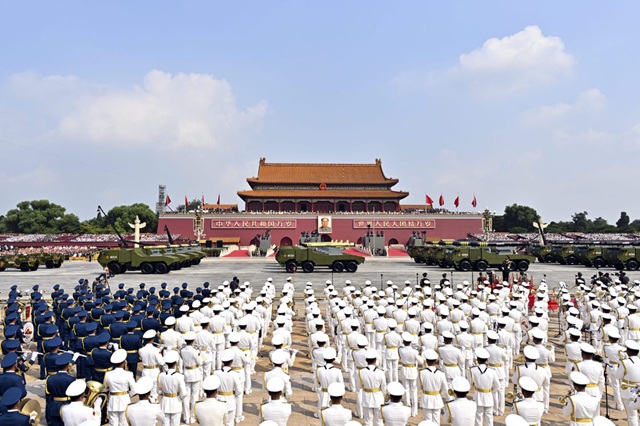
China’s grand military parade in Beijing, commemorating the 80th anniversary of Japan’s defeat in World War II, highlighted the country’s focus on weaving advanced technologies into its combat strategy, according to analysts. The event showcased the People’s Liberation Army’s (PLA) latest weaponry and reforms in command structure, signaling a shift toward integrating space, cyber, and information warfare capabilities into joint military operations.
The parade featured formations from the PLA’s established branches—the Army, Navy, Air Force, Joint Logistics Support Force, and Rocket Force—as well as three newly created branches: the Information Support Force, the Military Aerospace Force, and the Cyberspace Force. These new units displayed cutting-edge equipment for cyberspace warfare, electronic countermeasures, and information support, reflecting Beijing’s broader push to modernize its military and adapt to new warfare domains.
Observers interpreted the parade as a demonstration of China’s efforts to reshape its combat doctrine by leveraging advanced technologies across services. Timothy Heath, a senior defence researcher at the US-based Rand Corporation, noted that the PLA is working to “become a force capable of operating in all domains.” He added that the military is improving its ability to integrate capabilities from different services, which could enhance both lethality and effectiveness. Heath explained that command structures are likely to evolve to include officers from diverse service backgrounds, ensuring leaders are familiar with the technologies and strategies of other units.
Mark Cozad, another senior researcher at Rand Corporation and a professor at the Rand School of Public Policy, emphasized that the parade aimed to highlight more than hardware. “It is about combat formations and joint operations, especially new-type forces that have been discussed for years,” he said. However, he cautioned that despite the parade’s visual impact, questions remain about how much progress the PLA has made in fully integrating these advanced forces into its operational concepts.
The restructuring of the PLA began after Beijing’s first World War II Victory Parade in 2015. Following that event, the PLA launched a sweeping overhaul, consolidating its space, cyber, electronic, and information warfare assets into the Strategic Support Force (SSF). By the end of that year, these previously scattered capabilities were unified under a single command alongside the country’s main service branches. The following year, logistics units were reorganized into the Joint Logistics Support Force to further streamline operations.
Yue Gang, a retired PLA colonel and military commentator, explained that the overhaul was driven by the arrival of the information age and the technology revolution, which transformed warfare’s nature and scope. “The structure and organization of military forces are critical. They serve as a blueprint for development,” he said. “The rise of AI, unmanned platforms, and integrated combat architectures is reshaping military organisation, strategy, and tactics.”
In a notable development, the SSF was disbanded last year, with its functional units reorganized into three independent branches: the Information Support Force, Military Aerospace Force, and Cyberspace Force. All report directly to the Central Military Commission, China’s highest military authority led by President Xi Jinping. These forces, along with the Joint Logistics Support Force, were elevated to deputy-theatre level and awarded their service flags on August 1.
Yue Gang explained that the SSF’s initial structure proved too broad to manage effectively, spreading resources too thin and limiting focus and specialization. As warfare domains became more complex and technologically demanding, the PLA opted to separate these units into dedicated branches with their own leadership and resources. This move allows for deeper expertise, operational efficiency, and quicker adaptation to emerging threats.
Historically, China’s military doctrine has evolved in response to shifting threats and technological advancements. For much of the 20th century, the PLA followed Mao Zedong’s “people’s war” strategy, prioritizing large infantry forces and guerrilla tactics. In the 1980s, after setbacks in the Sino-Vietnamese conflict, the PLA transitioned toward mechanization, integrating armored vehicles, artillery, and air defence systems into a more modern fighting force.
The recent parade reflects China’s efforts to move beyond conventional capabilities by emphasizing intelligence-driven warfare. By establishing the Military Aerospace Force, China has drawn lessons from global counterparts such as the US Space Force, created in 2019 amid growing space-related tensions. Analysts view this development as a strategic response to the perceived threat posed by other major powers, especially the United States.
Yue Gang pointed out that both China and the US are closely observing each other’s military advancements. “China and the US are military competitors or potential adversaries. Each side monitors the other’s moves,” he said. Timothy Heath also noted parallels between the two countries’ space forces, explaining that both maintain independent commands for space operations and missions supporting broader military goals.
Mark Cozad added that while China’s new forces represent world-class capabilities, uncertainty remains over how well they will fit into joint operational concepts. “The US Space Force has decades of experience in joint operations and lessons learned that the PLA does not yet have,” he said. Nevertheless, Heath emphasized that China’s Information Support Force plays a critical role in integrating cyber and space capabilities with conventional forces, aiming to strengthen joint warfare potential.
The South China Morning Post, which covered the event extensively, highlighted how the parade underscored China’s commitment to modernizing its military. The newspaper pointed out that the newly unveiled forces and equipment signal a shift from traditional warfare toward intelligence-led operations, reflecting the strategic priorities shaping China’s defence reforms.